Are We Witnessing the Highest VO2 Max Ever?
The official record for highest VO2 max belongs to a former cyclist named Oskar Svendsen, whose brief career I wrote about back in 2019. VO2 max is a measure of how much oxygen your lungs, heart, and muscles can use to fuel your metabolism; if you want a single number to measure your aerobic fitness, it’s what you use. At 18, Svendsen could use 96.7 milliliters of oxygen per kilogram of bodyweight per minute, one of the only lab-verified readings above 90. Two years later, after an undistinguished stint with a minor Norwegian pro team, he quit cycling for good.
There are a few different ways to interpret this parable. One is that VO2 max is overrated as a predictor of success. That’s more or less the perspective that Svendsen himself takes. “Talent is more about grit and ability to perform over time,” he told Cycling Weekly when they tracked him down earlier this year, 12 years after his retirement. “The physical is a bonus.” Another is that the measurement was wacky or the machine was miscalibrated, a possibility that is frequently raised for ultra-high VO2 max scores (like the Instagram-only report that triathlete Kristian Blummenfelt had notched a 101.1 ml/kg/min earlier this year).
A third option is that lab tests don’t accurately reflect real-world conditions. Sure, you might pedal hard on a stationary bike because a scientist tells you to—but are you really digging as deep as you might when you’re trying to break your rivals on a key Tour de France climb? And are you even using the same muscles and movement patterns on a stationary bike? If we really want to understand the upper limits of human capacity, wouldn’t it be better to analyze actual world-beating performances?
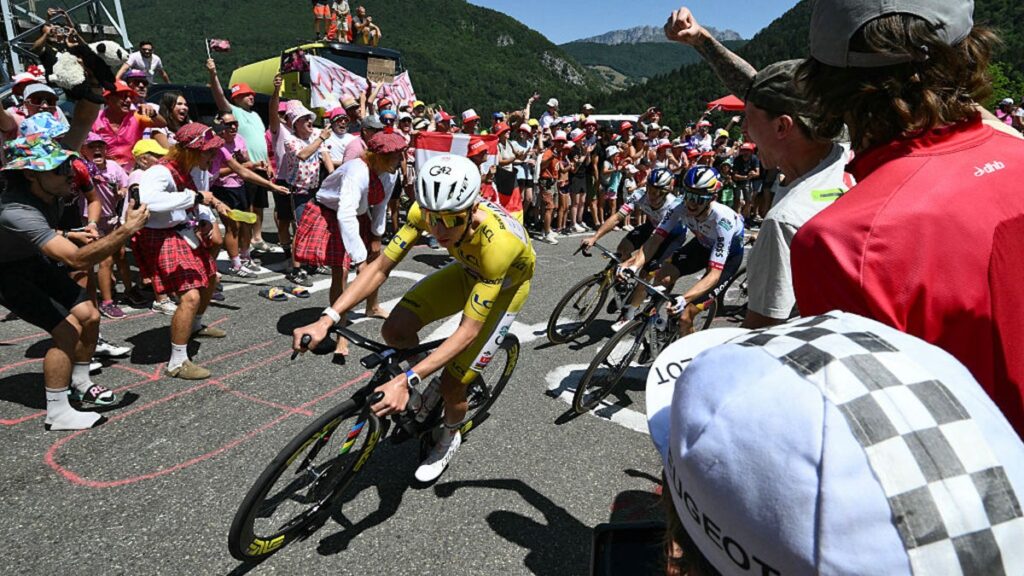
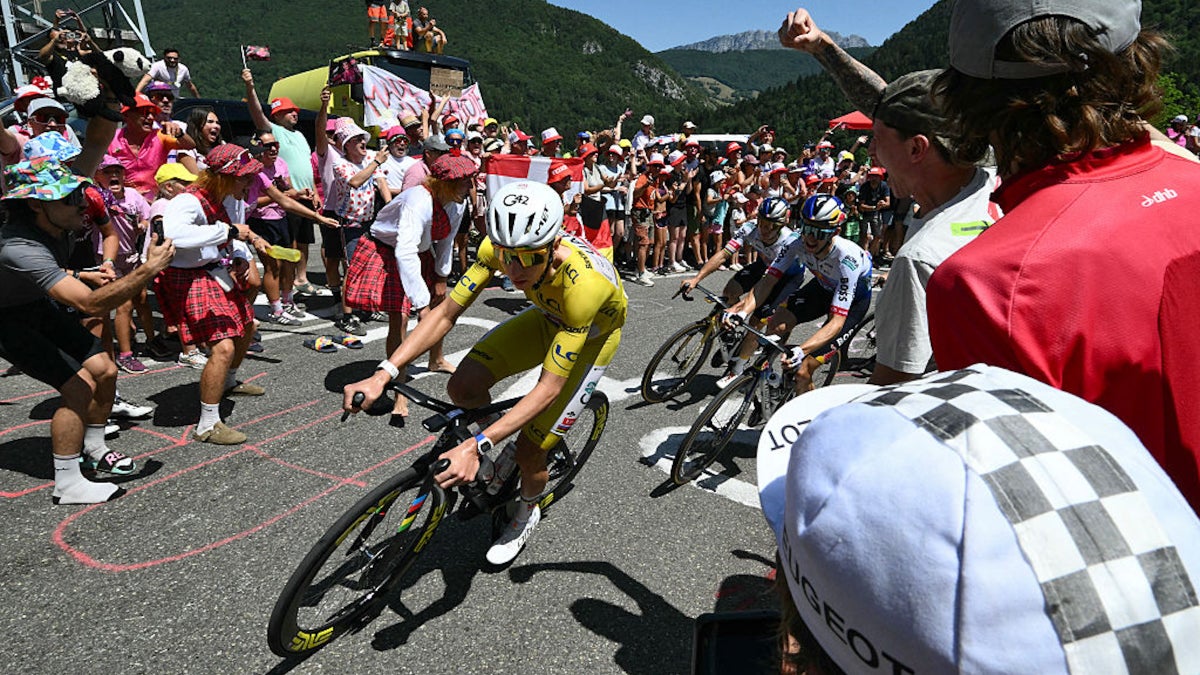
That’s the approach in a forthcoming study in the International Journal of Sports Physiology and Performance, from Pedro Valenzuela of the University of Alcalá along with colleagues Sebastian Sitko and Ole Kristian Berg. They take real-world race data from the most dominant cyclist of our time, Tadej Pogačar—who, barring disaster, will soon wrap up his fifth Tour de France title—and come up with an estimate of his VO2 max. Their conclusion: it’s comparable to, and perhaps even higher than, Svendsen’s off-the-charts number.
How They Estimated Pogačar’s VO2 Max
Grand Tour stages are several hours long and mostly ridden well below VO2 max. The moments of truth come on brutal climbs up mountain passes, where heroes are made and contenders sustain steady near-maximal efforts for as long as 40 minutes.
If you have a power meter on one of these climbs, you can make a decent estimate of your VO2 max. Let’s say you’re climbing Peyragudes, a pass in the French Pyrenees, and you manage to sustain an average of 476 watts over the duration of the climb:
- Watts are a measure of energy per time: 476 watts is equivalent to burning 6.8 calories per minute. That’s how much energy is turning your pedals.
- But humans aren’t perfectly efficient. When you burn a calorie of food energy, about a quarter of it (23 percent, on average, for elite cyclists) goes to turning your pedals while rest is wasted as heat. So if you’re using 6.8 calories per minute to turn your pedals, you actually need to burn 29.7 calories per minute of food energy.
- The metabolic reactions that turn food energy into muscle contractions during aerobic exercise require oxygen. In fact, they require a predictable and consistent amount of oxygen. To burn 29.7 calories per minute, you need 5.73 liters of oxygen per minute.
- If (like Pogačar) you happen to weigh 66 kilograms (145 pounds), that means you’re burning 86.8 milliliters of oxygen per kilogram of body mass per minute.
- But that’s still not your VO2 max, because Peyragudes is too long to ride up at max power. When Pogačar rode it in the 2025 Tour de France, he took 17 minutes and 19 seconds. For a climb of that duration, elite cyclists can usually sustain about 92 percent of their true max, which implies that Pogačar’s VO2 max is 94.3 ml/kg/min.
There are a lot of assumptions baked in there. He might be slightly more or less efficient than 23 percent. He might be able to sustain slightly more or less than 92 percent of VO2 max over a 17-minute climb. He might not have been exactly 66 kilograms that day.
And there’s a more serious challenge: Pogačar doesn’t make his power data public. So we don’t know that he averaged 476 watts on that climb. Instead Valenzuela and his colleagues have to estimate average power based only on how high the climb is and how long it took. With some assumptions, you can estimate how much energy was required to overcome gravity (397 watts), air resistance (45 watts), and the rolling resistance of the tires (13 watts), and you can make further adjustments for factors like high altitude. That’s how they came up with the estimate of 476 watts.
You might think this process is doomed to inaccuracy, but they tested it out on old data from former Grand Tour winner Chris Froome, who famously released some of his power data and lab testing in an attempt to quell doping rumors. Valenzuela’s real-world estimate for Froome’s VO2 max is 85.3 ml/kg/min, which is remarkably close to Froome’s published lab value of 84.4 ml/kg/min.
Overall, Valenzuela and his colleagues analyzed four of Pogačar’s recent climbs, ranging from 17 to 40 minutes: Plateau de Beille and Isola 2000 from the 2024 Tour de France; Peyragudes from the 2025 Tour de France; and Ganda from the 2025 Tour of Lombardy. The VO2 max estimates were, respectively, 96, 97, 94, and 98 ml/kg/min, for an overall average of 96 ml/kg/min—just like Oskar Svendsen. If you play around with the assumptions, for example imagining that he’s unusually efficient or inefficient, you can get a range of VO2 max predictions between about 90 and 102 ml/kg/min.
What It Means
For a long time, Svendsen’s record was way out of line with other readings. The previous “record” of 96 ml/kg/min that he broke, from cross-country skiing legend Bjørn Dæhlie, was only reported in a newspaper rather than a scientific journal. One version of the story I’ve heard is that they suspected the measurement was probably off, but decided to circulate it anyway to psych out Dæhlie’s opponents.
Other super-high measurements have often been accompanied by similar baggage, which is why there was plenty of skepticism when Blummenfelt shared the Instagram pic with a VO2 max machine showing an apparent score of 101.1. Valenzuela’s new analysis doesn’t tell us what Pogačar’s VO2 max is, but it tells us that he must be in that mid-to-high-nineties neighborhood—and possibly even higher, since Valenzuela’s assumptions were generally conservative. That means that these other sky-high readings are plausible, not necessarily measurement malfunctions.
Of course, I assume that Pogačar has had his VO2 tested in a lab. I’d love to see the results of those tests, needless to say. But it’s probably for the best that Pogačar and most other truly world-beating athletes tend to keep their lab data under wraps. You want to be remembered as someone who won races, not as someone who had the physiological potential to win races. Just ask Oskar Svendsen.
For more Sweat Science, sign up for the email newsletter and check out my new book The Explorer’s Gene: Why We Seek Big Challenges, New Flavors, and the Blank Spots on the Map.
The post Are We Witnessing the Highest VO2 Max Ever? appeared first on Outside Online.
About The Author