Great Basin Is One of the Most Underrated National Parks. And It’s Only Hours From Zion.
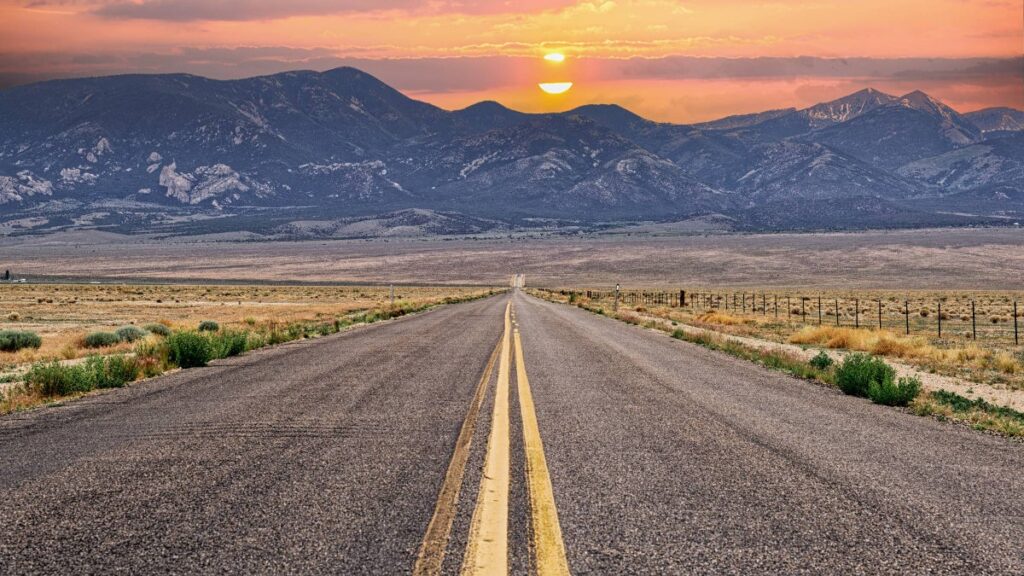
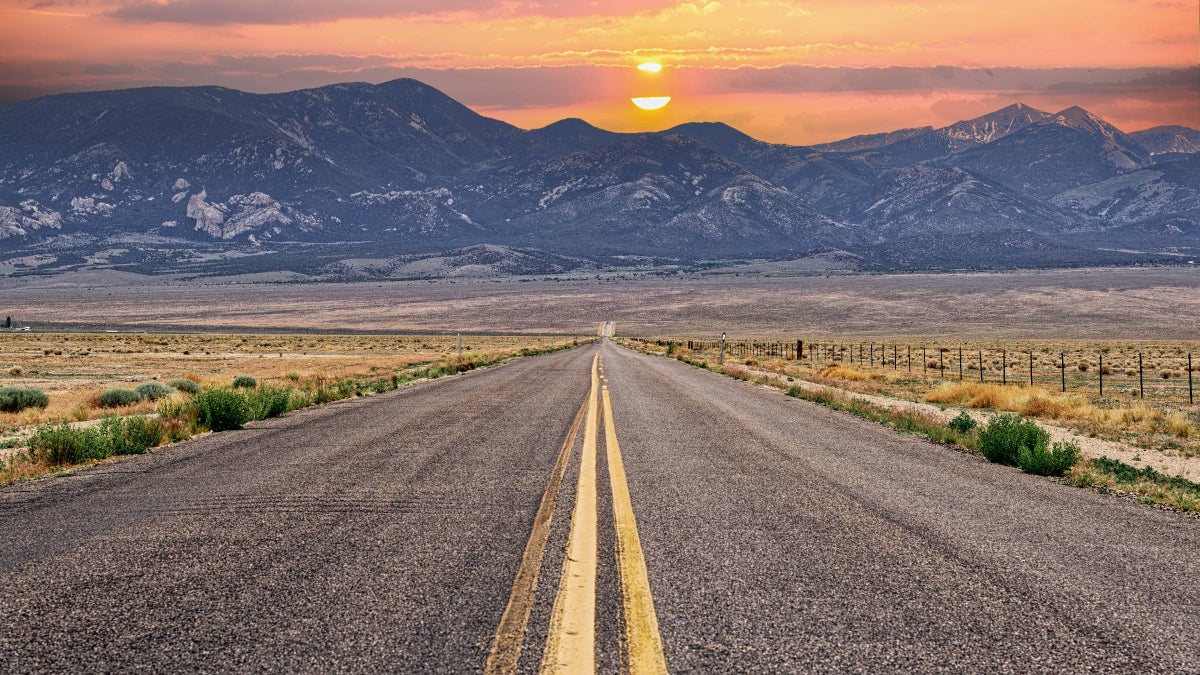
There are just two other vehicles at the Baker Creek Trailhead parking lot when my wife and I set off on a mid-May afternoon towards the snow-capped Snake Range, a 60-mile-long mountain ridge with four of Nevada’s highest peaks. We pass the other hikers just a few minutes in, tourists from France by the sound of it, heading back to the parking lot. From here on out, it feels as if we have the entirety of Great Basin’s 77,000-plus acres to ourselves. Not another soul in sight, nor a whisper in earshot.
The Baker Creek Loop is everything I love in a trail—runnable singletrack dirt with a smattering of rocks along the trail’s edge, cutting through a mix of white firs, Engelmann spruces, and the wonderfully alliterative ponderosa pine. The smell is the intoxicating scent of a natural world left unspoiled from the industrious human hand.
The plan is to trudge 2,600 feet up the mountainside, slowly but surely, roughly six miles to Baker Lake before connecting with Johnson Lake to loop back to the trailhead. But at 11,000 feet of altitude, we’ve wandered into an entirely different park with patches of snow-covered trail warning us of what’s ahead. We march onward through the thinning air, slipping into knee-deep snow as we reach the otherwise barren peak that gives me flashbacks of Nepal.
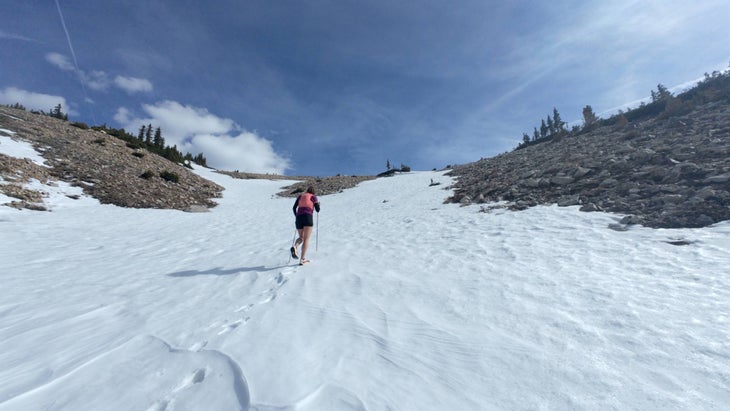
After another 1,000-foot schlep just begging for crampons, the trail disappears on the other side of the mountain under a crust of snow, baked hard by unrestricted sun. Johnson Lake tempts us in the shadow of the valley, but the descent is too steep without a visible trail to follow. Continuing would’ve ensured us a headline story in the local news, alongside a Darwin Awards nomination. So we make the prudent decision and double back, hotfooting it to the car before our host at the Stargazer Inn, Liz Woolsey, turns the pizza oven off at 7 p.m. sharp.
Fortunately, with the benefit of the downhill, we’re able to make it back to the car in almost half the time and roll back into town where Liz, without us needing to ask, has already thrown a veggie pizza into the oven for us before calling it a night. This romantic isolation blended with thoughtful caretakers is precisely what Great Basin National Park is all about.
Why Visit Great Basin National Park
Great Basin National Park is one of those places you’d be tempted to call a hidden gem if the phrase hadn’t been misused and abused to death. But in a sense, it really is hidden—albeit in plain sight—and nestled firmly off the tourist path, well over 100 miles from the nearest interstate highway.
I first came across the park while planning a western road trip, uncreatively hitting up the no-brainer national parks of Zion, Bryce Canyon, and Arches—as millions of annual tourists do. But while hovering over Utah on Google Maps, I noticed a green dot just over the border into Nevada. This, Travis Mason-Bushman later tells me over coffee at the Great Basin Café, is how many of the park’s visitors find them.
Mason-Bushman is the chief of interpretation at Great Basin National Park with 12 years in the U.S. Forest Service from Alaska to South Dakota and Colorado. He came to the Nevada park at the end of 2023, drawn by the opportunity to bring more attention to one of the country’s least-visited national parks. In 2025, Great Basin National Park ranked 54 out of 63 in park visitors at 161,210. Mason-Bushman says that’s roughly the same number that Utah’s Zion National Park, just 200 miles away, gets over Memorial Day Weekend. And the numbers will likely remain just about the same, even as the park celebrates its 40th anniversary this October.
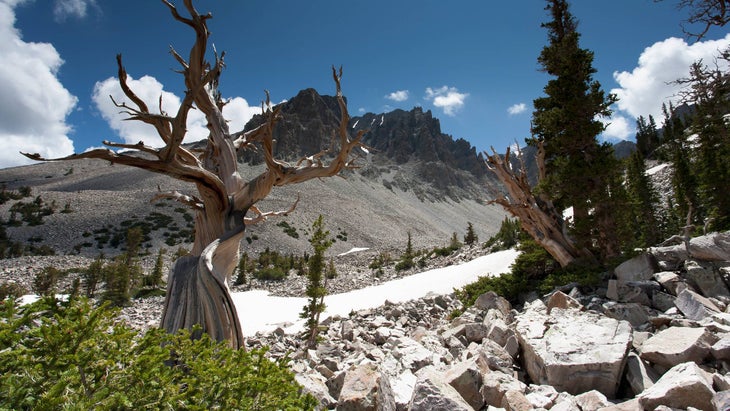
But over the long run, locals are confident word will continue to spread of a place full of unspoiled nature and a network of hiking paths where visitors can bask in pure isolation. The trails stretch across a massive elevation gradient of roughly 7,000 to 13,000 feet, allowing seven distinct ecosystems to thrive in the park. That means everything from salt-desert scrub and sagebrush valleys to the subalpine forests around Baker Lake and ancient bristlecones—something that’s become a kind of natural mascot for the area. The most obvious example is Woolsey’s Bristlecone General Store that doubles as reception for the Stargazer Inn.
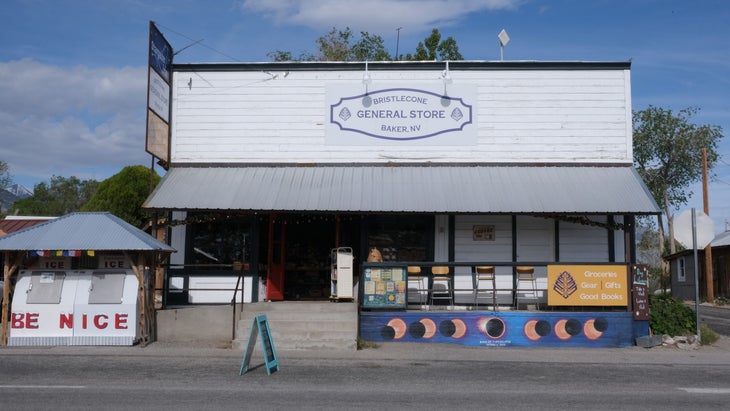
Woolsey opened her businesses just over a year ago, quickly becoming a local and traveler favorite — and not just because it’s the only hotel in Baker or that you might be greeted by her surprisingly affectionate ginger tabby cat. The general store itself is a cozy update on what used to be a staple throughout rural America. There are all kinds of merch (coffee mugs, hats) and a coffee bar where guests can pop a squat for breakfast while chatting up the staff. It’s the kind of place that makes a stranger feel instantly at home.
To truly appreciate the isolation, some recommend driving up with a stop at Zion along the way. The difference is a rock concert versus a meditation retreat.
That was part of the draw for Woolsey, who moved to the town of just 100 souls with her husband James in 2018, and who has been a longtime National Parks service employee. Because of his job, the pair have lived all over the country and even had a few years in France while James served as Director of Visitor Services at the Normandy American Cemetery followed by a stint in Paris. But they’d eventually find themselves settling down somewhere 21,000 times smaller than the French capital.
“We settled in Baker because it instantly felt like home,” she says. “We love the outdoor recreation opportunities, the creative people, and the peaceful pace of life in Baker.”
Since settling in Baker, Woolsey has come to know the national park as if it were a close family member or even an extension of her body. She’s just about left no stone unturned across the park’s 60-plus miles of trails.
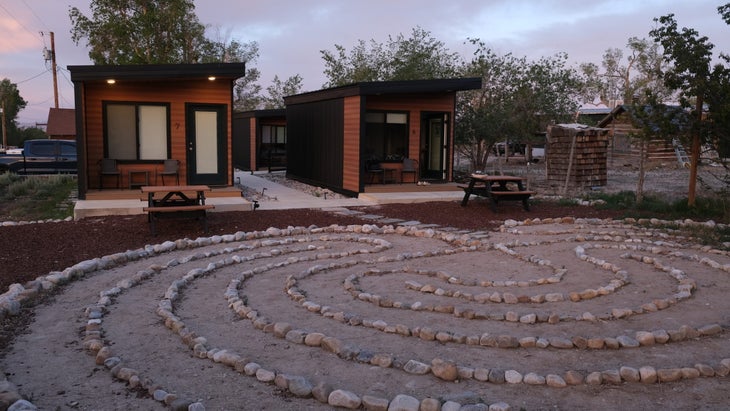
“We’ve hiked almost every trail in Great Basin National Park multiple times in all seasons, and explored many neighboring wilderness areas,” says Woolsey, who encourages travelers to make Great Basin part of their national parks road trip. “We travel throughout the West and are able to relay information to visitors about stops along their travels through Nevada, Utah, Arizona, California and Oregon.”
When to Visit Great Basin National Park
Although Las Vegas is the entry point to the park for most air travelers, Baker is about 3,000 feet higher in elevation than Sin City — even more if you climb to the summit of Wheeler Peak at 13,000 feet. This is all to say that the park’s environment is completely different from Vegas and varies drastically within the park itself throughout the year.
Trails, like those leading to Baker and Johnson lakes, aren’t expected to be cleared of snow until after Memorial Day weekend. But trails at lower elevations, like the 6.4-mile out-and-back Lehman Creek Trail, are generally accessible year-round—leading to pristine alpine-esque meadows surrounded by snowcapped peaks that remind Woolsey of the Austrian countryside in The Sound of Music. (Ask her to see a reenactment she filmed on her iPhone.)
To truly appreciate the isolation, some recommend driving up with a stop at Zion along the way. The difference is a rock concert versus a meditation retreat.
“We love that Great Basin National Park remains pristine wilderness offering quiet trails and dark starry nights,” says Woolsey. “The geology and natural history of the Great Basin desert is fascinating. We love everything from the sagebrush to the Alpine terrain.”
Joe Baur is a Berlin-based adventure travel writer and filmmaker who came to Great Basin National Park a blank slate and left as an evangelist for Nevada’s little green dot. He has run and hiked around the world, from the Himalayas to the Omani desert and beyond. His stories, usually involving trails wherever he can find them, have appeared in National Geographic, Travel + Leisure, Men’s Journal, BBC Travel, and more.
The post Great Basin Is One of the Most Underrated National Parks. And It’s Only Hours From Zion. appeared first on Outside Online.
About The Author