Diving with Giant Manta Rays in Mexico’s Remote Revillagigedo Islands
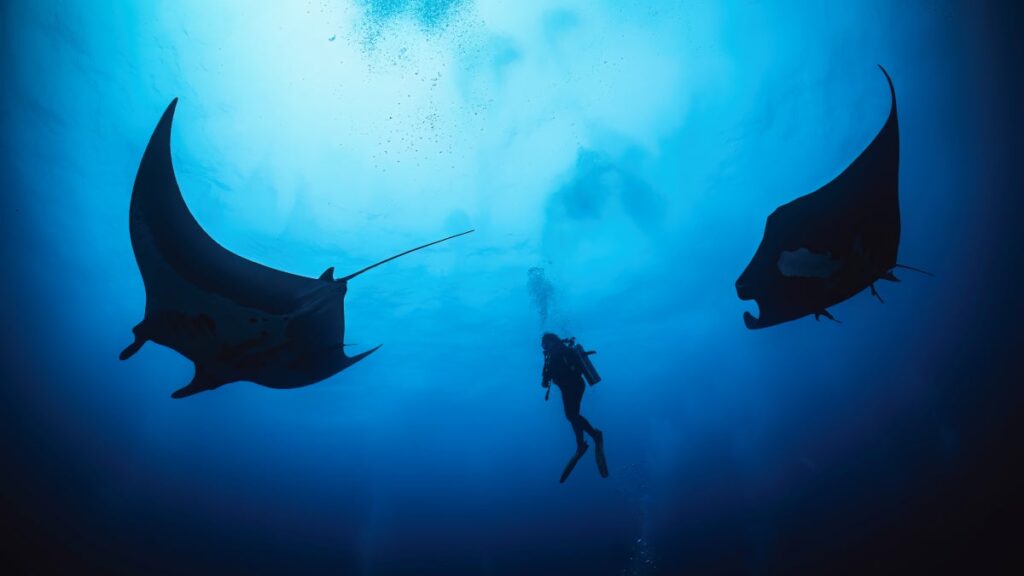
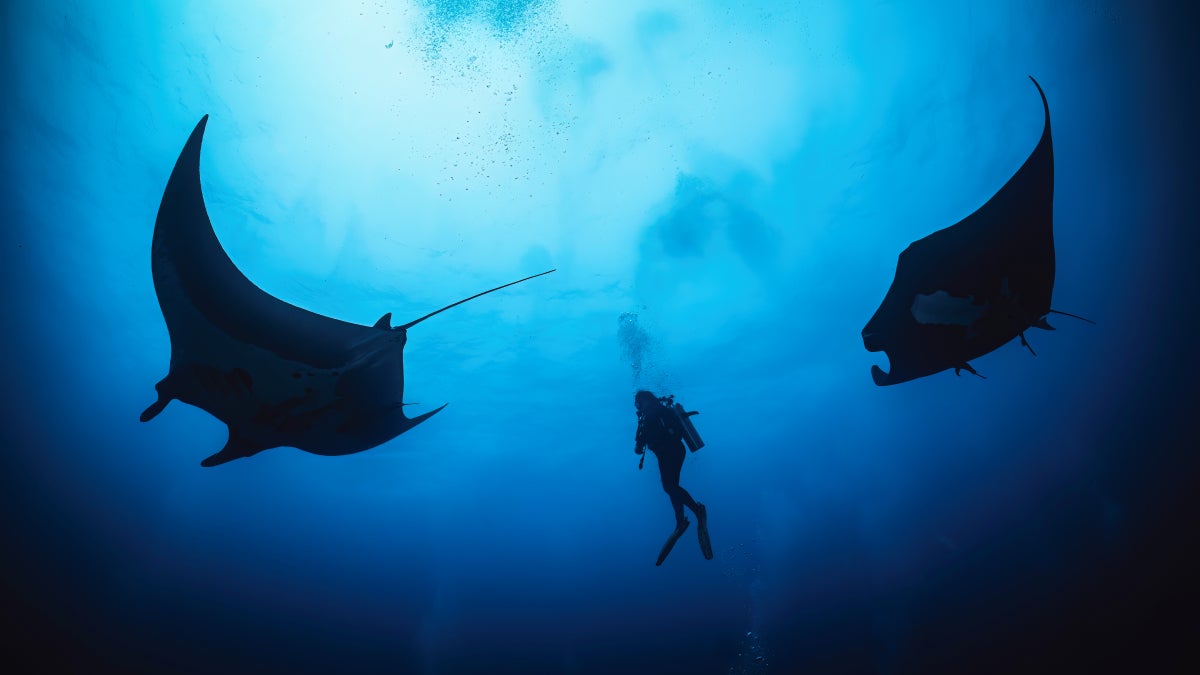
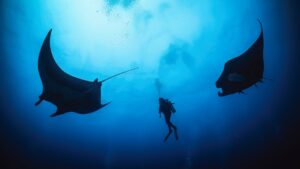
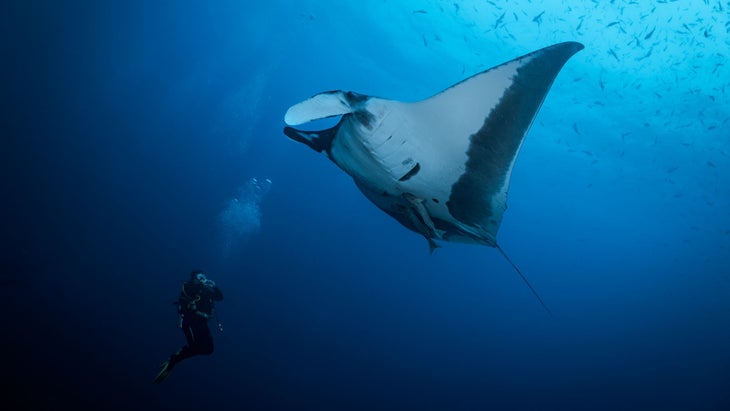
My dive watch shows I am 78 feet deep. Even though this is my 17th dive in four days, I feel my heart race and nerves bubble up as we descend into plankton blooms, which are not affording us the crystal-clear diving conditions we’ve experienced in days prior. With nothing to focus my gaze on in these hazy waters, my mind is flooded with thoughts I’ve pushed away this week, including just how far out in the Pacific Ocean I am. Suddenly, I see the now-familiar silhouette of a massive winged creature emerging from the blue. As it gets closer, I stay still—a tip that’s provided me with numerous close encounters this week. It circles me, so close I can see its depthless purple eye, the size of a tennis ball, watching me.
And then comes another. A giant oceanic manta ray (Mobula birostris) with a wingspan of 20 feet appears out of the abyss. A handful of other divers quickly kick over, camera rigs pointed forward like shields. Before they reach us, my giant friend hovers a mere four feet above me. I hang motionless. Time seems to slow as the manta reveals its chevron belly, unfurling its scars. And then it’s gone. An immense wave of awe washes over me; my eyes water behind my mask.
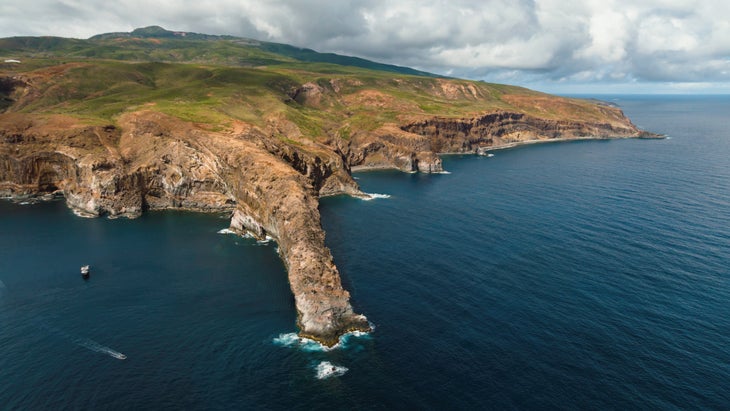
We are 250 nautical miles—more than 24 hours by boat—from Cabo San Lucas, on the southern tip of Mexico’s Baja California peninsula. That’s the closest civilization, so to speak, from us in the ultra-remote Revillagigedo archipelago. Uninhabited by humans, these four volcanic islands are often referred to as the “Galápagos of Mexico” due to their dramatic underwater pinnacles, exceptional biodiversity, and waters teeming with large pelagic species like giant manta rays, sharks, and whales. In 2016, UNESCO declared the islands a World Heritage Site, and in 2017, it became the largest marine protected area in North America.
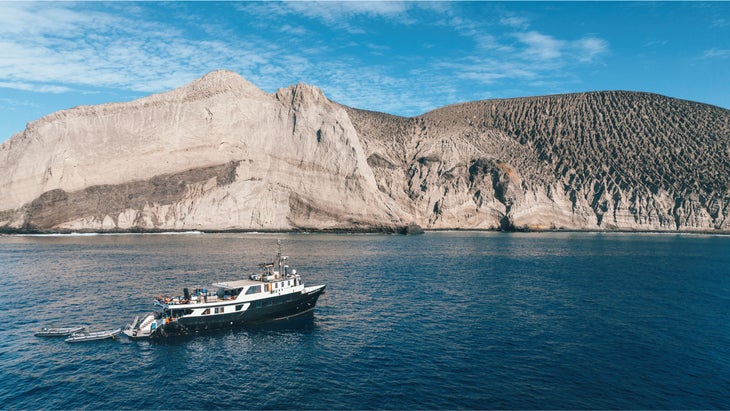
The only way to visit these remote islands is via a liveaboard boat. And while a Mexican Navy base houses roughly 250 caretakers and their families for this protected area, regular tourists aren’t allowed to step foot on the islands—permits are almost exclusively given for scientific research. But everyone’s here for what’s below the surface: hammerhead sharks galore, singing humpbacks, 20-ton polka-dotted whale sharks, and the islands’ biggest attraction—friendly manta rays that can reach up to 22 feet long.
Conditions can be challenging this far out, and out of the group of 20 divers on our seven-day liveaboard trip, I’m the least experienced arriving with only 45 dives. In comparison, some of my fellow divers have several thousand under their belt. Our guide is Jay Clue, the owner and founder of Dive Ninja Expeditions, the first designated PADI Eco Center in Mexico and one of the first in the world. Dive Ninja leads eco-minded big marine animal diving expeditions all over the world.
An award-winning photographer, Clue has a deep passion for marine conservation and sustainable tourism that proves these manta rays (and other endangered species) are more valuable alive than dead. On this particular trip, there are many aspiring Clues who want to hone their underwater photography skills.
So while my fellow divers are kitted out with the best and biggest camera rigs, I have chosen to dive without even a GoPro. With strong currents and sustained depths, a camera would be one more thing I’d have to think about. This camera-free choice affords me closer encounters, too—apparently, mantas want to look into our eyes, not our lenses.
Research suggests mantas are some of the most intelligent fish on our planet. They have massive brains, can recognize themselves in mirrors, and can recognize us, too, it seems. “I was unexpectedly greeted by two familiar faces once,” says Clue, who has led more than 20 trips to these islands in the last decade. “A few mantas I’ve spent time photographing on past trips swam directly up to me, then proceeded to unroll their cephalic fins as they glided, motionless, eye-to-eye only a few feet away.” Almost as if they were saying hello to an old friend, says Clue. “Is this just a rare coincidence my human brain is trying to turn into something it isn’t,” he wonders, “or could it be something more?”
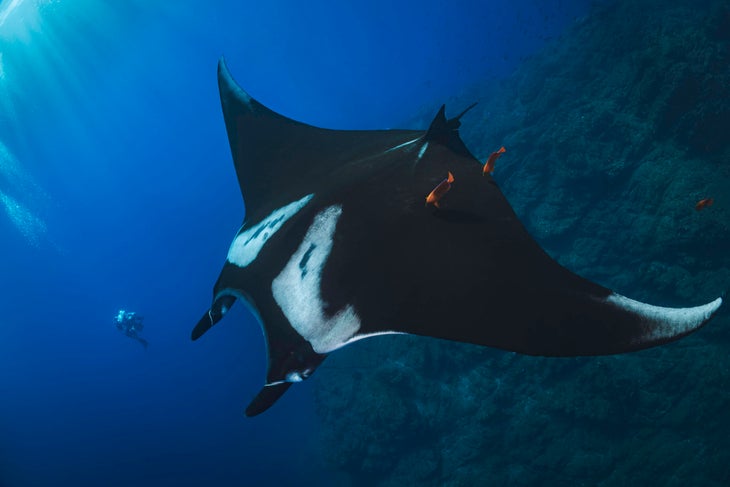
Robert Rubin, PhD, the region’s foremost expert on these “flying carpets of ebony silk,” as he calls them, has been studying gigantic oceanic manta rays in Mexico for more than three decades. The founder and director of the Pacific Manta Research Group, he believes manta rays are sentient, intelligent creatures that merit protection. Inspired by Rubin’s research, Clue set out to create dive trips that combine awe-inspiring marine encounters with conservation education and citizen science.
“You can dive with manta rays all over the world, but here they have a different behavior than we see anywhere else. They seem to seek out interactions with divers. You can see their eyes tracking you. It feels like they want to have a conversation with us,” says Clue. Several evenings on the trip, he gives presentations on Rubin’s research and Pacific Manta Research Group’s manta identification effort, which is a citizen science project anyone can get involved in. “Whether you have a tiny GoPro or a $10,000 camera, it doesn’t really matter. Anyone can take photos of the mantas’ bellies and submit them,” says Clue. This crowdsourced data helps researchers identify specific individuals to track migrations and protect critical aggregation sites.
Today, the biggest threats to mantas are overtourism (in mainland Mexico and worldwide) and boat strikes, both around the islands and on their migratory travels. “As Revillagigedo is a remote location, technically protected by both a national park and the World Heritage Site, it’s largely a safe space for these animals,” says Karey Kumli, project manager at Pacific Manta Research Group.
Responsible tourism, however, plays a powerful role in protecting the manta rays. “It wasn’t until all the tourist boats came [to Revillagigedo] that the fishing [ban] really was enforced. So it’s crucial that there’s tourists there,” says Cody Sheehy, director of The Last Dive, a new film about these islands and the mantas making its way across festival circuits this year. “The money and the jobs brought to those islands showed the Mexican government could justify their position on keeping it in the national park and [staving off] fishing,” he adds.
Individual mantas have been tracked through photo identification for up to 33 years—the worldwide age record for the oceanic (giant) mantas. When they look back at photo sets taken 10 to 40 years ago, 95 percent of those animals have made at least two appearances, says Kumli. Our dive trip alone added 44 new mantas to the research database. I added a manta to the database and named her Artemis. Inspired from the 2026 Artemis II historic lunar flyby where a crew traveled farther from Earth than any humans in history. It seemed a fitting name, as this dive trip felt like it was the closest I’d ever get to floating weightlessness in space.
After each dive at different islands throughout the week, we’d find ourselves elated, rehashing all our incredible encounters on the top deck at sunset. Gina, a veteran diver from Florida, said it best: “My version of heaven is where all questions are answered. Including what the mantas are thinking.”
Diving this far out, deep in the blue, felt like a spiritual, mysterious realm to me. And while we haven’t found out what mantas are thinking just yet, the fact that these creatures still trust us in this world feels like heaven enough.
This article is from the Summer 2026 issue of Outside magazine. To receive the print magazine, become an Outside+ member here.
The post Diving with Giant Manta Rays in Mexico’s Remote Revillagigedo Islands appeared first on Outside Online.
About The Author