I Spent 3 Days Watching the World’s Best Kayakers Face Danger. Here’s What It Taught Me About Living.
For this story Outside associate editor Madison Dapcevich spent three days at the 2026 North Fork Championship, a kayaking competition, in Idaho interviewing athletes, fans, and organizers. Dapcevich is a dedicated paddler herself, and wrote about the intersection of whitewater culture and competition at the race.
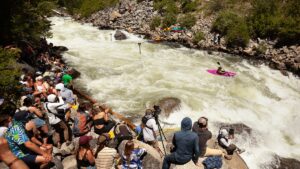
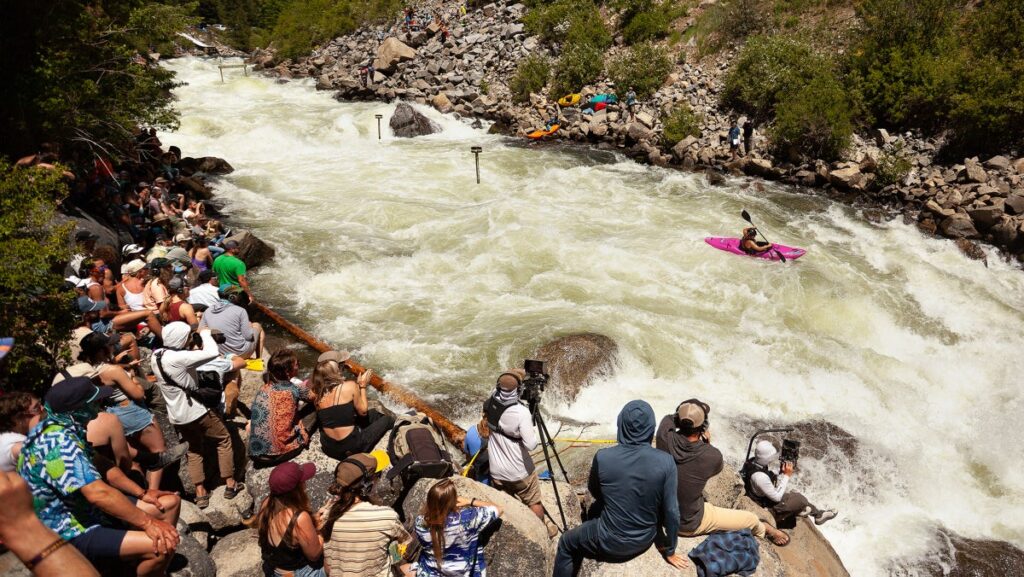
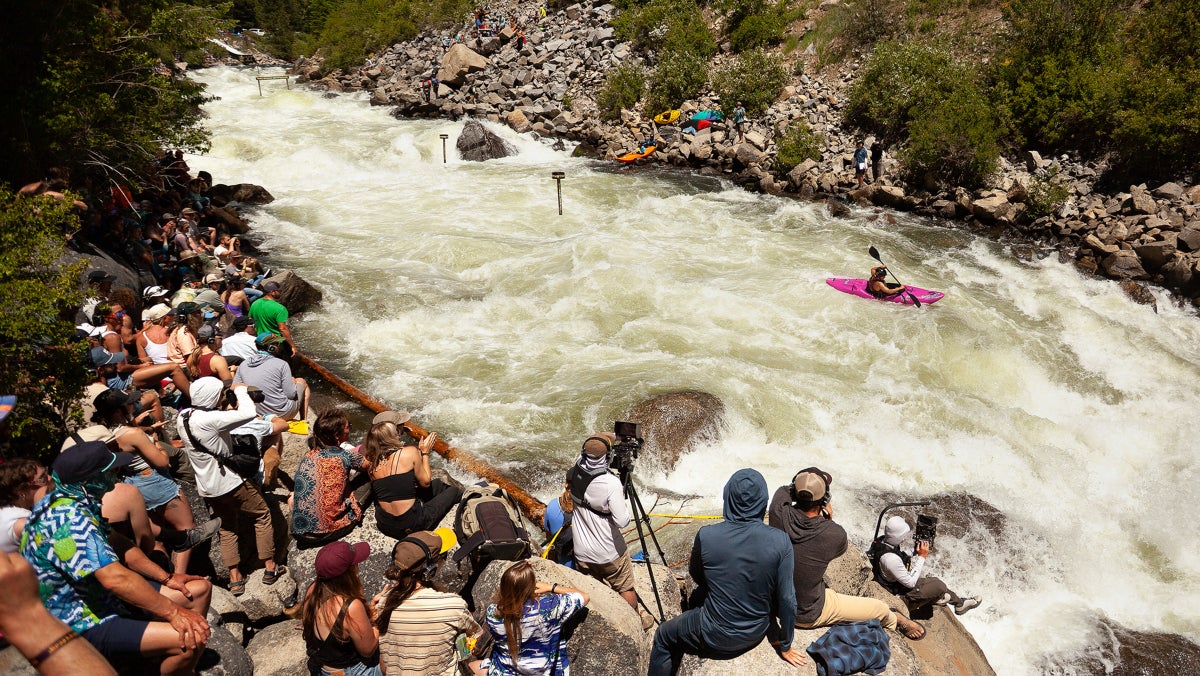
I’m seated alongside hundreds of whitewater fans, shoulder to shoulder, on the edge of a highway as semi-trucks whiz behind me. The roar of their engines is drowned out by the thumping howl of Jacob’s Ladder, a famously rowdy rapid on the North Fork of Idaho’s Payette River, which is just below our feet.
Jacob’s Ladder is less than a mile long, and it features massive crashing waves, discombobulating hydraulics, and metaphorical rooms built from walls of whitewater. It’s a global destination for kayakers, and every year, the very best travel here for the North Fork Championship (NFC), one of the world’s premier whitewater competitions.
Our viewpoint from the highway gives us a bird’s-eye view of the paddlers, but the mid-summer sun is starting to feel unbearable. A cool, refreshing breeze lifts off the river, reminding us of its mountaintop snowmelt origins. Wafting through the crowd are the aromas of campfire, neoprene, and stale beer—nearly everyone here camped the night before, and those scents tend to linger.
Across the river, accessible only by paddling above the rapid, a group of four guys unfolded a plastic table and set up their red camp stove. Shirtless, they painted the letters K, I, W, and I on their backs, presumably for their fellow New Zealand competitor, Zack Mutton. I look to the beginning of the rapid a few hundred feet upstream. Mutton sits at the top of the race’s ramp and takes a deep breath. The spectators hold theirs.
Three. Two. One.
An airhorn buzzer blasts. Within seconds, Mutton slides down the 30-foot-long, hand-built chute in his kayak, paddle in hand, and skyrockets ten feet in the air before landing with a loud whoosh that marks his entrance into the river. He dodges hydraulic features, then maneuvers through gates lining the whitewater course with hard paddle strokes that push athletes toward the most challenging route possible.
Spectators hoot. They holler. They exhale in relief as Mutton makes his way between vertical poles that organizers strung across the river days before. You don’t need to be a kayaker, or even know what a rapid is, to feel the coliseum-like energy vibrating through the crowd.
“To me, the North Fork of the Payette is the Yosemite of whitewater.”
It’s terrifying to watch. Nouria Newman, one of the world’s best kayakers, tells me that it’s even scarier to compete. When she barrels past the roadside audience, Newman gives a hand signal known as the brown claw—it’s the universal mudra symbolizing that a paddler just ran the stoutest part of a rapid, which we call the “meats.” (Lift your right hand, let your wrist go limp, and point all five fingers and your palm toward the ground. Now bounce your forearm up and down a few times. You’re so in.)
The name Jacob’s Ladder reflects this rapid’s lofty place within the world of whitewater kayaking. In the Book of Genesis, a biblical patriarch named Jacob dreams of a ladder rooted on Earth that stretches to Heaven, allowing angels to ascend between the realms. It’s a metaphorical connection that bridges the divine and humanity.
But this isn’t Heaven. Indeed, far from it. This is Banks, Idaho, America’s whitewater mecca. It’s a pilgrimage elite boaters make annually to the NFC, cloaked in ass-less chaps and biodegradable glitter, with boats cam-strapped to the roofs of their vans. In many ways, this death-defying race is more than a whitewater competition. It’s an immersion into a culture with its own language, risks, and community. And the people? Everyone from scrappy whitewater dirtbags and elite sponsored athletes to families, spectators, teens chasing their first big race, and the veterans who helped build the event into what it is today.
The post I Spent 3 Days Watching the World’s Best Kayakers Face Danger. Here’s What It Taught Me About Living. appeared first on Outside Online.
About The Author