Beater Cars, Beer Bellies, and Trash By the Ton. Welcome to Gambler 500.
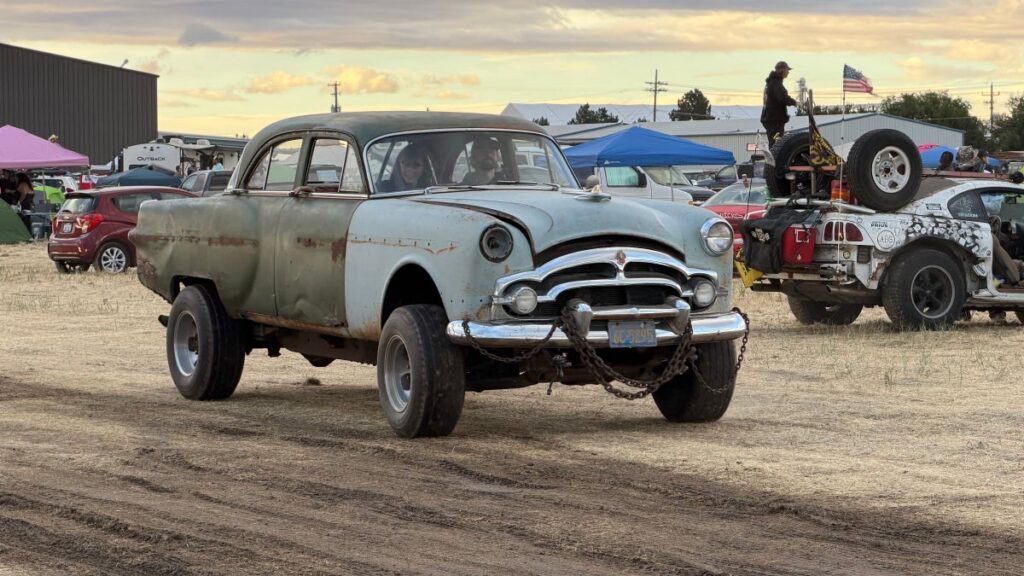
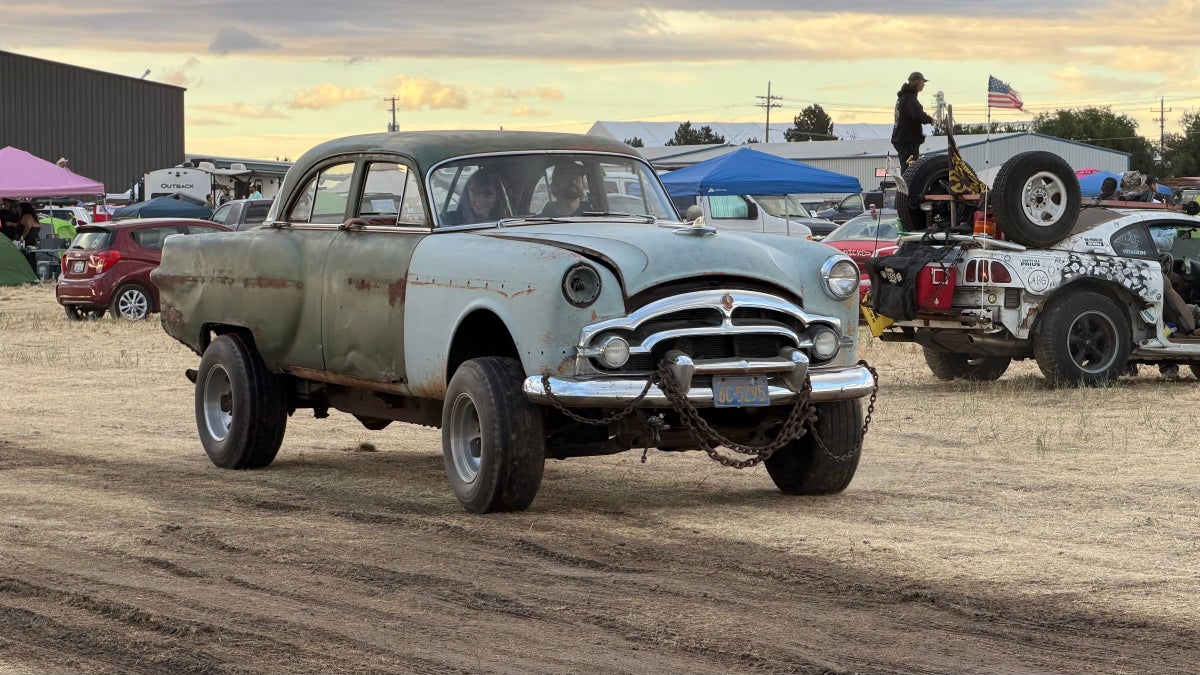
A whining growl interrupted my sleep just after 6 A.M. The day’s first emissary—a minibike—darted past, launched from the apocalyptic armada surrounding me. Another dawn for the captains, oft bearded and bellied like Toby Keith in a Frankenstein fever dream, reawakening their doomed creations with WD-40 and a Craftsman wrench.
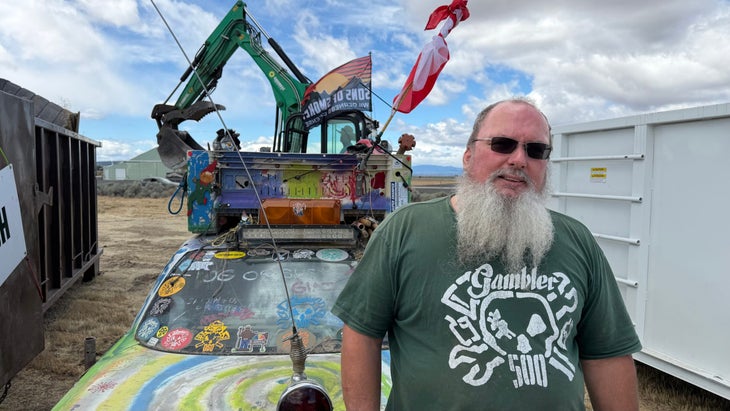
They are Gamblers with a capital G, living by their own car-centric lexicon and a meager rule set. Mainly: Don’t be a dick. They are gearheads, sharp-witted jokers, iconoclasts who fix broken things—usually internal combustion engines.
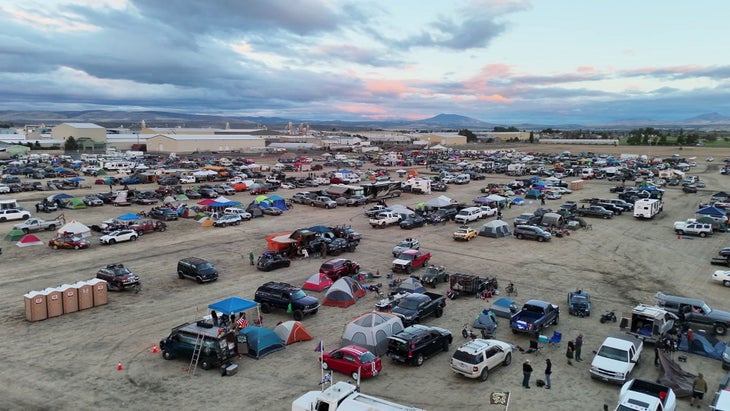
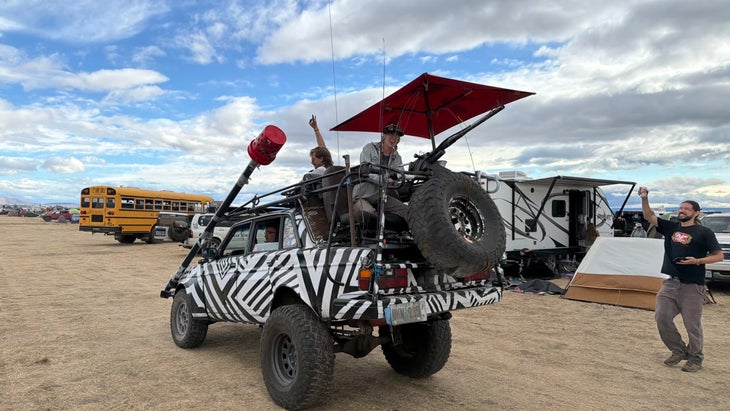
On this late June weekend in central Oregon’s high desert, they have congregated, 4,000 strong, as part of a sweeping movement to clean up trash-filled public lands. The weekend Gambler 500 event, also known as the OG 500 or simply Gamblertown, started small in Oregon just over a decade ago. It’s grown into a massive gathering that’s equal parts Burning Man and Baja 1000. Participants modify vehicles of every sort—cars, trucks, vans, and even school buses—into all-terrain adventure machines. Some dress in outlandish costumes. They venture into the backcountry to collect trash, have fun, and experience Mother Nature. Now there are Gambler chapters in every state, blending off-road rambling with environmental stewardship.
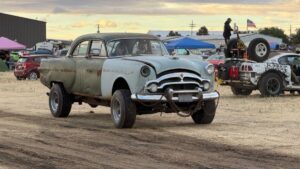
Invariably these Gambler events draw allusions to the “Mad Max” movie franchise. The oddest of vehicles—call them hoopties, beaters, or worse—sprout appendages like gnomes or spiders or even propane-powered flamethrowers, and it’s comforting to categorize them via a cultural reference point.
The only problem is that the “Mad Max” films are packed with insane characters trying to kill one another. Gamblers, while prone to some crazy moments, are battling litter as the enemy, bearing banners for Sons of Smokey, the Gambler 500’s nonprofit wildlands cleanup arm. An app (available to anyone) allows users to mark public-land dump sites, and drivers follow waypoints to remove anything from scattered trash to abandoned boats and recreational vehicles.
No comprehensive report describes the extent or the costs of the trashing of U.S. public lands, though studies hint at the continuing problem. The federal Bureau of Land Management oversees about 245 million acres, primarily in 12 western states; there are millions more acres in state and federal parks and forests. In addition to Gambler-led efforts, agency and volunteer cleanups routinely encounter illegal dump sites—the work of homeless encampments, individuals evading disposal fees, and others.
I had pulled into Gamblertown, in Madras, Oregon, the day before my morning minibike wake-up. Surveying a 60-acre field of mowed and yellowing grain stalks, I noted early arrivals: a desert-tan van budding a trophy buck from its roof and a giant faux cigarette from the grill, another van emblazoned with Pac-Man characters, and a bizarre menagerie of primer-colored cars displaying stickers and spraypainted slogans like defiant tattoos. My plain black 2020 Honda Pilot seemed forlornly out of place—abnormally normal.
A sound I would come to know all too well greeted me: a buzzing minibike, veering around a corner. Its bearded rider wore a colonial patriot’s breeches, a frock coat and tricorn hat. His shouts outdueled the minibike’s whine.
“The shitboxes are coming,” he proclaimed, mimicking Paul Revere. “The shitboxes are coming.”
‘Driving Some Cars Around Until They Die’
The Gambler 500 was born in an Oregon bar in 2014 as a cross between a question and a joke: Just how far could a beater car—one costing $500 or less— make it off-road?
“In the beginning it was just me and a buddy saying, “Hey, it will be fun driving some cars around until they die,” said founder Tate Morgan.
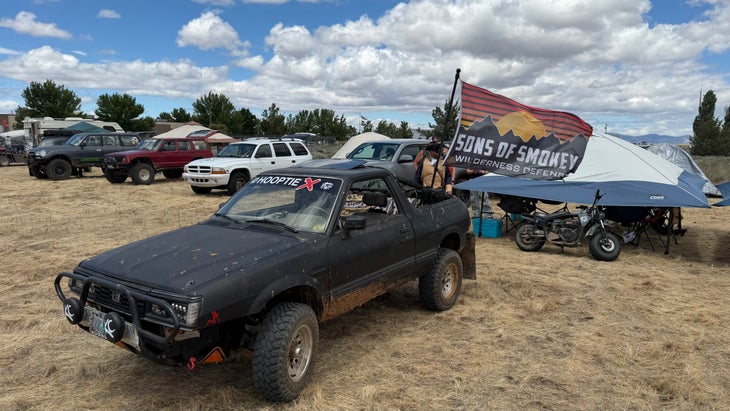
About a dozen members of a loose-knit club calling themselves the Gamblers kept the annual tradition going, adopting their own slang like “ABG” (always be gambling) and “pavement is lava”— a reference to staying off-road as much as possible. Their rallies followed preset waypoints; they departed in staggered starts from a suburban Portland saloon’s parking lot.
I met Morgan in the same saloon two and a half months before this year’s event. He’s huge—6 foot 4, 240 pounds—with glacier blue eyes, unruly graying hair and a salt-and-pepper beard. A black bead of motor oil ringed his fingernails. His no-bullshit conversation style is layered with equal parts f-bombs and words like “prescient,” “ubiquitous” and “propensity.”
In a measured voice, he described facing two collisions a decade ago that scarred him and raised questions over survival— his own and his newfound hobby’s. The first was discovering he had testicular cancer. The second resulted from a viral video about the 2016 Gambler 500 event.
The following year, Morgan expected anywhere from a few dozen attendees to a couple of hundred. Instead, 3,000 people showed up in central Oregon. Chaos ensued. Lines. Parking headaches. U.S. Forest Service officers issued tickets for permit violations, and a citation to someone who had abandoned a broken-down vehicle.
“We’re here to pick up some trash and do dumb shit.”
All of which left Morgan with a decision: Kill his creation or breathe new life into it. He had grown up in Eugene, Oregon, as a true-believer environmentalist, weaned on activist/author Edward Abbey and his 1975 novel “The Monkey Wrench Gang.” Abbey encouraged others to defend the Earth through “any and every method which may be necessary.”
But Morgan sought to build bridges, not detonate them. If Gamblers wanted to continue experiencing cheap outdoor fun, he decided, they needed to give something in return.
How an Ancient Subaru Earned Its Nickname
Gathered around their Madras camp, Brett Hrouda, the minibike-riding man under the three-cornered hat, and his friends described their converging paths, how an ancient Subaru earned its nickname, and their succinct plans for this year’s Gambler 500.
“We’re here to pick up some trash and do dumb shit,” Hrouda, 47, said. He lives near Roseburg, Oregon, and splits time as a maintenance director and invoicing manager.
Shenanigans, in his friend Tom Parker’s words. Which is why Parker and his wife, Liz, left the kids at home for the big annual event. Lots of vehicles, dust, and alcohol—especially after dark. They’ve been attending Gambler events for a few years now, including smaller weekend gatherings.
Hrouda tells us he finds peace while driving in the backcountry, “just following dirt roads wherever they go.” Until the trail leads to trash piles, where his patience peters out. The Gambler 500 rings on Tom Parker’s fingers spell out their disdain for litterbugs, with ominous mottos like “Throw trash, catch hands,” and more pointedly, “Kill all litterbugs.”
To be clear, the organization embraces solutions and education—not violence. An event flyer, for example, emphasized “do not engage with or collect trash from active houseless population.”
Liz Parker can see that her children are learning lessons from the adults.
“What I love about this is that our kids are in the habit now of saying, ‘Mom, there’s trash in that ditch,’” she said. “They see it and call it out. We’re passing stewardship on to the next generation.”
Tom Parker, 40, a power-line arborist from Camas Valley, Oregon, paid $350 for his first Gambler car, a Subaru, and pushed it hard for three years. Returning from a beer run, he heard sputtering. The rear-view mirror revealed clouds of black and gray smoke, signifying the Subaru’s impending death.
He traded an old dirt bike for another Subaru—a 1985 GL hatchback chopped down into a makeshift pickup. The car bore no nickname until last year’s Gambler 500, when the Parkers and Hrouda strapped an abandoned sofa and other junk onto the Subaru’s back. Returning to camp, they watched in horror as an animal scurried from the sofa into the cab. It was a rat.
Tom Parker braked hard, skidding. He tried to corner the rat. Liz Parker screamed and struggled to unbuckle, panicked. She wanted out.
“I don’t do rodents,” she said. “There’s nothing worse than trying to bail out of a vehicle and the seatbelt won’t disengage.”
The intruder didn’t survive the experience but is memorialized in the vehicle’s nickname: the Subarat.
Maintaining a Frankenstein Fleet
An insistent wind whipped dust and toppled the Parkers’ tent. As they righted it, a neighbor appeared, duct tape in hand. Did they have a quarter-inch adapter for a three-eighths drive torque wrench? No. I asked why it was needed.
“We have too many pieces of shit,” he said.
Keeping a collection of misfit motorized contraptions running can be a full-time endeavor, explained my new friend, Matt Vanella. Vanella and his crew had a rickshaw concocted from a scooter, wood and spare parts; a riding lawn mower towing a rickety wooden cart; a trike melded from bicycle and all-terrain vehicle parts, secured by scrap wood and yards of wrapped twine; and a “reverse trike,” consisting of a scooter crossbred with an ATV, supporting a forward-facing rider on a boat seat.
While maintaining this Frankenstein fleet, Vanella said, he and his pals were simultaneously scouting marked dump sites through the Sons of Smokey app. They sought trophy trash to parade into camp. Something big, but not too heavy. Like a fiberglass boat.
It turned out that Vanella and friends—Noah Hilton, John Rushing, Matt Wong and Eric Swanson, all from Oregon—were my camp neighbors. Swanson, 48, a cybersecurity engineer, was the mechanical mastermind.
“When I was in high school, I basically lived in the auto shop,” Swanson told me. “This recruiter came to school, and he asked me, ‘Do you want to be doing this when you’re 50?’ And the answer was no, not as a full-time job. But as a hobby I need that creative outlet that’s tangible, physical.”
Afterwards, Vanella, 42, a facility manager from Albany, Oregon, cajoled me into a ride on the reverse trike. He piloted it from atop the scooter, and I clambered into the front-mounted seat. No helmets for us. Just Vanella urging me to lean left, lean right to keep us from tipping. Shorts riffling in the wind, I felt giddy, thoughts ricocheting between staying upright and wondering how I would explain a concussion or broken collarbone to my wife.
Making new friends. Laughing uncontrollably at high speed. Doing dumb shit. Was I hitchhiking my way onto the Gambler highway? Judge for yourself: my neighbors recorded the weekend on video.
I found myself in the back seat of their Ford pickup an hour later, bouncing toward a marked trash site seven miles east of camp. Matt Wong, reading from the Sons of Smokey app, called out the turns, while Matt Vanella and the others kept a running commentary. We towed a tilting flatbed trailer. The rough gravel backroads did their best to rock me between the two Matts.
You’re in a Matt sandwich, one of the front-seat wags announced. A Matt-wich, said another. That kind of imagery just writes itself, one suggested faux-helpfully, then asked: Can you actually smuggle all this into your article?
(I think I just did.)
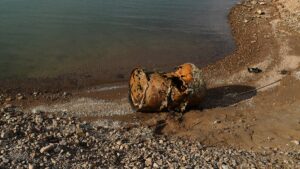
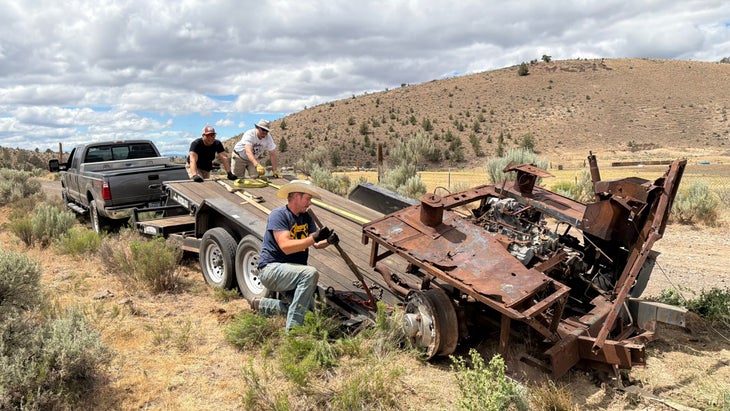
The app had marked our target as “the back half of a truck.” Instead, we found the rusted remains of a semi truck’s front end, including the motor, embedded in the roadside dirt. We figured it weighed almost a ton—far too heavy to lift by hand.
Lacking a winch, Hilton and friends rigged a series of heavy-duty ratchet straps and chains to the metal mass. Inch by inch, they coaxed it up the tilted flatbed. On the ride back, I recalled an old trucker anthem called “Looking at the World Through a Windshield,” and its driver “seeing everything in a little bit different light.”
Well, long strips of rubber that you see
Were burnt off of this rig by the likes of me
And they’ll rot along the highways in this land.
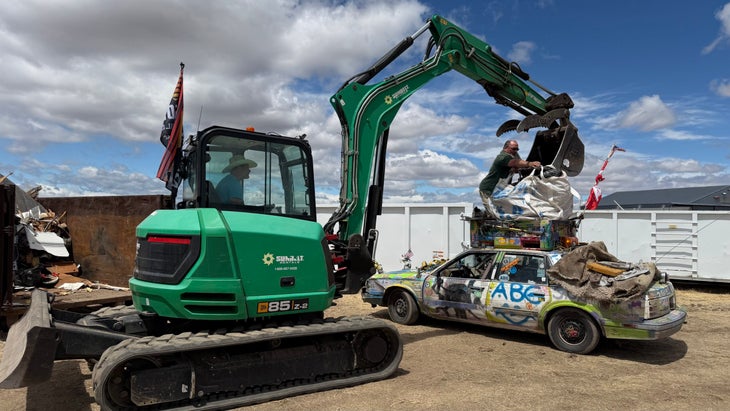
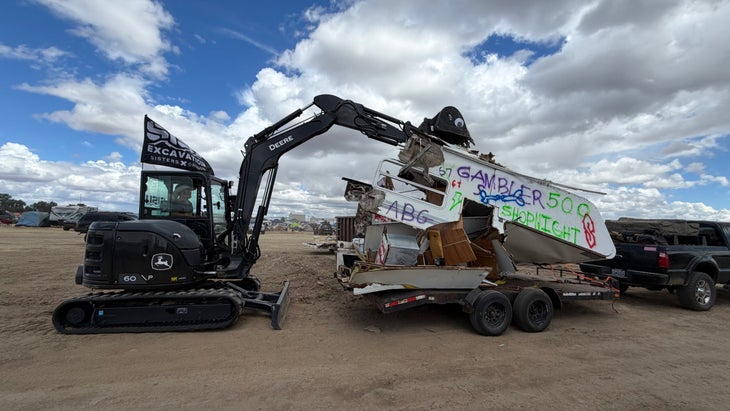
This big-rig remnant, having rusted on public land for years, rolled into camp on our trailer. An excavator’s jaws clamped tight and tossed it to the ground. Next stop: a metal recycler.
‘I Got to Keep My People’
From 2017 on, Morgan worked to establish Gambler chapters across the country. He refused to turn it into a money machine, but sought sponsors to defray costs for the annual event.
Morgan established the Gambler’s non-profit arm, Sons of Smokey, with a mission of facilitating “the collection and disposal of trash from public lands, while fostering a non-partisan movement for stewardship of the outdoors.”
He is proud of what they have been able to do over time—especially collecting more than 6 million pounds of trash.
Rambling around and outside Morgan’s shop in West Linn, Oregon, he described the lineage of his odd collection of Gambler cars, from doorless SUVs to an ugly Saturn and a dilapidated Datsun pickup.
The Gambler event no longer requires participants to invest $500 or less in their cars, but Morgan still embraces the ethic of making something out of next to nothing. That came through as he described applying layers of resin and paint on a car he was given for free.
“It’s like celebrating the shittiness of it,” he said, “because you can never lose if you’re kind of shitty on purpose. Which is kind of the gambler mantra—you know we’re not playing that game of trying to outspend or be faster or bigger or stronger than someone else.”
By keeping event fees low and allowing chapters in other states to use the Gambler name for free, Morgan says, “I got to keep my people.”
“Then by making it about trash and conservation stewardship, I’m also betting that everyone who comes out isn’t blinded by politics or some kind of fucking asshole,” he says. “We might disagree on a lot of stuff, but if you keep that and maybe your hate speech to yourself, it’ll be fine.”
All That Awaited in the Sagebrush
As the morning buzz of minibikes mounted, my nose led me to the neighbors’ camp, where eggs, link sausages and hash browns sizzled. No trash cleanups planned today, they told me—too many maimed machines to repair. The reverse trike’s carburetor kept flooding, and the riding lawnmower’s belt was toast.
Which left me hitching a new trash-hunting ride. I spied a convoy of cars and pickups forming, and an empty seat in a Toyota. The driver motioned for me to hop in. Like many of the Gamblers I met, the driver, Tyler Knudson of Corvallis, Oregon, is a military veteran.
After four years as a Navy helicopter mechanic, Knudson faced no insurmountable obstacles in transplanting a Volkswagen diesel engine into his 1990 Toyota 4Runner. In arcane detail, like play-by-play for a sport I will never comprehend, Knudson recited descriptions of TDIs and ALH engine codes, adapter plates and transversely mounted motors, drive shafts and mounting points.
“To keep my mental peace, I’ve resolved that I don’t care how it got here. I only care where it ends up.”
After a few minutes’ drive and a bumpy turn down a dirt trail, we descended into Willow Creek Canyon. A striking tan-green horizon melded into gray clouds. Until we stopped the cars and could fully comprehend all that waited in the sagebrush.
Up close, it appeared as if a garbage barge had run aground in a storm. Rusting cans. Broken bottles. Mattress springs. A rotting steer carcass. Moldy clothing. A car fender.
One of our convoy members, Colton Baker of Cheney, Washington, tried fitting the scene into words.
“I don’t get how people look at this beautiful view and go, ‘You know, what would be even better? Garbage,’” he said.
Knudson loaned me a pair of gloves, and we all bent knees and began filling garbage bags. Knudson strapped hunks of metal and wood on the Toyota’s roof. Our convoy’s informal leader, Bob Keeton of Port Orchard, Washington, corralled us back toward camp after an hour or so, acknowledging that we had made a dent. But there might be days of trash remaining.
“This whole litter issue is so complex,” he told me. “Some of it is a product of laziness. Some is desperation. To keep my mental peace, I’ve resolved that I don’t care how it got here. I only care where it ends up.”
He likes hunting tires, he said. That afternoon I found him in camp by the dumpsters, his 2003 Subaru Baja piled high with discarded rubber.
“I think it cost me a drive shaft, though,” he said, nodding at the Subaru. “That’s why I brought a trailer—we’re not driving it home.”
Attendees keep camp neat by packing out their own trash or placing it in the dumpsters. Cars that are disabled are towed out, given away or taken to auto recyclers.
“We wait to find a good deal on one that needs a motor—something that’s been used and abused and broken, then we bring it back to life. Yeah, then usually break it. Then re-break it.”
Keeton’s was not the only vehicle that failed to survive the weekend. In camp, a hand-lettered cardboard sign on a green 2002 Saab 9-3 summarized the damage done by trail rocks: “Free: Hole in oil pan.”
Its owner, John McKenzie of Fort Collins, Colorado, had paid $700 for the car the day before in Madras. It returned from a Saturday trail exploration on a trailer. McKenzie’s friend, Russell Caldwell of Mountain Home, Idaho, said that’s pretty much the standard Gambler auto experience.
“We wait to find a good deal on one that needs a motor—something that’s been used and abused and broken, then we bring it back to life,” Caldwell said. “Yeah, then usually break it. Then re-break it.”
Re-creation and recreation. Not unlike Mary Shelley’s descriptions of Dr. Frankenstein’s “whirlwind passions.” When the pressure became too great, the fictional doctor described “bending my steps towards the near Alpine valleys, (seeking) in the magnificence, the eternity of such scenes, to forget myself…”
More Than 391,000 Pounds of Trash Collected
By the end of the Madras event, the 4,000 in attendance put up some substantial numbers: More than 391,000 pounds of trash collected. Fourteen cars, eight RVs, four boats. More than 2,500 tires.
The organization’s cleanup efforts have won praise from land managers and outdoors enthusiasts. Environmental groups, however, contend that off-roaders—like mining operations and oil drillers—are exploiting public lands.
“It’s easier to villainize the entire off-road culture than have a nuanced understanding of how other people interact with the outdoors.”
Jeff Miller, senior conservation advocate for the non-profit Center for Biological Diversity, recites a litany of off-roads degradation, from wildlife habitat to archeological sites to entire ecosystems.
“It’s great that someone is picking up trash, but that doesn’t offset all the environmental damage,” he said. “Off-road driving is a destructive hobby, and I don’t think it has any place on our public lands. That whole road system is the reason trash is there—it’s providing public access.”
Morgan, the Gamblers’ founder, acknowledged that some off-roaders’ actions have given others a bad name. But he says the group’s cleanup results tell a clear story.
“I can’t see any work being done that is more significant and visibly helpful for public lands than what we’ve accomplished,” he said. “I believe that public lands exist to serve all users. But it’s easier to villainize the entire off-road culture than have a nuanced understanding of how other people interact with the outdoors.”
Word of mouth, amplified by the Gamblers’ robust social media presence, continues to reverberate. In July, a friends group of Utah’s Grand Staircase-Escalante National Monument approached Morgan about partnering on cleanup efforts.
“I see trash all over southern Utah, into Arizona and as far south as the Grand Canyon,” said Jackie Grant, executive director of Grand Staircase Escalante Partners. “We occasionally will see something huge—a camper or vehicle—that we don’t have the capacity for. I’m hoping we can come together and make a really big impact on trash.”
Similarly, BLM land managers in Idaho report a “vast landscape that has just been trashed,” with inadequate staff to address the issue. National and Oregon BLM spokespersons said volunteer efforts, including by the Gambler group, are both welcome and “inspiring.”
Cycles of Ruin and Renewal
Scientists tell us that our brains automatically assign individuals into social categories so we can understand their motivations and better predict their actions. But when we met before the event, Morgan had warned against overgeneralizing.
“These are the nicest, kindest people you will ever meet,” he told me. “If you need gas, if you need help fixing your car, if you need a ride to the hospital—these people are there for you.”
This I know to be true. Because a couple of years back, as I knelt beside my Dodge pickup’s flat tire on a roadside, a stranger stopped to help. I asked him about the Gambler stickers on his rear window, and his answers—crazy car fun mixed with cleaning up public lands—ultimately led me to invite myself along for this weekend adventure.
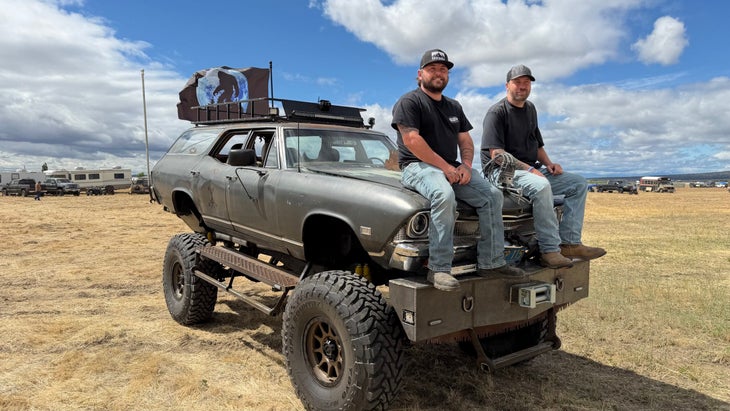
Where I met mostly white men, one of whom offered me a beer and happily explained fitting a fiberglass boat on top of a Buick, dubbing the creation the “Lamboatghini.” I met a woman, 8 months pregnant, behind the wheel of a one-ton Ford pickup towing a flatbed trailer piled high with recovered junk.
And met John Thompson of Burbank, Washington, a longtime Gambler, whose battered, tie-dyed 1993 Oldsmobile Cutlass Ciera has survived 222,000 miles and has been submerged in a pond. Thompson paid $200 for it in 2018, when it was vanilla white and bore some resemblance to a normal vehicle.
“If my 18-year-old self saw me driving this thing now he’d kick my ass,” Thompson said. “But this car will probably outlive me.”
Thompson nicknamed it “Lazarus.”
Seemed like nearly every Gambler was determined to pen a new chapter on rising from the dead. As I prepared to leave camp, I found my neighbors huddled with funereal solemnity, clutching beer cans instead of flowers. Their eyes examined the remains.
Behind the riding lawnmower, the crude wooden cart sprawled on its side. Splintered frame boards told a tale: A hard right turn, and Newton’s first law of motion sent the cart—and its occupants, Vanella and Rushing—tumbling. Neither was seriously injured, though Vanella displayed a skinned knee like a war wound.
“I’m kind of happy because now maybe we can throw this cart away,” he said.
But his friends weren’t in mourning – they were plotting. A couple of tie-down straps might reunite the cart and its frame, at least temporarily.
“We’ll get ‘er fixed in no time,” Hilton said.
I wished them well and proffered a round of handshakes. Wheeling the dusty Pilot out of camp, I turned northwest onto U.S. Route 26, passing a station wagon bearing a discarded sofa on its roof. One more load arriving.
After two days of ABG (always be gambling), I held a new appreciation for what lies hidden beyond the asphalt in the high desert’s sagebrush and juniper. I’d seen the weird and the wonderful, witnessed maimed machinery being nursed back to life, donned gloves and filled trash bags, and found hope lurking under a veneer of garbage and indifference.
The snow-topped Cascades and a twisting roadway loomed between me and home, affording a couple of hours to ponder cycles of ruin and renewal, loss and resurrection. Pavement is lava, and I had 93 miles to burn.
Four-time Lowell Thomas Award-winner Alex Pulaski is a former travel editor turned freelance writer. His travel articles have appeared in Afar, National Geographic, The Boston Globe, The Los Angeles Times, The Washington Post, and other publications.
The post Beater Cars, Beer Bellies, and Trash By the Ton. Welcome to Gambler 500. appeared first on Outside Online.
About The Author