‘Everest: The Other Side’ Made for the Highest, Most Inhospitable Film Set on Planet Earth
Just after 10:40 A.M. on September 26, 2022, ski mountaineers Hilaree Nelson and Jim Morrison clipped into their skis on the exposed summit of Manaslu, the eighth-highest mountain in the world. They were on the Nepali peak training for an even more audacious goal: skiing the direct North Face of Mount Everest, a descent no one had ever completed. Pemba Sherpa (Sharwa) was on the ridge filming them for the upcoming documentary, Everest: The Other Side.
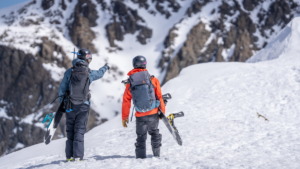
Up there, at 26,781 feet, the wind tugged at a string of prayer flags secured to the peak. Nelson and Morrison were ski partners and life partners. They had matching outfits on: red ski boots, dark pants, red jackets, and white backpacks. For Nelson, who’d spent her life making bold first descents around the world, high-altitude summits were where she made a living, but they also offered something else: a space where the boundaries between the physical and spiritual world blurred, where “you can almost reach through to the other side,” she says in the film.
Morrison skied first, taking a few turns and pulling off to the side to wait. Nelson followed in his tracks, traversing across the small summit pyramid before pausing. As she started to ski, the slope released above her, and the avalanche knocked her off her feet. It carried Nelson past Morrison and out of sight.
After Nelson disappeared, an anguished sound came from Morrison. “It was not really a scream,” he said in an interview this fall. “Sort of a noise.” At that moment, though he said that he felt like she was still alive, the sound made it seem as if, deep down, he already knew the worst had happened.
Desperate to reach Nelson, Morrison started skiing. He recalled making risky moves above a large cliff band. Pemba screamed at him to stop. He wanted to try to air through the cliffs after her, but knew it would probably kill him. To help her, he’d have to stay alive.

That day, avalanches released all over the mountain, at different altitudes and different aspects. At the moment Nelson was swept away, Morrison felt like the mountain shook on all sides, all at once. A huge slide between Camps 3 and 4 caught and carried other climbers. The fixed ropes were gone, pickets were broken in half, and he was doing what he called “the most impossible skiing you could ever do,” on bare ice and in bad visibility.
Two days later, cameras captured Morrison and Mingma Tenzi Sherpa as they got out of a helicopter in crevasse-riddled terrain 5,000 feet below the summit. Mingma Tenzi’s GoPro provided a first-person view as he picked up a red puffy from the snow.
At that moment, though he said that he felt like she was still alive, the sound made it seem as if, deep down, he already knew the worst had happened.
“Oh shit,” Mingma Tenzi whispered under his breath. “So sorry.”
Morrison, a rope length below him, shouted up that he’d found her.
“Be strong, please,” Mingma Tenzi yelled back as he descended to join him. When he got there, Morrison was digging.
“I’ll do it,” said Mingma Tenzi as he took over.
“I’m with you,” said Morrison, hand over his heart.
When they dug Nelson out of the snow, Morrison said he put his arms around her, but she was no longer there. As the others wrapped her in a tarp, he collapsed to his knees. “I’m praying for the children,” Morrison said, referring to Nelson’s two teenage boys, Grayden and Quinn.
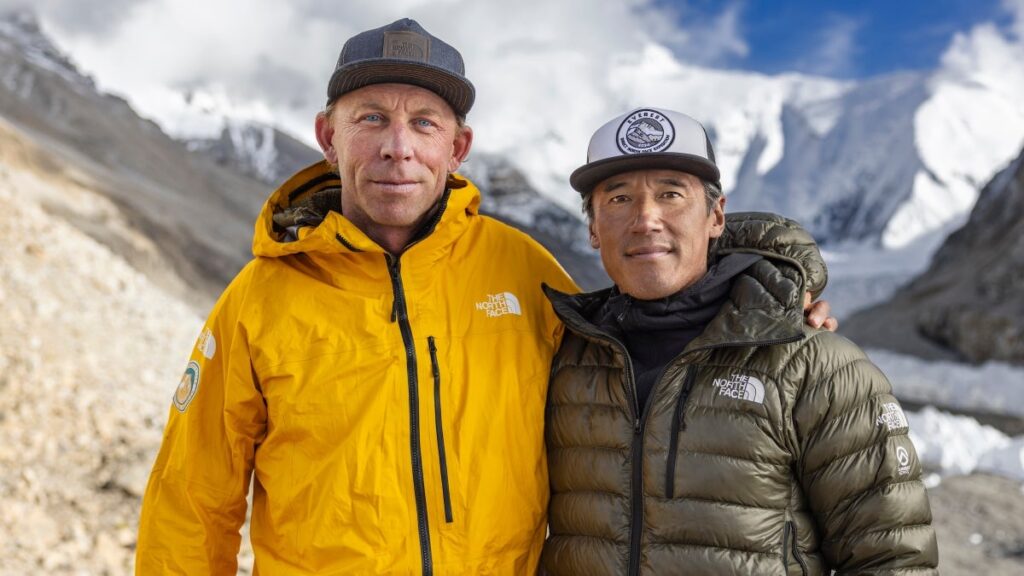
It was 3:00 A.M. when Jimmy Chin got a phone call from mountaineer Conrad Anker, who told him about Nelson’s fatal fall on Manaslu. Chin is a film director, photographer, author, and mountain athlete. He was co-directing Everest: The Other Side alongside Elizabeth Chai Vasarhelyi, who is known for documentaries that bring a character’s humanity to the forefront, like in Free Solo, Nyad, and Love+War.
Chin had to balance two obligations: First, to his dear friends. He and Nelson had joined The North Face athlete team around the same time over two decades prior. Their first expedition together was on Denali, where climbers must haul heavy sleds full of gear from camp to camp. When Chin went to move Nelson’s sled, he could barely do it—she’d taken other people’s gear and added it to her own to help lighten their loads. “She always led quietly, by example,” he said.
Chin immediately got on a flight to Kathmandu.
His second obligation was to the film he was directing about Morrison and Nelson’s attempt at Everest, which had been in the works for two years at that point. But he couldn’t carry both objectives in that moment. He called producers Anna Barnes and Shannon Dill in the middle of the night, and Barnes headed to Nepal with director of photography Christopher Murphy and cinematographer Savannah Cummins to capture what would become some of the movie’s rawest scenes: Morrison, grappling with the sudden loss of his life partner, asks Chin a question that often bubbles to the surface after someone dies in the mountains: “Why did we do this?”

Chin, no stranger to loss himself, responds that he doesn’t know if he finds it justifiable anymore. Are expeditions like this, even with the deep personal meaning they can offer, worth the potentially tragic outcomes?
In the weeks after Nelson died, Morrison didn’t want to go back to the mountains. He didn’t want to be on a summit. He didn’t understand why they’d risked so much. For Nelson’s memorial, he enlarged photos of the peaks that made her feel alive. It got him thinking about what it would feel like to ski again. He’d moved through the thick fog of grief before: In 2011, the plane his wife, Katie, was flying from Los Angeles to Las Vegas hit rough air and crashed with their two children, Hannah (5) and Wyatt (6), on board. No one survived the crash. Getting back into the mountains helped him heal. This time, his dog, Wilson, coaxed him outside, and he slowly got back on his feet.
“I think what happened on Manaslu was almost as if the mountain just took her,” said Morrison. “Like, ‘Your time here is done, and now we want you for this other task.’”
As time passed, his desire to go back and finish the goal that he and Nelson had dreamt of resurfaced. His focus returned to Everest’s North Face, the film crew restarted production, and Chin stepped in as Morrison’s climbing partner.
The North Face of Mount Everest features the most direct line off the top of the tallest mountain in the world. It’s also dizzyingly difficult: It connects the narrow Hornbein Couloir with the Japanese Couloir, which features some of the steepest skiing on the route, as it descends from 29,032 feet to 19,975 feet. That’s more than 9,000 feet of no-fall-zone skiing at extreme altitude.
Before this project, only five people had ever successfully climbed to the summit of Everest via the Japanese and Horbein Couloirs. The one person who’d tried to descend the line, snowboarder Marco Siffredi back in 2002, was never seen again.
When most people think of Mount Everest, they imagine the South side, in Nepal, not the North side, accessed through China. Every spring in Nepal, a colorful sea of tents sprawls across the glacier at the base of the Khumbu Icefall. The photos of people waiting in line on the Southeast Ridge Route’s bottlenecks in their down suits, all trying to squeeze their summit attempts into the same tiny weather windows, crop up every season. That’s not what it’s like on the North Side, where Morrison’s team was based.
During the 2026 spring climbing season, there were over 1,000 successful summits of Mount Everest from Nepal. On May 20, 2026, alone, 274 climbers reached the top. China didn’t even open the North Side of the mountain to foreign climbers for the spring season, but a team of 28 Chinese climbers reached the summit via the standard North Col Route.

Climbing Mount Everest is rarely done in the fall. While stable weather emerges after the monsoon season ends, climbers have to contend with heavy snowfall as they acclimatize and hope to make an attempt before the violent winds of the jet stream arrive and the season ends for good.
Morrison’s vision of an epic ski descent on Mount Everest had been simmering for years, but the film crew—a core team of climbers, cinematographers, and producers—that would eventually assemble to document it had been coalescing for far longer.
Twenty years ago, in the village of Phortse, Nepal, Jimmy Chin and Conrad Anker met Pemba Sherpa (Sharwa) when he was just 15 years old. They were on their way to climb Cholatse and stopped to visit the Khumbu Climbing Center, which provides training for Nepalis who climb and work in the big mountains.
Pemba’s father worked on expeditions, including one on the North Face of Everest in the 1980s, but his parents wanted a less dangerous life for their son. They sent him to a boarding school in Kathmandu, but Pemba was still drawn to the high peaks of the Himalaya.
“I told my family that I just want to experience how it is because I grew up hearing my dad’s stories,” said Pemba. “Because I have the word ‘Sherpa’ after my name, wherever I go, it’s, ‘Have you climbed?’” He told his parents he wanted to go once just to see what it’s like.
That was in 2012. On his first Everest expedition, he brought a digital camera his father had given him. Its AA batteries struggled in the extreme cold. The guiding company he worked for gave him lithium batteries for his radio, but Pemba saved them for his camera instead. The camera lagged and glitched, but he managed to snap a few photos on the summit.
Pemba was awestruck when he saw the climbing film Meru—Chin’s 2015 documentary about his first ascent of the Shark’s Fin, a steep granite prow in the Garhwal Himalaya, with climbers Renan Ozturk and Conrad Anker. Even after years spent honing his craft in the mountains—on peaks like K2, Broad Peak, and Nanga Parbat—he never dreamed he’d have a chance to work with Chin on a project like this.
Erich Roepke, another high-altitude cinematographer on the project, had a different reaction when he saw Meru: He carved WWJCD into his laptop. What would Jimmy Chin do? At the time, he was ski bumming in Tahoe and cutting his teeth on expeditions in South America. Money was so tight that he rented the floor space underneath his friend’s bed. In 2020, Roepke heard Chin was putting together a crew for an Everest project, so he moved closer to Jackson, Wyoming, just to be in Chin’s orbit. He wanted in.
When another cinematographer dropped out, Chin began looking for someone young and enthusiastic. A friend suggested Roepke.
“I said literally, ‘I’ll do anything. I’ll be a porter. Like whatever it takes to be on this, I would do, because this is my life goal,’” said Roepke.
When Chin finally called, Roepke was about to pay for an ice cream cone. Panicked, he threw his cone and his wallet in the air and ran out of the shop.
Photographer and cinematographer Savannah Cummins first met Chin in 2012 at a climbing gym when she lived in Jackson. She later ran into him on the summit of the Grand Teton while photographing a friend’s engagement. He gave her a tip on where to get the best shot. Shortly after she signed on to The North Face athlete team, she joined an expedition to Queen Maud Land in Antarctica. Chin was also on the trip. Since then, she says he’s thrown her “into the deep end” on photo and video projects that have pushed her to sharpen her skills, and they’ve become close friends—there’s a parking spot in Chin’s driveway that says “Reserved for Camp Host Savannah Cummins.”
In 2020 when Cummins’ boyfriend, Nolan Smythe, died in a climbing accident, Nelson and Morrison reached out to her. They all grew close and took a climbing trip to Ten Sleep, Wyoming, that year that became an annual tradition. Cummins captured the earliest footage for the film on that trip: a scene where Nelson, Morrison, Chin, and Vasarhelyi are gathered around a van talking about the Everest project.
They were all there climbing together in 2022, just a few weeks before Nelson and Morrison went to Manaslu. When Nelson died, Cummins traveled to Nepal to film and to support Morrison. “I just tried to be there as much as I could for him, having just experienced loss myself and knowing what he was going through,” she said.
The first two times that Morrison and the production crew went to Everest, in 2023 and 2024, the team ran into insurmountable obstacles. In 2023 they were “asking China to open Mount Everest for them,” says Chin in the film. The country did, but permit delays led them to arrive too late in the season to give it a proper go.

During the second attempt, an avalanche hit one of their Nepali climbing crewmembers, Pur Bahadur “Yukta” Gurung, while he was up at almost 26,000 feet fixing lines. He fell 60 feet. With a broken leg, Gurung was unable to descend alone. It was snowing, there were still active avalanches, and no helicopter was coming. The team, film crew included, launched a 28-hour mission to rescue him. After that, morale waned amongst some of the team, and bad weather shut down the attempt for good.
The project was all-consuming. When the team wasn’t on Everest, they were preparing to go back: combing through every minute of footage to identify coverage needs, working with the Chinese government to get permissions and permits, securing more funding, sleeping in tents that simulated high-altitude, physically preparing to spend weeks climbing, and mentally preparing to leave their friends and families behind.
The protracted production gave them a gift: the time to get good at making a movie at the highest, most inhospitable filming location on Earth. Not only did they get to know the route up the North Face well, but they learned where the avalanches tended to release. They learned how many people they needed, and where on the mountain they should be. They’d gotten close after living together for months on end. They’d developed a shorthand.
Leo Hoorn was in charge of shooting aerials. He perfected his tactics for getting shots at high altitude: He figured out what could go wrong, and then found a way to prevent it. He studied thermal updrafts and charts so he could calculate exact flight corridors 10,000 feet above his head, determining the most efficient way of getting up the mountain with the least amount of wind resistance. He learned how to fix the two 2,000-watt generators they hauled up to Camp 1. “It was total mad scientist shit,” said Roepke. At the film’s Telluride Film Festival premiere, Hollywood producer Frank Marshall, famous for Indiana Jones and Jurassic Park, pulled Roepke aside to ask him about how they got the epic aerial shots. “It was like a work of art, to be honest,” said Roepke.
The team got used to the flow of an expedition. After rotations up the mountain, lead camera assistant Graham Deneen would clean all the camera gear, charge batteries, and download media onto drives. Every week when food deliveries came up the mountain, they sent small hard drives filled with footage back down to the town of Zhaxizong, where they’d stationed post-production team members. At a hotel room in town, an editor would make three backups on 80-terabyte RAID drives and send the smaller shuttle drives back up to be filled with new footage. Over the years, they amassed an abundance of footage, and the town, which had no street lights, installed its first stop sign.
I punched it with my teeth, turned it back on, and kept rolling.”
During the weeks they spent waiting for a weather window, one of the film’s directors of photography, Clair Popkin, and producer Shannon Dill set up a video village where the team could watch footage together. Because multiple camera units operated across different camps, the reviews allowed the team to see what was shot and adjust creative direction as they went.
It was something of a multi-year masterclass from Popkin for the cinematographers, and they absorbed his advice: anticipate the scene rather than react to it, pick the right frame, create three points of contact to keep the camera steady, and hold your shot for longer than you think.

“He basically changed my cinematography over three years,” said Roepke. When Roepke pressed record, he started counting down from 20 in his head. He’d run through coverage for each scene: wide, medium, tight, cutaways. He said Popkin liked controlled, intentional shots while editor Bob Eisenhardt favored the shaky, unpolished ones that felt raw and helped convey the tension the climbers were experiencing. “The way we shot a scene changed quite a bit.”
On one push up the mountain, an avalanche swept over the crew. As the snow slammed into them, Roepke remembers feeling “an insane amount of pressure” as the fixed ropes securing them to the mountain went taut. The slide lasted a full minute and as he did his best to hold on, all he could think about was the camera. Somehow in the chaos he noticed that it had stopped recording, but his hands were busy gripping the rope. “I punched it with my teeth, turned it back on, and kept rolling,” he said.
In the fall of 2025, a post-monsoon mega storm plastered Mount Everest with multiple feet of snow. It was late in the season. People were tired after years doing this dance. Nobody knew if the ropes they’d fixed were there, or even if their camps were still intact.
When the storm subsided, guides Carla Pérez, Esteban “Topo” Mena, and Roberto “Tico” Morales, with the American outfitter Alpenglow Expeditions, who had been brought on in 2025 to lead the fixing team, went up to Camp 1. In the relative safety of camp, they decided they were going to stay there until the face cleared. They wanted to show the team that they had the patience to wait, and that they were committed to making Morrison’s dream a reality. It had become their dream, too. For a week, they watched the wall purge itself. High winds hammered the mountain. Avalanches were constant.
“It was really about following our intuition just like we do in any other big climb,” said Mena. “You go to the base, and you look at the thing for 24 hours non-stop. You listen to it. You feel it.”
Sometimes, the mountain says no, and they go home. This time, there was a moment where they could feel “this energy” and “the mountain start to open the doors.” The face looked clean, and they felt comfortable leading the team of Sherpa climbers and the film crew up the mountain.
“Just before we left for the summit push, I had this feeling that everyone was really in this mood to give Hilaree a tribute,” said Pérez. “It’s hard to describe, but I was so connected with the idea that we have to make this beautiful for her. It was very emotional, you know, it was not just a climb in itself for egos and success and things like that. It was also something very profound.”
In Tibetan religious tradition, high mountain summits, ridges, and passes are sacred. They’re the abodes of deities. People often leave strings of colorful prayer flags in these auspicious high places, both out of reverence and to let the wind carry prayers and goodwill to all beings across the universe. In Tibet, Everest is called Chomolungma, which translates to “Goddess Mother of the World.” It’s said that a goddess named Miyolangsangma lives there, and her defining virtue is that of inexhaustible giving.
The jet stream was set to arrive on October 16, which would effectively shut down the climbing season. Morrison and the team had less than a week to make their third attempt in as many years on the peak. The camera crew led by Chin was hoping that after five years of working on the film and more than six months spent capturing footage on the mountain, they would finally capture the film’s ending: where Jim reaches the summit of Mount Everest and skis back down. They hoped it would be a happy one.
“It was really about following our intuition just like we do in any other big climb. You go to the base, and you look at the thing for 24 hours non-stop. You listen to it. You feel it.”
As the team started to move up the mountain, Mena and Morales were alone at Camp 3. Their tent clung to a steep slope at 26,080 feet at the base of the Hornbein Couloir, a narrow 1,500-foot gully. They’d spent the day fixing the route up and through it. At one point at around 27,500 feet, the couloir narrows to a skinny rock chimney. Until that point they’d been simul-climbing, climbing at the same time without stopping for formal belays, but now they were facing the first of two climbing cruxes.
When Tico got to the chimney he called Mena on the radio.
“Yo, brother, I need a belay!” he yelled. It was the first time he’d needed one. “Hurry up!”
Morales hammered in two pitons, both of which “kind of sucked,” he said, and tried to keep his cool as he waited.
“It was funny giving him a belay on the first crux because this guy is like a 5.14 climber, and one of the most badass guys around,” recalled Mena. “And the chimney is like 5.6 or 5.7.”
As Morales squeezed through the chimney, his regulator hit the rock and his oxygen canister—his only one—started leaking. He was in such a tight and uncomfortable position that he had to keep climbing before he could stop to fix it and get it turned back on.
When they got back down to Camp 3 that night, it was -20 degrees Fahrenheit and one of their two sleeping bags had fallen down the steep face. They huddled together for warmth, tugging the bag back and forth. Mena radioed Pérez, who was leading the Sherpa team down at Camp 2. The report was that a little bit of doubt was starting to creep in. Violent winds were causing Morrison’s tent walls to cave in. Chin popped his earplugs in and tried his best to drift off—if they were going to get blown off the face he wanted to be asleep when it happened. It was brutally cold. People were stressed. It seemed like things were on the brink of falling apart.
“There is zero chance I’m going to self-arrest. If I blow a turn, if I screw something up, I’m going to the bottom, and that’s it.”
But up there, high on the face, Mena and Morales felt a surreal energy start to take over. When they woke up the next morning, something had shifted. There was a palpable feeling, almost like a spell had been cast, that things were going to be OK. Down at Camp 2, Morrison was reading messages from friends and family around the world. He felt a strong wave of what he called “collective energy” rallying around them, and it buoyed him. “I just had a really deep knowing that we were going to make it work,” he said.
As Morrison moved up to Camp 3 the next day, he saw the route was in bad shape. When the 100-mile-per-hour winds stripped the storm snow away, it created some of the worst ski conditions he’d seen in his life: bulletproof, wind-hammered snow, black and blue ice, and exposed rock. He wondered if he’d be able to make a single turn. That night he spent 45 minutes trying to light his stove with a mini BIC lighter, and managed to choke down a few bites of instant mashed potatoes. He organized his gear and attempted to rest. Sleep would’ve been nice, but they were just too high up.
Despite the conditions, and the fact that he’d twice tried and failed to ski this line, Morrison felt calm. Still, he knew it wouldn’t be hard for things to go wrong. If he lost his balance or caught an edge, that would be it. “There is zero chance I’m going to self-arrest,” he said. “If I blow a turn, if I screw something up, I’m going to the bottom, and that’s it.”
He had a plan if that happened: relax and accept it.
But Morrison felt confident. He didn’t want to die doing what he loved. He didn’t want to die at all.
By the time Erich Roepke had laid down to sleep it was time to get up. Pemba and Yukta Gurung shared tsampa prepared by Gurung’s wife. Morrison sipped coffee and stuck water bottles full of warm water into his ski boot liners.
Some 8,000 feet below them, producer Shannon Dill woke up at Advanced Base Camp, riddled with anxiety. When she started this project, her daughter was in kindergarten; now she was in fourth grade. Dill is from Los Angeles—an ocean person—but over the previous three years she’d racked up more time at remote mountain base camps than many professional climbers do in their careers. Expedition producer Mikey Shaefer and Popkin were there, too. As were audio mixer Jim Hurst, field producer Taylor Li, and Deneen—the day before the three of them dug out a platform and put up a tent so the team had a sheltered spot to watch and film from.
It was time to go.
Less than seven hours later, their team of 12 stood on top of the world.

“When I got onto the summit, it was a stark contrast. I stopped moving. I stopped gritting my teeth and trying to make it happen,” said Morrison. He looked around and saw Lhotse and Makalu, mountains he and Nelson had climbed and skied together. “And all of a sudden, Hilaree was just there all around me.”
When Chin took his last few steps toward the top, his third time up there, everything hit him at once. On the way up, he’d been focused on the present moment: his own breathing, the team’s safety, and all the shots they needed to get. But he hadn’t thought about what it might feel like.
“The whole Himalaya spread out in front of me, and the entire journey of however many years…everything hit me at the same time,” said Chin. The last decade of his life flashed in front of his eyes. They’d finally done it.
He collapsed into Morrison’s arms, in tears.
The team was elated, but Morrison still had to ski back down. No one had gotten more than a few hours of sleep over the previous few days, and this was the part of the movie they’d been trying to shoot for so long. They had one chance.
Pemba was on the summit of Everest for the ninth time, which was good because he had little time to admire the views. He took direction from Chin, turning his camera back and forth between Morrison, the crew, the epic landscape, and every emotional moment: Morrison spreading Nelson’s ashes and Roepke scattering his father’s, whom he had lost in an avalanche when he was 15.
Lav mics were taped to the inside of everyone’s innermost layers just so. Attach them wrong and the giant down suits and regulators would muddy the audio. Cummins had spent an entire evening making sure all 40 mics were charged and synced to the same time code. Big gloves keep fingers warm, but make it hard to adjust camera settings and press record. Batteries lose charge quickly in extreme cold. They all had hand warmers in their chest pocket right next to their spare batteries to keep them warm, or used dummy batteries, which slot into the camera like a normal battery but draw power via a cord from a source tucked inside their down suits.
At that point, Leo Hoorn had already been shooting aerials for seven hours non-stop. Hoorn and Cummins were down at Camp 1 executing their system for providing constant coverage of the action: Hoorn would film Morrison for as long as possible while Cummins was flying a new camera up to him, then they’d switch controllers, and Hoorn would continue shooting as Cummins flew the other one back down. “I pushed it to the absolute last possible second,” said Hoorn.
By the time Morrison was ready to ski, the low battery alarm was going off on Hoorn’s camera and filling their tent with constant beeping, but he couldn’t risk missing the first turn. As soon as he got it, Cummins stepped in, but the camera was about to power down.

“Savannah is going into cardiac arrest because she’s responsible for getting the thing back to camp,” said Chin.
At that moment, she was on her own. She needed to fly over the harsh terrain of the North Face and back to Camp 1, which is surrounded by crevasses. If the camera went down, “we would never be able to retrieve it, and it’s got all of the summit footage and the first turns,” said Chin.
Cummins flew the camera high above Camp 1 just as it lost power and fell out of the sky. This ended up being a good strategy: shoot as long as possible, then “crash land” somewhere close by, grab the camera, put its battery on the charger, back up the footage, wipe the card, and start the entire process all over. Over the course of the summit push, Cummins and Hoorn estimate they did this almost 70 times.
As Morrison made his way down the Hornbein and toward the Japanese Couloir, he skied past Mark Fisher, the film’s high-altitude director of photography who was working solo to capture him lower on the route. Seven-thousand miles away at her house in New Jersey, producer Anna Barnes woke from a fitful sleep. She’d had a vivid dream that she was in Nelson and Morrison’s house in Telluride filming them telling Nelson’s boys that they’d skied the line. “It was wild,” said Barnes. “It was like she was present.”
When Morrison finally crossed the bergschrund, the deep crevasse that marks the transition from the steep face to the more mellow glacier, he stopped. He’d done it. In the film, he looks up at the route and exclaims: “That one’s for you, Hil.”

Shortly after, Morrison called Hoorn on the radio.
“Did you see me get in the back seat?” he asked, referring to a sub-optimal position where a skier’s weight is shifted back, making it hard to stay in control. Hoorn’s camera had been trained on Morrison for the entire descent.
“I didn’t,” said Hoorn. “Did that happen?”
It hadn’t. Morrison wasn’t interested in going to Everest and side-slipping his way down the face. He wanted to ski it in good style. Despite the horrid conditions, he said, he was linking turns, skiing fast, and “shredding.”
When he skied into Camp 1, four hours and five minutes later, he was ecstatic and relieved.
“Were you worried for me?” Morrison asked Cummins.
“I actually didn’t feel worried at all,” replied Cummins. The first year of filming, Cummins didn’t think it was possible to ski the face. The second year, she thought that maybe it could be done safely if they lined up conditions. By the final attempt, she felt a huge shift: “It became something that felt completely impossible the first two years to, ‘Oh, it’s going to happen.’” To Cummins, he’d looked so solid.
Hoorn had been gripped watching Morrison. He knew as Morrison got lower on the mountain he’d become more tired, just as he had to ski some of the steepest sections. “I was still really concerned for his safety,” said Hoorn. “Seeing him cross the bergschrund was an absolute sigh of relief.”
He’d had a unique perspective that day, observing Morrison on his camera screen and staying in constant radio contact. “I watched him climb up the entire thing, and then I was right beside him the whole way down,” said Hoorn. “I wasn’t physically there, but I was literally beside them on the summit.” Hoorn could hear him breathing. According to Morrison, as he was living out what he said was “the absolute best moment of life” in regard to his craft, Hoorn was also “operating at that same kind of supreme level.”
Most of the team was still way up the mountain, slowly rappelling the 9,000-foot route and taking down the upper camps as they went. Over the course of the day, Chin drank only about half a liter of water. When he arrived at each belay station, he’d wake up the person below him so they could continue on, then he’d clip into the anchor and doze off for a few minutes. By around 10 P.M., most of the team had stumbled back into camp.
Pérez and Mena decided they were going to be the last ones on the mountain to make sure everyone was down safe. Their team had fixed over 15,000 feet of rope over the course of the expedition. Exhausted and out of supplemental oxygen, they navigated slowly in the dark, picking their way across the bergschrund.
“We just sat down and started to cry,” said Pérez. “That was very special, you know, to have that feeling: ‘We made it, oh my god, we made it.’ And the mountain is clean, nobody is up there, we left nothing behind.”
At the film’s Telluride premiere in early September, actor John Malkovich pulled Chin aside, put his hands on both of Chin’s shoulders, looked him in the eye, and told him the film was extraordinary. Malkovich said that the film called to mind Aristotle’s writing on the purpose of tragedy: to arouse strong emotions that bring on catharsis, the purging of those emotions. In that sense, tragedy can be purifying, cleansing, and a relief. That was true for Roepke, when he spread his dad’s ashes on the summit.
For Vasarhelyi, Morrison’s story offers hope: He came back from inconceivable loss twice. “Even when the worst happens, he’s still willing to talk about it,” she said. “He understands these are our deepest fears, and the idea of finding hope, that you can live through grief, and you can have a life of meaning is really important. It’s not really about Everest.”
Chin and Dill showed the rough cut of the film to Morrison early in the summer of 2026. Chin knew from past experience that it’s hard to be objective “when you see your life” laid out in a feature documentary. Dill was nervous. Morrison felt like they were worried that it was going to stir up emotions that he didn’t want to face. After the film ended, people in the small group of friends that had gathered to watch it with him were crying. But suppression was not how Morrison had handled any of the painful moments in his life.
He went to find Chin.
“I lived it all, Jimmy,” he said, wrapping him in a big hug. “I lived it all.”
The post ‘Everest: The Other Side’ Made for the Highest, Most Inhospitable Film Set on Planet Earth appeared first on Outside Online.
About The Author