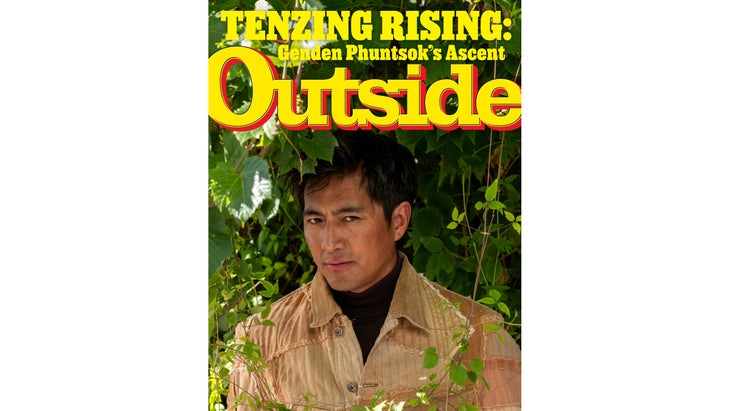
73 Years Later, Tenzing Norgay Gets Top Billing
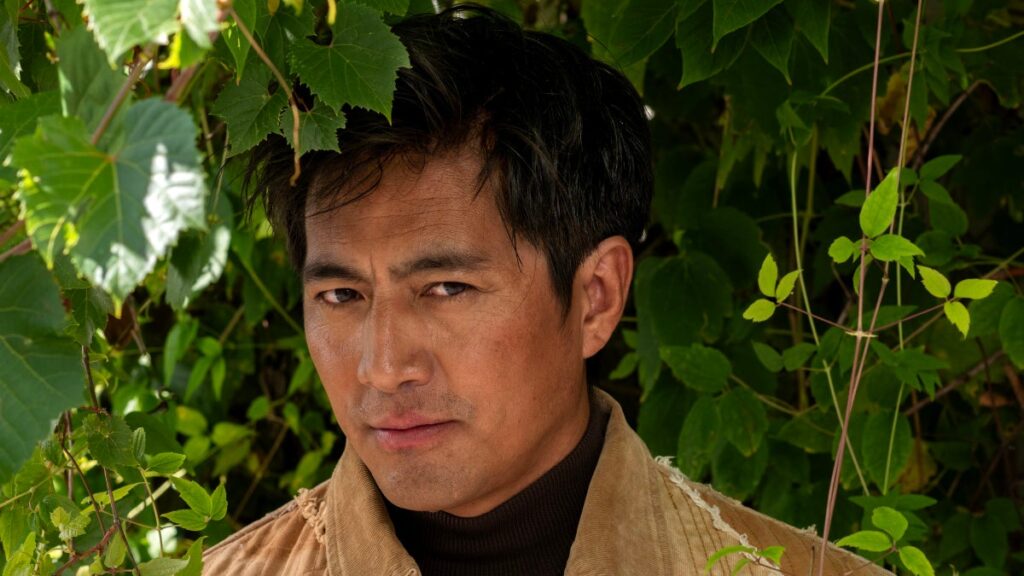
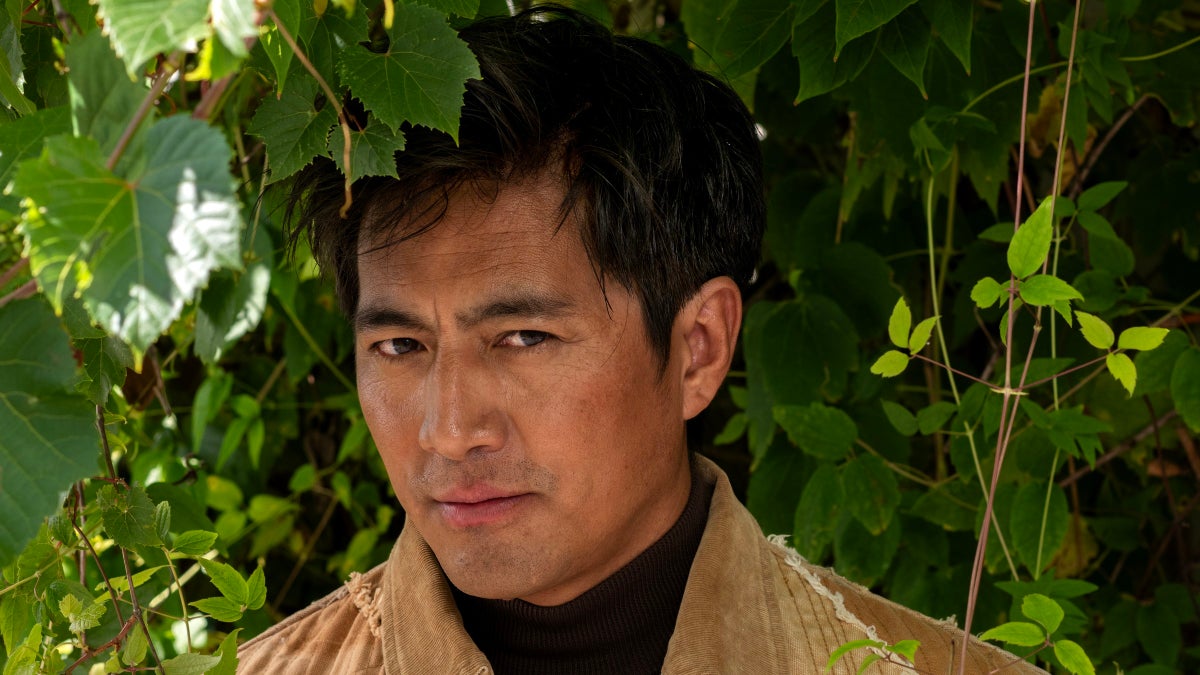
Genden Phuntsok had been walking for a full day.
He was headed down to Lukla, Nepal, and the Tenzing-Hillary Airport, a narrow strip of asphalt at 9,300 feet where sticking the landing can feel like a life-or-death proposition. It was time to meet his co-star. Tom Hiddleston was arriving by helicopter. Genden and his host, the Sherpa mountaineer Phurba Tashi, had hiked down from the village of Khumjung to collect him. Genden had never met a Hollywood movie star. He knew exactly who was stepping off that helicopter.
He walked up, put out his hand, and said: “Hey, Hillary.”
Hiddleston shook it and said: “Hey, Tenzing.”
“From that moment,” Phuntsok told me, “we could feel we were the roles.” They spent the next two days walking back up to Khumjung, running dialogue and reflecting on the history of the trail —the actual approach the men they were about to play once used. This road was really bad back then, they’d say to each other. Not like this. How hard it was for them.
Jennifer Peedom’s Tenzing, in theaters October 9 and on Apple TV October 16, is a rare thing: a movie about the first ascent of Everest in which Edmund Hillary is the supporting role.
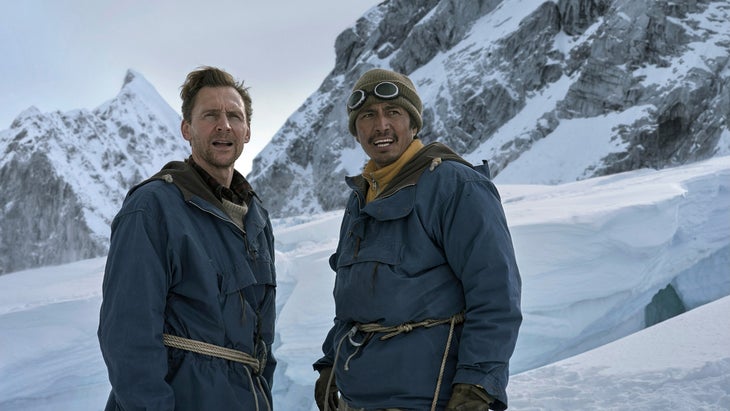
Hillary was the Auckland beekeeper who stood on the summit with Tenzing Norgay on May 29, 1953. He was knighted for it within weeks. Tenzing got the George Medal, and a lifetime of being asked which of them stepped up first. Hillary got the title, the lecture circuit, and eventually his face on New Zealand’s five-dollar note. Yet the only photograph taken on the summit that day is of Tenzing—ice axe up, flags snapping—because Hillary had never taught him how to use the camera, and the top of Everest is not the time for a tutorial. The man in the picture spent the rest of his life as the second name in the sentence.
Peedom’s film is mostly not about the climb at all. It’s about everything Tenzing had to survive just to reach the starting line—a story about family and faith and where a person is allowed to belong. It’s called, simply, Tenzing, and everyone involved seems to have understood the assignment. “Tom knew that the movie was not his movie,” Peedom told me. Willem Dafoe plays expedition leader Colonel John Hunt. The Sherpa climbing team is played by Himalayan actors out of Kathmandu, Canada, San Francisco, and India.
I’ve seen it twice so far and the climbing scenes and mountain sequences are extraordinary, and they’re not what stays with you. What lingers is more subtle: a man moving toward something he believes is holy, surrounded by people who are certain he’s doing something perverse.
And at the center of the whole thing is a man very few people in the West have heard of, who had to brush up his English, learn Sherpa, learn to climb, and carry a film that looks like it cost nine figures. The harder job was the other one: getting Tenzing Norgay’s name back to the front of his own sentence.
Genden is a Chinese actor of Tibetan descent, born on the Tibetan plateau in Sichuan, in a village near Kasa Lake. His family kept yaks and horses and planted barley and potatoes, much like Tenzing Norgay, who herded his father’s yaks in the shadow of Everest as a boy.
“This is just normal life for us,” Genden said, when I asked him to describe it. “But you are really close to nature. My hometown is almost like New Zealand or Switzerland.” Then, because he’s been living in cities: “When you’ve been in a big city for a long time, you recognize that beauty even more.”
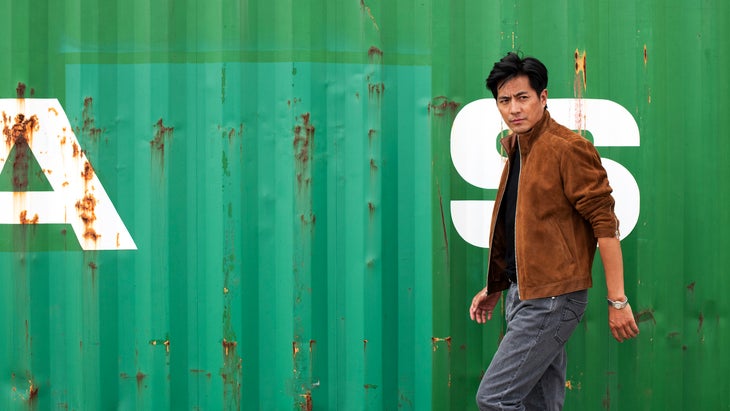
Before he ever auditioned, friends back home started sending him a black-and-white photograph. It was Tenzing on his wedding day. It’s so strange, they wrote. This man really looks like you. Genden’s reading of this is that it was fate. Peedom’s reading is that she’d been watching him for years in the films of the late Tibetan director Pema Tseden—most notably Jinpa, which took a screenwriting prize at Venice in 2018. To her, Genden’s energy was obvious.
“There was this really contained force,” she said, “like Champagne just sitting behind a cork, always about to explode.” The production looked at roughly 2,000 actors around the world. It narrowed to three. Then Genden walked into a hotel lobby in Kathmandu for the workshops, and Peedom knew she had her Tenzing.
Genden wasn’t so sure. After the first audition he flew home to China, assuming he’d lost the part, and then started preparing for it anyway. He read every book about Norgay he could find, in libraries and coffee shops, keeping a notebook for the English words he didn’t understand, looking each one up and rereading the passage. “Some books I read maybe four times,” he said. “Then I really knew what he did.” Eventually the producers called: one more audition, this time in English, in Australia. “I said OK, no problem. I went there, that was the last audition.” He got it.
When I asked whether a part like this had ever been a dream of his, he declined to treat it as one. “You can try hard to get somewhere. But the result is not something you can decide. If you really get the result you want, that’s perfect. If you don’t get it, that’s also perfect—because on the way, you gain knowledge and experience, and that is also the value of your life.”
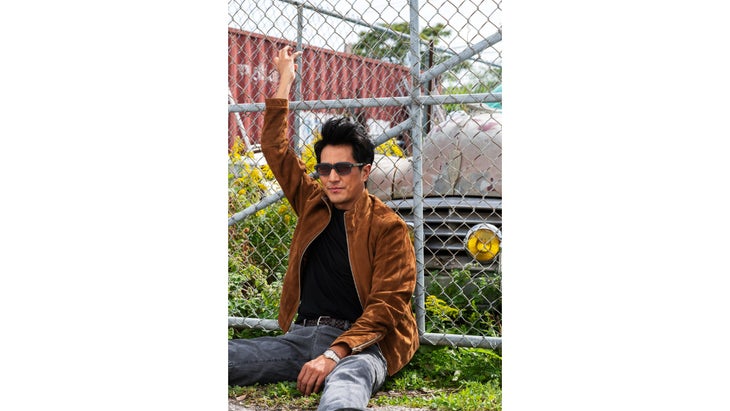
Also, the yaks. I’d heard a rumor he practiced his lines on them, and asked if it was true. “That’s true. I’m like a crazy person. I always say my dialogue to strangers, because I want to see whether they understand what I’m saying in their language.” Strangers, sheep, donkeys, dogs. “I know they don’t understand, but I pretend they are listening to me.” Later, on set, he did this to Willem Dafoe, mid-meal, without warning. Dafoe said, “What?” Genden said, “That is our dialogue.” After that Dafoe ran lines with him whenever he was ambushed, which was often.
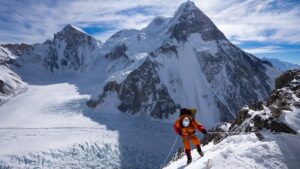
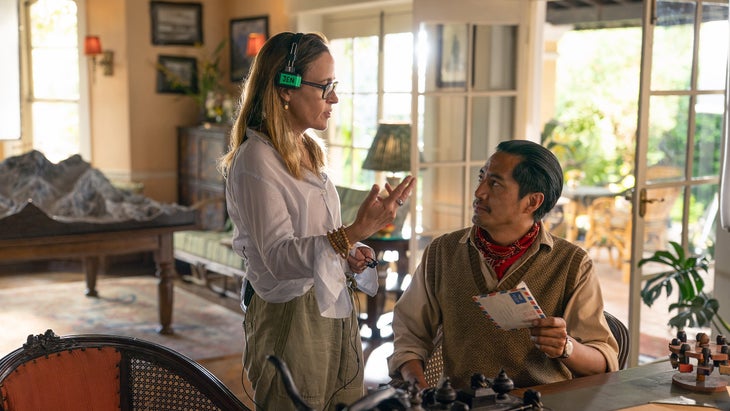
Peedom has been circling this story for a long time. Her 2015 documentary Sherpa put her in touch with Tenzing’s children and grandchildren, and it convinced her that the story she actually wanted—everything Norgay’s life before the expedition—couldn’t be told as a documentary, because none of it exists in any archive. So it became a drama, with the blessing of Tenzing’s eldest son, Norbu, who came aboard as an executive producer. Her line in the sand was that none of the mountain would be shot on a stage. Everything from base camp up was filmed on real glaciers and real ice cliffs in New Zealand’s Aoraki/Mount Cook region, with plates shot on the actual Everest dropped into the deep background. The summit is Hochstetter Dome. “All real and practical,” she said. It looks it.
Her philosophy about actors is the same one that governs her documentaries: “Memory is more powerful than imagination.” If you want someone to play a Sherpa sirdar, you don’t ask him to imagine it. You send him to Khumjung.
So Genden moved in with Phurba Tashi, one of the great sirdars of Everest, who has summited the mountain 21 times, and who stopped only after his mother, who had begged him for years to quit, died while he was up there. “Phurba is really like a tiger,” Genden said. “Endless. He never tires.” Four hours of hiking every day, minimum. The whole household became his dialect coaches. Genden doesn’t speak Sherpa—it’s a cousin of Tibetan, close but not the same—so he’d run his lines for Phurba’s wife until she corrected his accent, then run them again until she understood him, then take them out into the village and test them on the neighbors. Phurba’s young daughter drilled him too. Genden isn’t a father; Peedom says watching Phurba with his kids is where he found the way he’d play Tenzing with his daughters, Pem Pem and Nima.
One day Phurba took him up the ridge across from the village and pointed. “He said: that is Mount Everest. It looks small, but that’s because it’s far away.” Genden stood there. “I was thinking: Oh my God—that is almost the top of the world.” He shot a short video of it. He has watched it many times.
Before he’d met either of his famous co-stars, Genden called Peedom from Khumjung. “He said, ‘Oh, Jen, I feel like I’m carrying the weight of this whole movie on my shoulders. I just feel so much responsibility.’ And I said, ‘You and me both, buddy.’”
The weight had a face. At the puja ceremony that opened production in Kathmandu, Norbu Tenzing met Genden for the first time and, Peedom said, was “just very tearful. He just said, ‘I feel like I’m looking at my father.’” Genden remembers it from the other side. “I had a feeling that we are blood.” He told Norbu that his father was not a normal man, that he was a hero. Then something odd happened. Genden had a hundred stories he wanted to tell these people about the man he’d been living inside for months, and couldn’t. “It was like there was a piece of glass between us. I could see them, but somehow I couldn’t really touch them.”
He carried that into the performance. “Maybe that is Tenzing Norgay now—he is somewhere higher; he can see everyone, but he cannot touch them.”
Before filming, the production also reached Kanchha Sherpa,the last surviving member of the 1953 expedition, who died last year. What Kanchha remembered about Tenzing wasn’t heroism. It was that the man would not stop checking on people. Sherpa, British, didn’t matter. Are you OK? Do you need something?
Genden took that literally. On the walk up from Lukla they stopped overnight in a village teahouse, Hiddleston in the next room, and Genden lay awake worrying about an Englishman’s altitude. Before dawn he heard footsteps through the wall.
Tom! Tom!
Eh?
Are you OK?
I’m OK, no problem.
“And I thought: OK, good.”
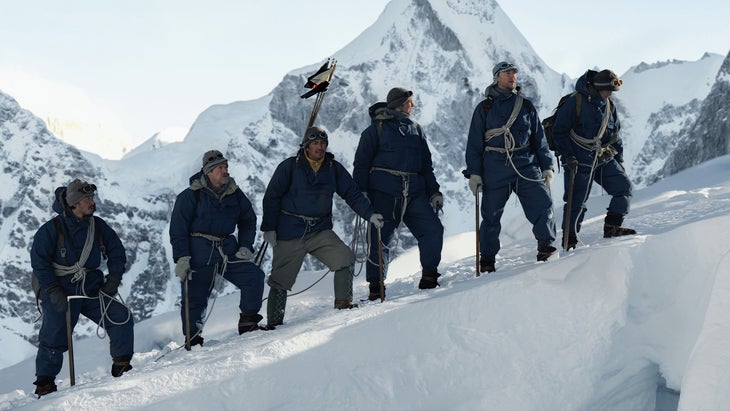
He had never climbed before. Growing up at altitude, working with yaks, swimming all day in a cold lake with a bag of tsampa for lunch—that’s children playing after school, not mountaineering. So the production hired guides who’d summited Everest multiple times and put him and Hiddleston on rock and ice in New Zealand until they looked like they belonged there. Then they dressed them in 1953 gear: leather boots, wool, crampons with all the bite of a butter knife.
The crevasse scene is the one to watch for. Hillary drops in; Tenzing gets him out. Genden had to climb from the bottom to the lip, camera across from him, no stopping. “If I stopped, maybe I would fall.” Three takes. Halfway up one of them he paused and looked down. “Tenzing didn’t have a safety rope, and he was doing this work. If you fall down, you just die.” He talked to himself, kept calm, kept going. He collapsed at the edge. Peedom told him they got the shot.
The summit ridge, meanwhile, was shot in a single take—not for art, but because un-footprinting snow takes a long time for the crew. And the question everyone asks—who stepped up first—the film answers by refusing it: a little after-you, no-after-you joking. Peedom’s position is that for anyone who has shared a rope, it’s “the most ridiculous question, and not even worth asking.” Genden won’t give a position of his own. He defers to the two men who were there. “Our thinking about it was just what Tenzing Norgay and Edmund Hillary said: in their minds, who stepped first is not important. The most important thing is: we summited. Meaning, it’s as if humanity summited.”
He has turned down a climb before. At 23 or 24, guiding back home, he walked two Europeans toward a holy mountain near his village. In his culture you don’t climb the holy mountains. He told them that. They told him it wasn’t a problem for them. “So I said: OK, if you want—I respect you, you can go, but I don’t go there.” They made it about halfway, understood what they were standing in, and came back down. He tells the story without a flicker of vindication, which is what makes it land.
“We are very tiny in front of nature,” he said. “So we should understand that.” He likes a line of Hillary’s: not that they conquered the mountain, but that the mountain accepted them. The film’s version belongs to Tenzing, after Hunt calls Chomolungma an enemy: Where they see mountains, we see ourselves. They are the bones and we are the blood. Peedom workshopped the Sherpa tent arguments with actual climbing Sherpas until one of them said he’d had that exact fight on Everest. A Sherpa anthropologist told her it was the first film she’d seen that let Sherpas show a full spectrum of emotion, including anger.
This is where the film does its most interesting work. Tenzing never argues that people shouldn’t climb mountains. It just builds a world where the question is offered and then leaves you alone in it.
What does Genden want people to take from it? Not a mountaineering tip. “Every Sherpa climbing with a team has a big family behind them—waiting for their husband, their son, to come back safely, every day, every moment. I really hope the world sees this.”
The man on screen is grieving, contained, deep and calm because Peedom asked him to be. The man on my screen, calling from Toronto the morning after our shoot, is someone Peedom describes as “a firecracker,” and she’s right. He wishes Pema Tseden, “really like my father in my career,” who died two years ago, could see the film. “I really want to show him: I did this job.” He’d like to hike to Everest Base Camp; the summit, he says cheerfully, is not for a man his age. He’d like to scuba dive someday, location unimportant: “It’s a big ocean.”
Mostly, when he isn’t working, he goes home to Sichuan and sits with his mother. His father is gone. “Sometimes I miss him and I want to call my father. But no one answers me in this world.” So he drinks tea with his mom and gets her to tell stories from when she was young, and she cooks for him. I asked what. Potatoes, he said. Same as Tenzing grew. What kind?
“Boiled potatoes.”
There was one thing he confessed to regretting. After all those months in Tenzing’s wool and leather, he was too shy to ask to keep a single piece of it. Then he brightened, and let me know he’d be circulating this story and magazine back home. “They’ll say: ‘Oh, we have such a good man.’”
They do.
The post 73 Years Later, Tenzing Norgay Gets Top Billing appeared first on Outside Online.
About The Author