Our Nepal Expert Answers the Biggest Questions About the Devastating Floods
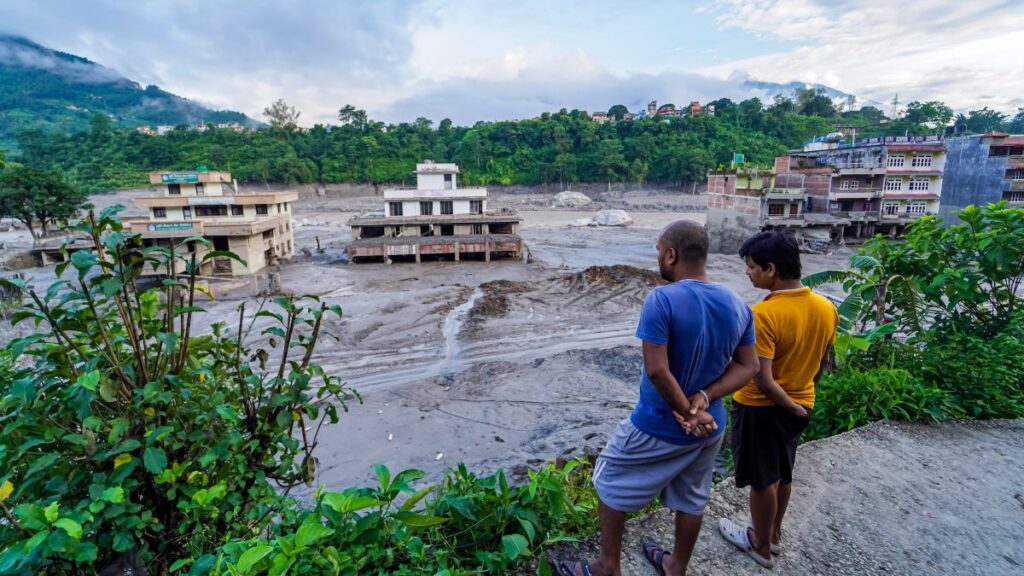
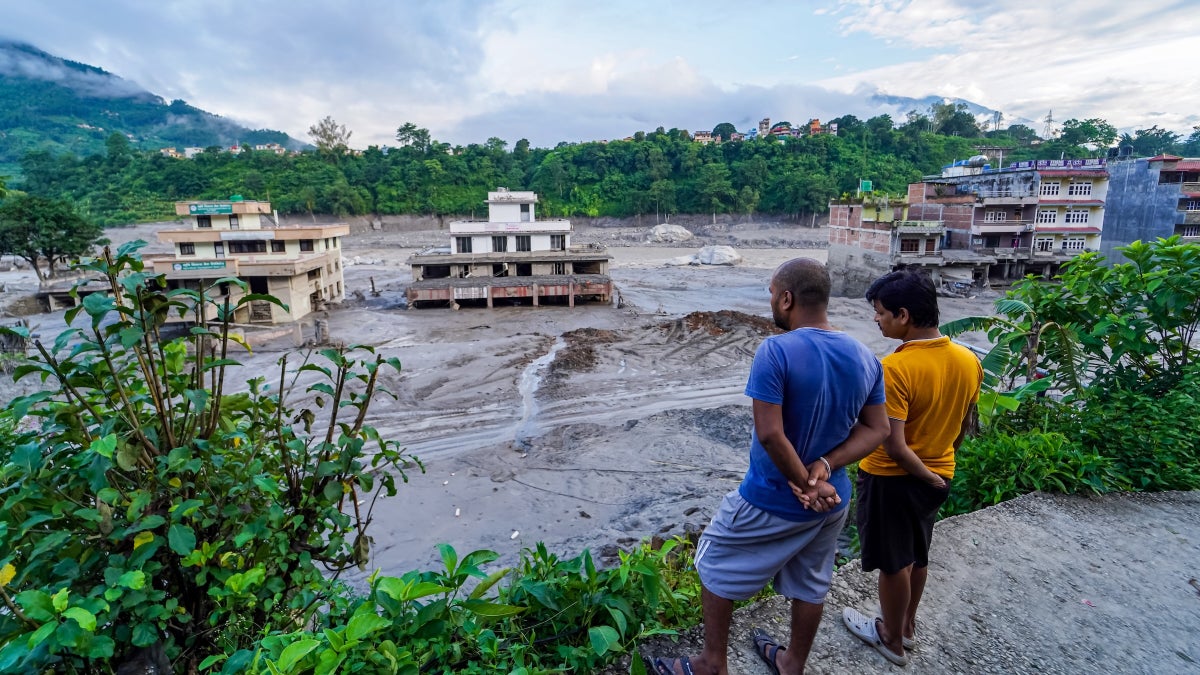
Himalayan regions in Nepal and China are reeling this week, following a devastating flood that swept down river valleys below the high peaks, destroying everything in its path. Videos of the devastating water and landslides has dominated social media this week. As of August 28, the death toll has risen to 580 people, but the number of missing has risen from 900 to 1,900.
Ben Ayers, Outside’s longtime Himalayan expert and Mount Everest reporter, has spent the last 20 years living in Nepal. Ayers participated in the rescue efforts in the wake of Nepal’s devastating earthquake in 2015, and he has traveled to parts of the country impacted by the floods.
Ayers has provided a handy explain of the current tragedy, and has answered some of our—and your—most pressing questions about the disaster.
How did the Nepal flood start?
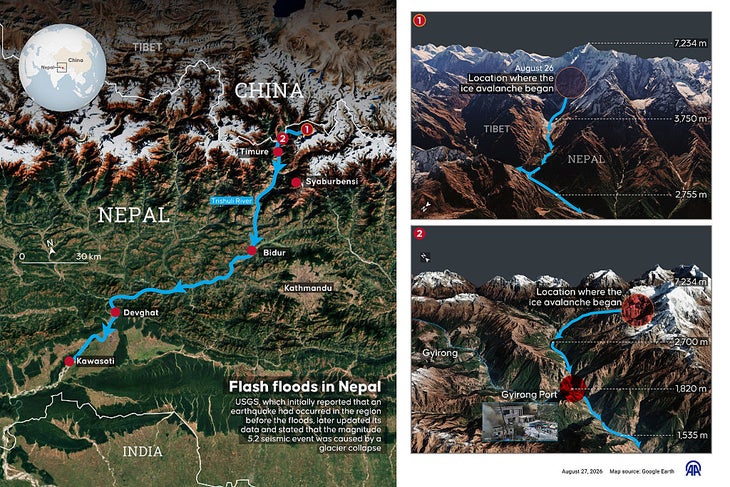
At 8:37 A.M. Nepal time on August 26, an enormous hanging glacier weighing perhaps ten million tons detached from the north slope of the 23,711’ Langtang Lirung in Nepal’s mountainous Rasuwa region, plummeting 6,000 vertical feet to the valley floor. Glacier experts told The BBC that the energy generated by the glacier’s fall was the equivalent of multiple Hiroshima-sized nuclear explosions.
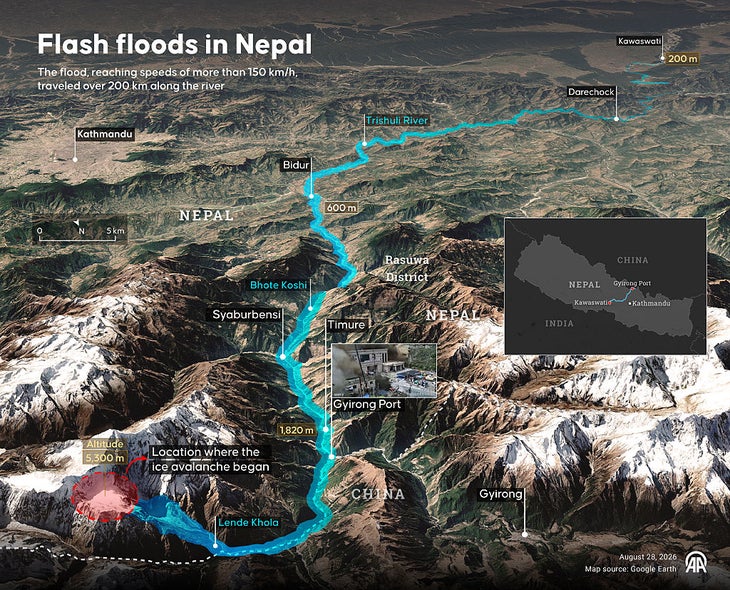
In the moments that it took the glacier to reach the floor of the Lhendekhola river valley, the massive amounts of friction and energy pulverized the snow, rock, and ice into a thick and muddy slurry traveling at enormous speeds. As it descended the steep Himalayan slopes of the riverbed, the slurry swallowed the surrounding glacial till and permafrost, saturated from recent heavy monsoon rains, gathering enormous speed, mass, and destructive power.
Austin Lord, a Senior Fellow at the Stimson Center, who specializes in disaster and climate risk management, and has studied this particular region for over a decade. In an interview with Outside, Lord told me that the glacial debris dammed the river for a few minutes. Water pressure built behind the blockage before the dam burst out in a single, violent wave that surged downstream.
“This event was like a concrete wall that pushed mixed debris and the river ahead of it,” he explained. “Imagine driving a massive snowplow down a river—it was like that.”
Except, by the time this snowplow turned sharply south at the Chinese border with Nepal, and confluence of the Bhotekoshi river, it contained 80,000 Olympic-sized swimming pools of water, and was traveling at over 100 miles per hour.
Then what happened?
The scale of the impact of the floodwaters on villages and roads and other infrastructure is difficult to imagine. Rescue teams report that, in some areas in the upper reaches of the upper Bhotekoshi gorge, the high-water mark is clearly visible several hundred feet above the riverbed.
Massive hydropower projects, earthquake-proof Chinese customs buildings, and entire villages were obliterated in an instant. The floodwaters quickly overwhelmed the region’s early warning systems for flooding, and anyone in the river corridor—including many foreign tourists—had very little chance to escape.
The wall of water continued down into the Trishuli river, one of Nepal’s most important, and sacred, waterways. It ripped through concrete highway bridges, miles of cropland, and numerous small urban areas that have popped up across Nepal’s middle hills in recent years. The floodwaters destroyed the lion’s share of the communications, power, water and road infrastructure along the river, leaving thousands of people stranded with no options for rescue.
Nepal is no stranger to these types of events. In 2025, another flood down the same valley killed 18 people and caused extensive damage to the China-Nepal border crossing. Farmers in Nepal’s mid-hills region have a saying that translates roughly to “Live in the mountains, and farm on the valley floor.” The local adage means that homes and crop storage are located on higher ground, well out of the way of regular floods. But this flood destroyed the villages in higher ground, too.
My friend Arbindra Khardka, a National Geographic Explorer and field glaciologist from Nepal’s Nuwakot district—one of the areas affected by the flood—recently explained just how unprecedented this flood is.
“When we prepare road infrastructure, we look at annual floods and ten-year floods,” he told me. “Sometimes we look at 100-year floods—meaning that the probability of a flood of a given size happening in a given year is one percent. This was a 1,000-year flood.”
What can you tell me about the region of Nepal that was impacted?
The flood originated along the Chinese border in central Nepal’s Rasuwa district, and then followed the river corridor approximately 150 miles south to the Nepal-India border, significantly impacting communities for at least 60 miles downstream. These communities are ethnically and culturally diverse, with Tibeto-Burmese languages spoken by Buddhist communities in the mountains, and numerous Indigenous and Nepali-speaking Hindu groups residing further down the valley.
Rasuwa is a mountainous area, and it is the launching point for the popular Langtang trekking trail. This famous hiking route draws hundreds of backpackers and climbers into the region each fall and spring. The river corridor is also an ancient trade route, connecting Nepal’s fertile plains to markets in China and Tibet.
Today, this route is a popular border crossing for tourists and travelers heading to Tibet to climb the northern slopes of Mount Everest, or to visit the sacred Mount Kailash. Mount Kailash is a holy pilgrimage site for Hindus and Buddhists alike.
Since 2026 is the auspicious Fire Horse year in the Tibetan and Chinese astrological calendars, the region has seen an enormous increase in pilgrims along the route. Usually, they make this trek during the warm summer months. The Indian spiritual leader Jaggi Vasudev, also known as Sadhguru, told his followers and the media on August 27 that 80 members of pilgrimage groups affiliated with his foundation were still missing after the flood.
Has this kind of flood ever happened before?
Tragically, yes. But not exactly at this scale.
When the same region was hit by a 7.8 magnitude earthquake in 2015, another massive hanging glacier detached from the southern slopes of Langtang Lirung— the same mountain where the 2026 flood originated. In 2015, the glacier completely obliterated the village of Langtang, claiming the lives of around 300 local residents and trekkers.
In 2025, on July 8, a glacial lake burst in another tributary of the Bhotekoshi and flooded the same corridor as in 2026, killing 18 people. Over the past ten years, there have been numerous massive flooding events across the Himalaya that have killed thousands, including another hanging glacier collapse that tore through the Rishi Ganga valley in Uttarkhand, India and claimed over 200 lives.
A recent assessment by the International Centre for Integrated Mountain Development (ICIMOD), a Himalayan research non-profit, claims that Nepal’s glaciers are melting twice as fast today as they were only 20 years ago.
It’s seems evident that, as our climate continues to warm, these types of unthinkable, 1,000-year events will become more and more commonplace. Unfortunately, we need to treat this event as a demonstration of the real effects of the climate crisis, and a sign of what’s to come.
Is this region close to Mount Everest or any other famous peaks?
The Langtang mountain range is easily visible from Kathmandu on a clear day. A number of the 6,000- and 7,000-meter (19,600 to 23,000 foot) peaks in this area are regularly climbed by adventurous tourists and climbers, but they don’t see anything close to the crowds that travel to Mount Everest or Nepal’s other 8,000-meter peaks.
While Mount Everest is quite far away from this region, which is in Eastern Nepal, the closest 8,000 meter peak is 26,781 foot Manaslu. That’s approximately 60 miles to the West of the valley.
Manaslu is seen as a training peak for Mount Everest, and attracts enormous crowds in the fall season. Many climbers are already on the mountain, fixing ropes to the summit and establishing an elaborate Base Camp for the nearly 400 permitted climbers who will attempt the mountain this year. While the Manaslu region was not directly impacted by the floods, road access to the area and the diversion of helicopters to rescue operations could well delay or otherwise impact the climbing season.
Why is this disaster creating such a problem for rescuers and emergency responders?
For starters, the scale of the damage and loss of life is overwhelming. Secondly, all communications infrastructure—cell phone towers, internet, and electricity—has been completely wiped out.
The initial wave of Nepali rescue personnel was overwhelmed by the sheer scope of need, and the difficulty finding survivors along the massive swath of destruction left by the flood. The only option for rescuers to reach the impacted areas is currently via helicopter, or on foot. This severely limits the number of rescuers on the ground. It also drives up the cost of the recovery.
The nature of the damage, too, is extraordinary. For example: the river corridor was home to numerous large hydropower projects, some fully operational, and others still under construction. As of now, 933 hydropower workers at these various power plants are still missing. In the complex tunnel systems of these projects, workers could feasibly have survived the flood. They may still be impossible to reach by rescue crews, and they have no food or water, and no means of sending out word about their whereabouts.
Despite the challenges, the Nepal government has mobilized over 15,000 personnel to the area and is using helicopters, heavy equipment, and thermal drones to locate and rescue survivors. In the past three days, almost 2,000 people have been rescued by helicopter alone.
How is the Mount Everest guiding industry reacting to the flood?
The mountaineering and guiding industry in Nepal has mobilized to respond to the flood and join the relief efforts as needed. A group of highly trained IFMGA-certified mountain guides have been on standby at the airport in Kathmandu, should any survivors require high-angle or longline rescue.
Many people in the industry are suffering an emotional toll from this disaster. Guides and mountain workers frequently moonlight as leaders on lucrative summer tours to Mount Kailash. Numerous guides and members of the mountaineering community remain missing after the flood.
As someone who lives in Nepal and has traveled widely there, what long term impact do you believe this will have on the country?
I’ve lived in Nepal long enough to know that we shouldn’t make predictions on what comes next. Nepal constantly surprises me, both in terms of the scale of the challenges faced by so many people in the country, and the speed in which people find ways to bounce back and recover.
I do know that this flood has caused billions of dollars of damage to Nepal’s critical infrastructure, including disrupting international trade with China, removing 800 megawatts of electricity from the already-taxed national grid, and hampering travel from the capital of Kathmandu to much of the center of the country.
On a local level, we can still only guess at the actual scope of the destruction and what the final death toll will be (as of August 28, it’s at 579). The psychological toll on families and communities of survivors is unfathomable.
This incident also came in the middle of the monsoon growing season, which is a crucial time for food security for a majority of families along the river corridor. Many survivors will be facing an oncoming winter without homes, employment, or food and will be dependent upon aid from a Government and international community that we know from past disasters, tend to have a distressingly short attention span.
Nepal’s heavy reliance on remittance money sent back to the country from young people working abroad to sustain its economy may actually be a blessing in disguise here, as it will provide many affected families with a reliable source of income to get back on their feet again. But the immense costs of reconstruction or, even funeral expenses for loved ones will necessitate that those families stay separated for longer.
While this event may be something that, geologically speaking, only occurs once in a thousand years – for so many of the affected families and communities, the next few years will feel much longer.
If you want to support relief efforts for affected communities in Nepal, you can donate to the official Government of Nepal relief channel here.
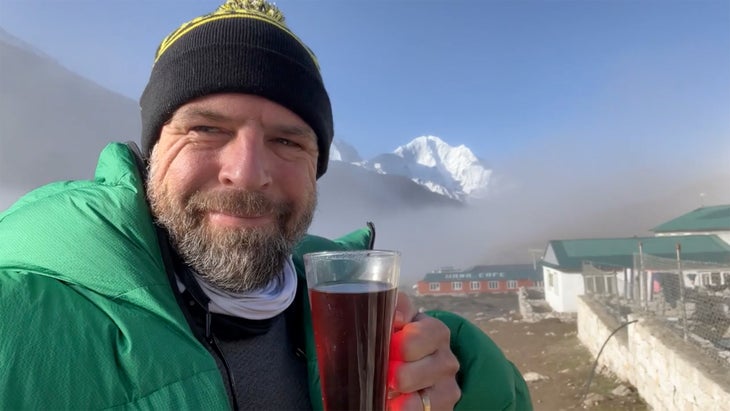
Ben Ayers splits his time between Vermont and Kathmandu. He oversees Outside’s coverage of Mount Everest climbing, and spent the 2025 and 2026 climbing seasons reporting from Base Camp. Ben is also the cofounder of EverestLive.
The post Our Nepal Expert Answers the Biggest Questions About the Devastating Floods appeared first on Outside Online.
About The Author