These Guys Are Searching the Pacific Northwest for Bigfoot. I Tagged Along.
The forest sounds empty, but I know it’s not. Earlier today, I’d walked along the lakeshore and seen hoof prints, a cougar track, and coyote scat.
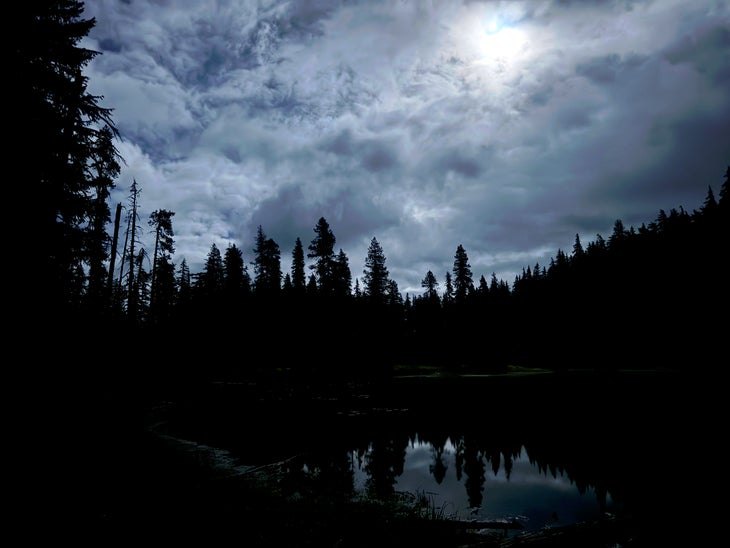
The trees have all turned black beneath the night sky. The only light comes from the full moon creeping through clouds. I’m deep in Washington’s Gifford National Forest and it’s so quiet I can hear my own heartbeat.
No creature is giving its location away by making noise—but we certainly aren’t alone as we stand on the edge of a lake, its waters as dark as midnight. I look at the shadows between trees and wonder what’s hiding in the forest.
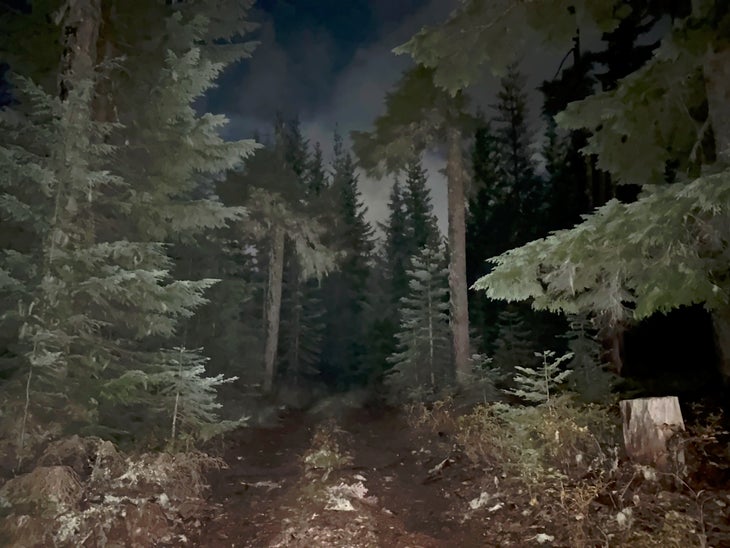
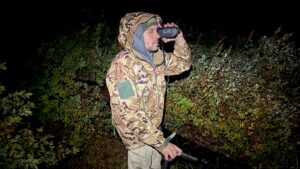
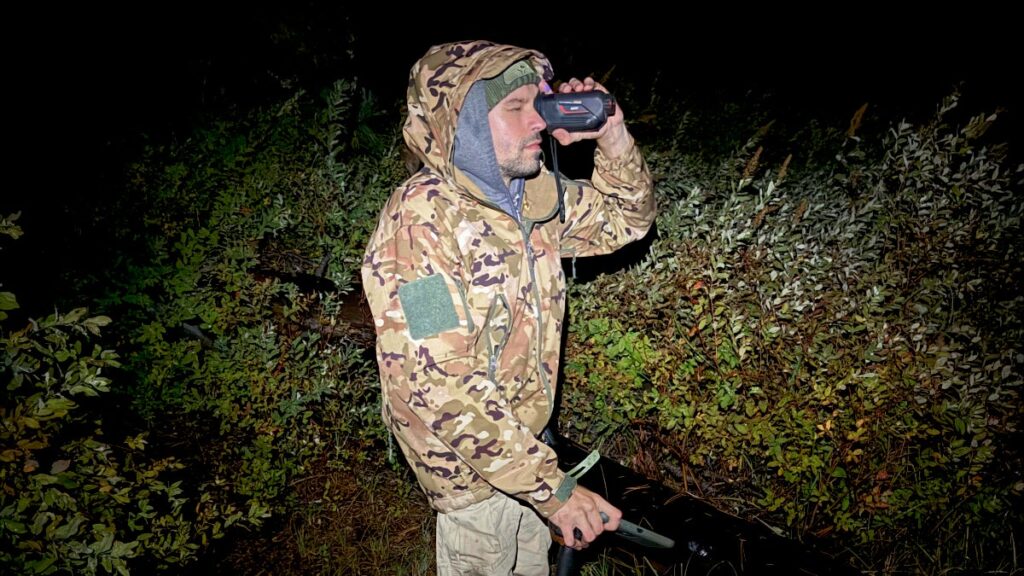
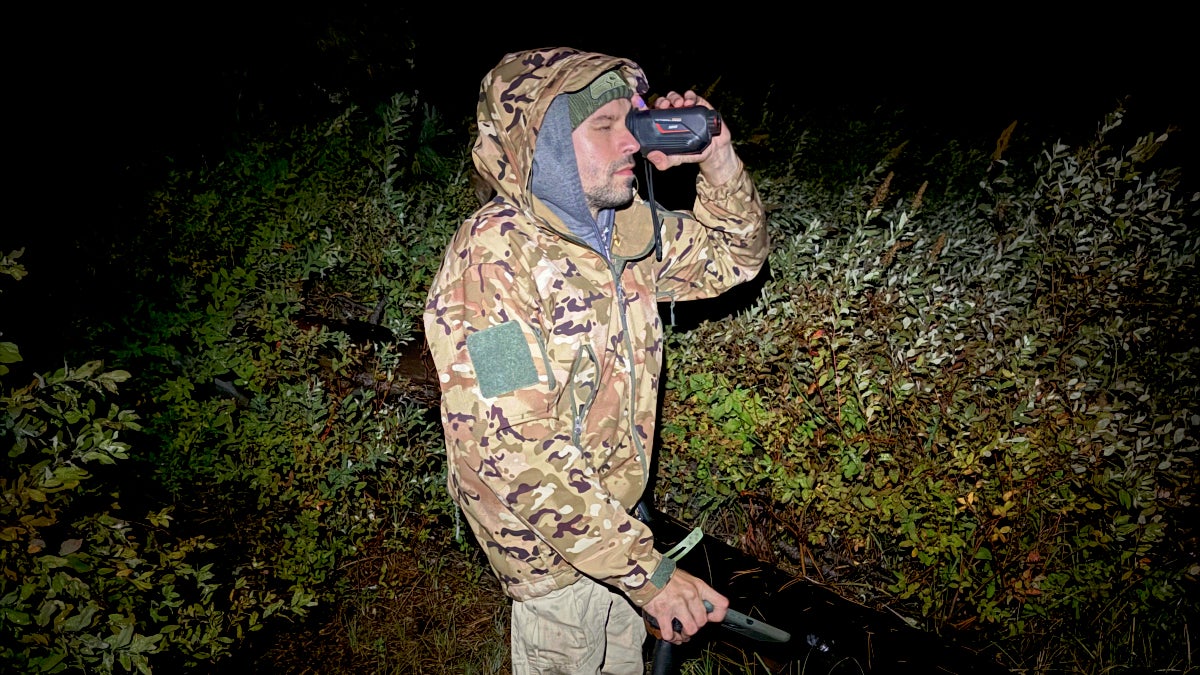
Beside me, Tanner Hoskins raises a thermal scope to his eye and scans the trees to look for heat signatures. He pauses as he sweeps to the far corner of the lake.
“I think I’ve got something moving,” he says.
For the last six years, Hoskins and a group of friends have been searching the Pacific Northwest’s wilderness for an answer to that very question: What else is out there?
And I’m tagging along for a weekend to see what happens when I go looking for evidence of the unknown.
About two miles away, as the crow flies, a dispersed campsite is tucked into a grove of pine trees.
On a July night in 2020, decades-long buddies Kelly Stolp and Mike Palagi sat around a fire with Stolp’s sons and Palagi’s fiancée. Flames licked the black sky as they laughed into the night. It was a familiar scene for the friends, who met in the Army in 2005.
Stolp retired to his tent while the fire was still crackling. Deep in the night, he heard a loud, guttural howl—it sounded like a car engine trying to turn over. Then, footsteps. Slow and steady, getting closer to his tent. They seemed too loud to be human. More stomp than step. He could feel each footfall hit the earth. But he knew, without a hair of doubt, they were coming from a two-legged creature.
Stolp grew up on a 35,000-acre ranch in Montana. He’s hunted for decades and recreated outside since he could walk. He went on his first backpacking trip at the age of 12. He’s an avid outdoorsman and familiar with all of the wildlife that roams the West. A grizzly bear once came into his camp. But in that moment, he knew he wasn’t hearing a bear, nor a cougar, elk, or coyote.
Stolp listened as the creature approached his tent, brushing up against the huckleberries just feet away. It was only 50 degrees, but he was covered in sweat. Then, he heard the footsteps disappearing up the dry creekbed that winds past the campsite.
The next morning, he told Palagi, “Something came through camp last night.” It was large and two-legged, he went on. Palagi laughed, said he didn’t hear anything, and pointed at the empty bottle of whiskey as an explanation. Stolp dropped the topic for the rest of the day.
He could feel each footfall hit the earth. But he knew, without a hair of doubt, they were coming from a two-legged creature.
But at 3 A.M. that night, Stolp heard the footsteps again. Thump. Thump. Thump. The same guttural howl was now coming from two different spots.
He sat up and said, “Mike. It’s back.”
He heard a gun racking, then: “Kelly, I’m up.”
“Two legs or four?”
Palagi didn’t hesitate: “Bipedal, man.”
“How big?”
“Really fucking big.”
They rolled out of their tents. Stolp shouted, “We’re armed, show yourself.”
Palagi and Stolp both trained as military snipers and knew how to clear a space. They moved through camp, weapons ready. They found nothing, but the two men, who don’t scare easily, passed the rest of the night in their cars.
“I’ve spent my entire life outdoors and encountered everything the wilderness has to offer,” said Stolp. “But I’d never slept in my truck, not even when a grizzly came through my camp.”
They tried to recreate the stomping sound in the morning. They were not small men. Palagi played football in Montana as a defensive lineman, and Stolp looks like he could have been on a team, too. But even when Palagi jumped with his full body weight, he couldn’t come close to what they’d heard.
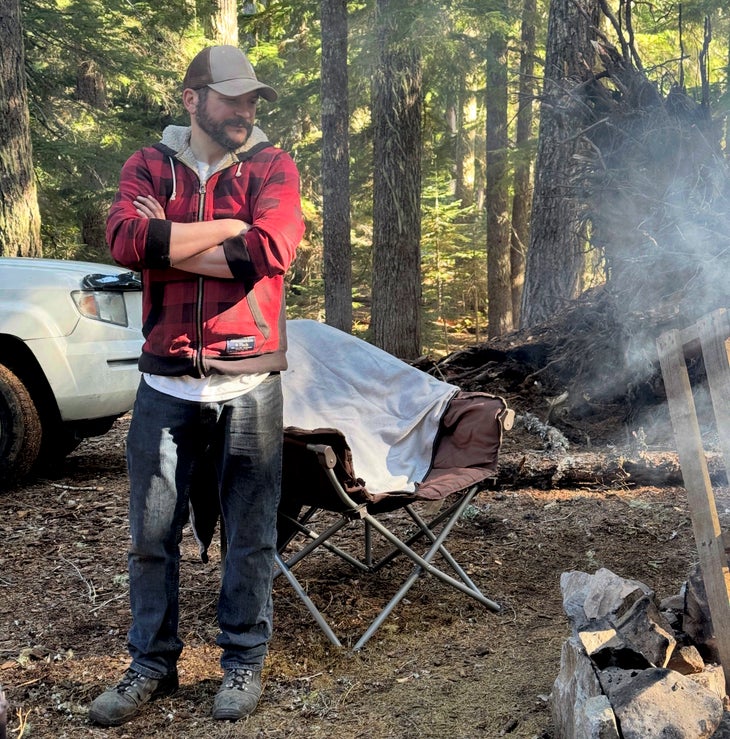
Stolp headed to the Shriners Children’s Hospital in Portland the next Monday, where he worked as an electrician alongside Palagi, a maintenance engineer. He pulled his coworker, a security guard named Hoskins, aside.
“But you have to promise you won’t tell anyone,” he told Hoskins. He knew how ridiculous the story sounded. He didn’t want anyone to think he believed in Bigfoot.
But Hoskins was more of a believer. While he was growing up, his great-grandmother had warned him about “hidebehinds,” a large, mysterious creature that was blamed for the disappearance of loggers in Idaho. Stolp’s story, when added to ones told by his great-grandmother, made him wonder if the Pacific Northwest was home to similar creatures. Hoskins swore he wouldn’t say a thing. Then he went home and built a website for the Pacific Northwest Bigfoot Search, telling anyone who found it about his friend’s story—and inviting others to share their own.
Tales of large, mysterious, forest-dwelling creatures have swirled around the world for centuries. Bigfoot’s other most-used moniker, Sasquatch, is an anglicized version of “Sasq’ets”, a word from the Coast Salish People, a tribe that lives in British Columbia. Versions of this mythical being, which goes by many different Indigenous names, have traveled across generations of stories, as both a large, hairy animal and a spiritual guide.
Today, Bigfoot has grown into something else entirely—as has the hunt to prove Bigfoot exists. Its likeness has been slapped on stickers, shirts, and road crossing signs. The Bigfoot subreddit boasts nearly 300,000 members. There are Bigfoot podcasts, conferences, symposiums, and a seven-night Bigfoot cruise that features daily lectures with Bigfoot researchers. Animal Planet released 11 seasons of the popular show Finding Bigfoot, and the Travel Channel has aired 59 episodes (and counting) of the docuseries Expedition Bigfoot.
There’s no question that Bigfoot has captured the imagination of many, but whether Bigfoot has any foothold in reality remains a mystery.
There are thousands of reports alleging Bigfoot’s existence; most of them focus on one creature, though the common belief within the Bigfoot community is that Bigfoot encompasses an entire species, like wolves, bears, or cougars. The Bigfoot Field Research Organization has collected more than 5,000 sightings through its online database. Washington state leads the charge, with over 700 reports. For decades, people have circulated grainy photographs, videos, and stories. But if Bigfoot is real, he (or she) remains elusive and incredibly camera-shy.
Bigfoot hunters, like Hoskins and crew, want science to back them up. “Science wants a body” is a common refrain in Sasquatch circles. Most aren’t actually rooting for the death of Bigfoot, but if he happened to peacefully pass away in an easily findable location, that would really help them out.
Bigfoot hunters might be lacking scientific proof, but they do have some trained scientists on their side, including tenured professors like the late anthropologists Grover Krantz and Jeffrey Meldrum, who both spent years researching the creature. Even Jane Goodall said she was open-minded about the existence of Bigfoot, and believed some of the stories she heard, adding that it was compelling that every continent has stories about a Bigfoot-type creature.
When Hoskins launched the website for the Pacific Northwest Bigfoot Search, he invited people to submit tales of their own encounters. He shared the site widely through social media channels and online Bigfoot groups, as well as in more general outdoors, fishing, and hunting forums. He also used geotags on Instagram during the group’s early searches, which generated some of the first reports from people who’d experienced supposed encounters near the same areas.
Since 2021, Hoskins and the rest of the Pacific Northwest Bigfoot Search have received 287 reports via the website and social media, covering everything from footprints and vocalizations to alleged sightings. “You have to take a lot of them with a grain of salt,” he told me. But he finds some reports compelling, especially the ones from people who want to remain anonymous, like loggers, law enforcement, and government employees.
The Pacific Northwest Bigfoot Search has grown beyond solely an online database. The crew has headed out regularly, every month or two for the last five years, looking for evidence of unknown, large, bipedal creatures across the Pacific Northwest. The four men behind the Pacific Northwest Bigfoot Search include Hoskins, Stolp, and Palagi, who all once worked at Shriners together, along with Alberto Quinones, a warehouse manager who married Hoskins’ cousin. They’ve all become best friends, Hoskins says.
At 30 years old, Quinones, who usually sports a black hoodie and mustache, is the youngest of the group. Stolp, 48, is the oldest and a father of two, who commutes to Texas where he manages a multibillion-dollar construction project. He’s been out of the Army for over a decade, but his haircut could probably still pass a military inspection. His Army buddy, Palagi, likes to challenge his friends to cook-offs and lives with his three cats and dog at his home outside Portland. And Hoskins, also a father of two, is the de facto leader. He doesn’t relax until everyone’s made it to camp and always requests texts to make sure everyone got home safe after a trip. He likes to say that he “looks like a cop,” though he was denied a career in law enforcement because of severe scoliosis and an amputated right leg.
The four men don’t seem like typical Bigfoot hunters. For starters, half of them don’t think Bigfoot is real. Palagi calls himself the greatest skeptic of the group, saying, “I’ll drill holes in their theories all day long.” And Stolp is quick to clarify that he “doesn’t believe in that shit.” As for that camping trip in 2020, Palagi has an explanation: “A deer pouncing with both legs.”
And the loud, guttural howl: “A territorial bullfrog on the deer’s back.”
Even Hoskins, who spearheaded the formation of their Bigfoot search, says he’s only at 80 percent on the Bigfoot-believometer until he sees one for himself.
A washout pitches my car sideways at a precarious angle. A tunnel of overgrown bushes and trees scratches at my van. The rutted old logging road I’m following, full of creek crossings and potholes, turns my drive into a carnival ride. Hoskins warned me I’d need the right rig to get into camp to join the crew for a two-night Bigfoot search. I’m driving my 2011 Toyota Sienna, to which, Hoskins tells me, “I’ve never seen a minivan on that road.” But it’s all-wheel drive and equipped with an aftermarket lift kit and beefier tires for extra clearance. So far, it’s getting the job done, even if my heart rate is accelerating with every ditch I have to drive over. I wonder if this will be the scariest part of the weekend.
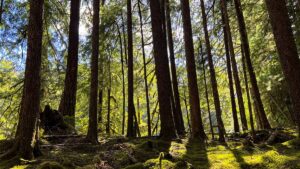
As I drive farther into the Gifford Pinchot National Forest, the trees seem to grow taller and thicker as the road narrows. I’m 47 miles from the nearest gas station, and each washout feels like a “do not enter” sign. I can’t help thinking that this densely wooded forest in the shadow of Mount Adams is where I’d come if I never wanted to be found.
I’m not a Bigfoot believer. But I’m curious about some of the stories I’ve heard that don’t have an easy explanation. Like, what exactly stomped through the guys’ campsite in 2020, howling like no creature they’d ever met.
The 1.3-million-acre Gifford Pinchot, where I’m meeting Hoskins and crew, is a hotbed for Bigfoot reports. It’s home to the aptly named Ape Canyon, where gold prospectors allegedly encountered seven-foot apelike animals in 1924. There’s also Skookum Meadows, where scientists found a body imprint left in the mud in 2000 that they attributed to an “unknown primate” because they couldn’t connect it to any animal. There were so many Bigfoot reports around here in the 1960s that Skamania County passed an ordinance to protect Bigfoot from harm, punishable by jail time or a hefty fine, which still stands today. The original ordinance acknowledged the increasing volume of “well-armed” Bigfoot hunters and expressed concern that said firearms could threaten both Bigfoot and humans traveling through the area.
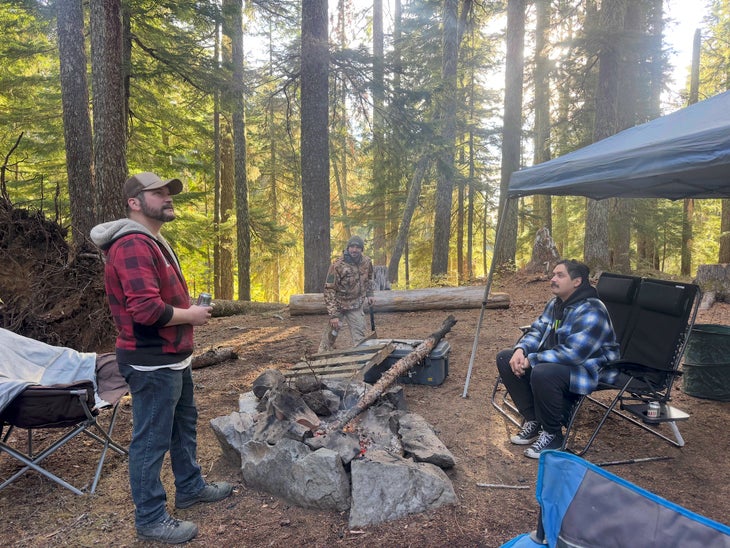
Finally, the narrow road opens to a small clearing in the trees, where two vehicles are parked a stone’s throw from a fire ring. Hoskins and Quinones are tossing wood onto a campfire. The ground is damp from 24 hours of rain. This summer’s fire ban has been lifted, and the group is taking full advantage.
At five-foot-two, Hoskins is about a foot shorter than Quinones. His work pants hang loose over his prosthetic leg, and he holds a walking stick in his left arm. He moves around the campsite with confident steps as he grabs his chainsaw and returns to the pile of firewood.
I walk over and see that a folding table is covered with their go-to supplies for Bigfoot hunts: thermal scopes, drones, casting materials, trail cameras, and audio recorders.
Hoskins has a handgun on his hip. Quinones has a shotgun in his car. They’re always armed, says Hoskins, though more for humans than Bigfoot. He mentions the Green River Killer, who murdered 49 women in the Pacific Northwest in the eighties and nineties, and left some of the bodies in the forests, which were later found by hikers.
It’s not unusual for campers to be armed in the woods this time of year. It’s hunting season in Washington. I’ve got a bright pink fleece and neon orange hat packed, thanks to Hoskins reminding me to bring colorful gear. He, on the other hand, is wearing a camouflage jacket and light brown pants. Quinones is dressed in all black.
“Bigfoot hunting is like playing the lottery, and the only way to really play is to go camping.”
As Hoskins fiddles with the thermal camera, he tells me that it took four years after that first encounter for them to find anything that could be pinned to Bigfoot. Fittingly, it was a big footprint, measuring 16 inches from heel-to-toe and 7 inches wide, that they stumbled upon in the woods. That’s roughly equivalent to a U.S. men’s size 26.
“That’s a long time to keep looking with no results,” I say.
“Well,” Hoskins starts. “There are only 2,000 Bigfoot creatures across North America.”
It’s unclear how exactly that estimate was generated, considering there isn’t definitive proof of a single Bigfoot. It’s also unclear what the plural of “Bigfoot” is. Bigfeet? Bigfoots? Bigfootuses?
“There are 30,000 bears in Oregon,” he goes on. “How often do you see one?”
I think back to the last bear I saw. It was in May. And the only one I’ve seen this year, despite spending most weekends, and plenty of weekdays, on trails around my home in Oregon.
“Bigfoot hunting is like playing the lottery, and the only way to really play is to go camping,” says Hoskins.
“I mostly said yes to my first search because I love camping,” says Quinones, who tells me that he grew up in a family that sees the outdoors as more of a threat than a fun pastime. When he moved to Sherwood, Oregon, from Los Angeles as a teenager, his main social options were hanging out in parking lots or around trees. “I chose trees,” he says and gestures at the many pine trees towering over us.
“I’d stopped getting outside until Kelly shared his encounter,” Hoskins adds.
Hoskins says he used to love driving deep into the forest and spending the night outside. But in his twenties, he fell into a different routine. Most of his friends preferred video games or dive bars to camping trips.
After Stolp told him about his 2020 encounter, Hoskins seized the opportunity to drive his rig back into the woods and set up camp. He also lost his great-grandmother in 2021, who was a parental figure through a childhood affected by addiction. He found himself even more drawn to the outdoors after her death.
“I spent weekends in the trees just screaming, crying, and staring at the fire,” he says. “I think being out here is the best thing for you when you’re going through shit; your mind actually has space to process what you’re feeling.”
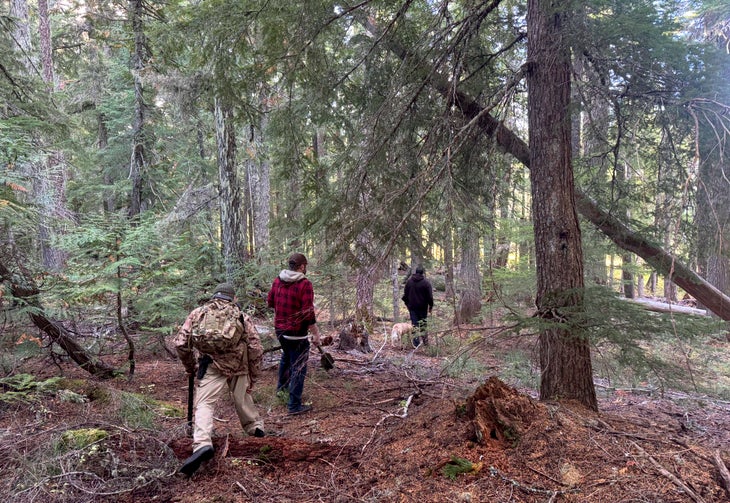
He’s not the only one in the group to use these camping trips to process grief, stress, or other hardships. “Some weekends, we’re all just sharing the tough things we’re going through around the campfire,” he says.
“It feels like the only place we can talk about everything, down to the really, really hard stuff,” says Stolp.
“The news is garbage, social media is garbage, everything is garbage,” Stolp continues. “The only thing that feels real and meaningful, other than my family, is going into the woods with my buddies. I think a connection with the outdoors is probably what a lot of the world is missing.”
Hoskins sweeps his arm around the campsite, which, short of the thermal scope and casting materials, looks like any weekend campsite, with camp chairs, packed coolers, and plentiful BBQ fixings. This location is a favorite of the group, I’m told, both for its idyllic setting on an alpine lake and for the ideal Bigfoot terrain that surrounds it: remote wilderness, very few humans, and thick forests. Also important is what they all describe as “weird energy.”
“Something about this camp is just creepy,” says Palagi. “At night, there’s just a weird feeling, maybe it’s because you can’t see very far. But the energy just shifts after the sun goes down.”
They’ve been to this particular spot so many times that they constructed a makeshift outhouse on a tree stump downhill from camp. Though Hoskins warns me not to use it, thanks to the local fire ant population taking a liking to it.
“I think it’s incredibly important to be good stewards of the land,” Stolp tells me, adding that they often pack out more than they pack in.
Hoskins checks the battery on the audio recorder. We’ll leave it out overnight to see if it captures any “vocalizations,” like the howl heard back in 2020. Bigfoot is also rumored to be a wood knocker, screamer, and whistler, depending on whose accounts you read or hear.
“Witching hour is from 11 P.M. to 3 A.M.,” he says.
I pull my hood up as the rain picks up. The shadows are growing long on the forest floor.
Hoskins tells me he was thrilled to see rain in the forecast for the weekend—not just because it’s good for campfires, but because “rain is great for prints.”
Last month, the group found a 12-inch footprint in the forest adjacent to our campsite. That’s equivalent to a size 14, which is less outrageous than the size-26 print, but still suspicious, according to Hoskins.
“I assume they aren’t born eight-feet tall,” he says. “That would be a very painful birth experience.”
He promises to show me where they found the footprint tomorrow.
“Tonight,” he says, “We’ll go down to the lake after it gets dark.”
The Gifford Pinchot isn’t just a hub for Bigfoot activity.
In 2021, a family reached out to Hoskins because their loved one, Glenn Austin Oldfield II, had gone missing in 2015 while camping alone in the Gifford Pinchot. When they saw the group was spending so much time in the same area, they asked if the Bigfoot hunters could keep an eye out for any sign of him.
Inspired by the request, Hoskins reached out to the Washington State Patrol, and they sent him a list of 34 people who’d been reported missing in the Gifford Pinchot since 1979.
It was then that the group launched the Pacific Northwest Missing Persons Project to look for evidence of missing persons and bring closure to cold cases. They realized that the same skills they use to look for abnormal footprints and disturbed soil could help them find scraps of clothing or human bones. They search in the Gifford Pinchot and beyond—wherever their hunt for Bigfoot takes them—or wherever there’s a family in need. Hoskins compiled the names of 500 people missing across Oregon, Washington, Idaho, Montana, and California. Every time they go out, they’re armed with lists of clothing and belongings.
“I’ve been told I can’t do a lot of things. But no one can stop me from being out here.”
They see their work as picking up the trail where search and rescue leaves it, since most SAR squads lack the funding to continue the hunt after a mission moves from a search to a recovery.
“I want these families to get the closure they deserve,” says Hoskins.
Many families have gone years without answers. Some of them tell Hoskins they’ve been moved from detective to detective, while others can’t get anyone to answer their calls.
For Hoskins, searching for missing people gives him the purpose he’s been unable to find in his career. Hoskins was born with severe scoliosis and had 14 surgeries as a kid. His right leg was amputated when he was a toddler. He uses a hiking stick to get around, and has to physically lift his amputated leg over many of the logs that we crawl over throughout the weekend.
He wanted to serve in the military or go into law enforcement, but he couldn’t pass the physical fitness tests. He got within 30 seconds of completing the course Oregon requires for police candidates, but no matter how hard he trained, he couldn’t do it any faster. He was denied by every branch of the military, he told me. When he was young, doctors told him he wouldn’t be able to walk or run.
“I’ve been told I can’t do a lot of things,” he said. “But no one can stop me from being out here.”
The Pacific Northwest Missing Persons Project is currently pursuing three active searches and has a waitlist of over 100 families. They’re mostly limited by time and gas money, Hoskins says; he would take on every case if he could. Last fall, they found human bones during one of their searches. They’re still waiting on law enforcement to identify them.
A curtain of mist shrouds the lake in the early morning. The night before, we’d set up an audio recorder on the shore and searched the forest for heat and sound. I don’t know if it was the campfire stories or the “weird energy” vibes, but I wasn’t upset that Hoskins had that handgun on his hip as we slipped into the shadows of the dark forest. Quinones recounted how they once heard a voice, “clear as day,” saying “hello,” as they walked through the woods. It’s part of the legend: Bigfoot will mimic human voices or animal sounds. We didn’t find any sign of Bigfoot last night. Still, I didn’t get out of my van to pee until the sun was up.
This morning, we climb over the deadfall that guards the lake and bushwhack through its marshy edges. We walk over broken tree limbs, foot-long pinecones, and downed logs, looking for disturbances or anything that seems odd: boulders that have been moved, branches that have been woven together, or footprints that seem too big and too out-of-place to be human.
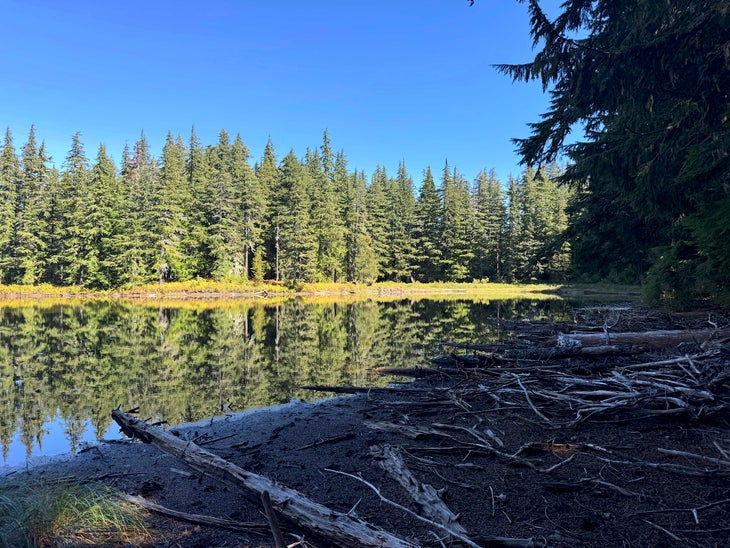
“Basically anything that looks like nature didn’t do it,” says Hoskins. The crew draws from their many years of military service, backcountry hunting, and outdoor navigation to look for clues during their searches.
“I’m constantly scanning 20 feet in front of me, looking for breaks, looking for grass pushed down, watching game trails, seeing if there’s a track,” says Stolp.
As we hike, the guys point at the foliage, which is starting to change color, and the hillside that rises above us. Quinones offers to take me up to the ridge so I can see the view. “It’s just gorgeous out here,” says Hoskins.
I get the sense that if searching for Bigfoot involved cities, smog, and skyscrapers, they’d quickly lose interest.
After a lot of off-trail hiking, we get to the shore of the lake and scan the softer, more malleable ground for prints. There are hoofprints galore. But after searching banks of mud, we spy something much bigger than a hoof.
“That could be a deer butt,” says Hoskins. “But let’s cast it to find out.”
He pours plaster into each depression in the soil. We’ll pick up the hardened casts tomorrow to see if they reveal anything promising, like toes, or a whole footprint.
Hoskins then leads us to where they found a footprint last month. When they discovered it, they had Quinones try to match it.
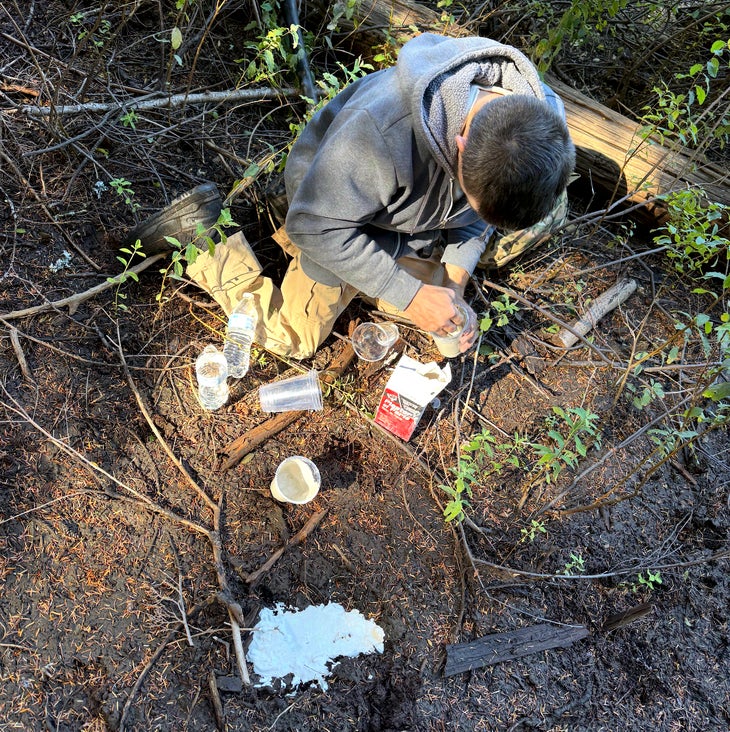
“He’s our go-to guy when we’re trying to gauge whether a large human could’ve left the print,” says Hoskins of Quinones’s six-foot-two height and 250-pound build. “He couldn’t come close.”
“Our first step is to try to debunk anything that we find,” he says. “I can’t say that it wasn’t a human.” Then, he gestures to the ground, which is covered in debris right up to the mud, before sweeping his arm over the lake, which is more bug bog than pristine water.
“But would you walk around here barefoot?”
Palagi shifts his gaze towards the canopy and asks, “You ever look up while you’re out here?” His tone suggests he’s gearing up to spook me, not to point out the scenery.
It’s the next morning, and we’re walking back to the lake to fetch the cast. Palagi drove into camp a few hours ago while an owl was still hooting from a nearby tree. He had to work all weekend, so he told Hoskins he’d get here before we woke up to make breakfast. I thought there was no way Palagi would show up, just to cook us some eggs. Our campsite was a two-hour drive from his home outside Portland, each way. But I saw his headlights cutting through the night while I was still in my sleeping bag. Before I was out of my van, he had his entire camp kitchen out, along with fixings for breakfast sandwiches, and more wood for the fire.
“There’s definitely a crisis going on for men right now,” says Stolp, as he talks about why he keeps coming back to these woods. “And we’ve found a brotherhood through going out in the woods and looking for something that may or may not exist.”
I look up at the canopy and ask Palagi: “Does Bigfoot like to hang out up there?”
“No,” he scoffs. “But cougars do.”
“There’s definitely mystery out here,” Palagi goes on, as he looks around the trees that surround us.
Palagi tells me he plans to stop telling the tale of that camping trip in 2020. He’s sick of talking about something that he doesn’t believe in.
But he’s still out here—and even the “greatest skeptic of all” thinks about that question when he’s walking around this forest, he says: What else is out there?
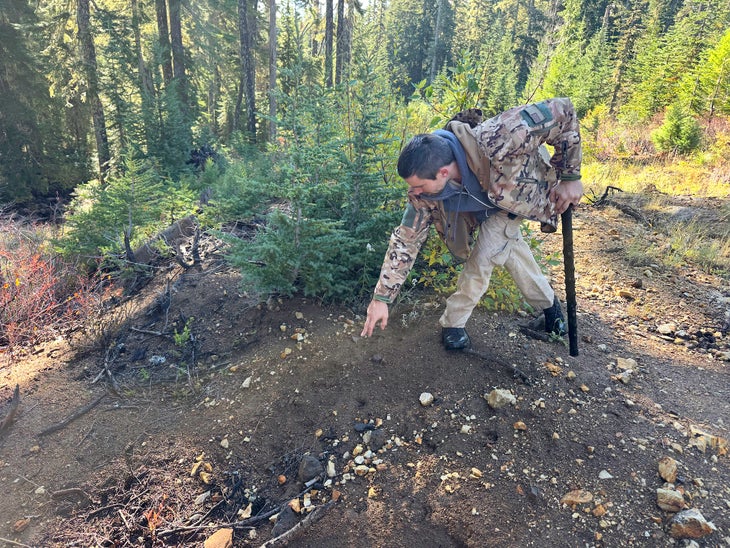
It’s like a treasure hunt every time they come out, Stolp tells me, like being a kid again. And, minus the loaded firearms, this camping trip is reminiscent of scenes from my childhood, when I’d wander through the woods of Vermont looking for my next pirate ship or dragon’s den in the trees and boulders. The possibilities felt endless every time I stepped into the forest.
And maybe that’s a big part of why these guys come back again and again. Whether we believe in Bigfoot or not, there’s an appeal to searching for the unknown. We’re wired to stare at the ocean, the night sky—and a dark forest—and wonder what’s out there. We like thinking about that question, even if it comes with goosebumps on occasion. But it’s easy to lose touch with that in all of the other wires of life.
Hoskins grabs a toothbrush and goes to work on the cast. He gives a play-by-play while he dusts off the hardened plaster, “Indent, another indent.”
When he holds it up for its dramatic reveal, everyone stops talking so he can tell us what he found. I want it to be a large and indisputable footprint. But I know it’s hard to win the lottery on one ticket.
“It’s an unidentifiable blob,” Hoskins says. “Most of them are.” I’m disappointed, of course, but I realize that even the biggest, most undeniable footprint wouldn’t really answer anything. Not even another size 26 track would stop anyone from coming back to the forest—between deadlines, commutes, and night shifts—to walk through the trees and look for reasons to believe the world is still full of wonder.
Emily Halnon is a story collector and teller based out of Eugene, Oregon. She’s the author of the bestselling memoir, To the Gorge, and can often be found sharing snacks and trails with her best friend, Dilly Pickle Chip. Some of her most notable runs include setting a record on the 460-mile Oregon PCT, finishing Hardrock in both directions, and traversing every Domino’s Pizza in Eugene city limits. You can find her online at @emilysweats.
The post These Guys Are Searching the Pacific Northwest for Bigfoot. I Tagged Along. appeared first on Outside Online.
About The Author