“These Aren’t Victimless Crimes.” Vandals Deface Ancient Petroglyphs Near Moab.

The Bureau of Land Management (BLM) announced on November 6 that it was investigating vandalism at two ancient rock-art sites near Moab, Utah, where someone carved names into petroglyphs, leaving damage that may be impossible to remove.
The incidents occurred at the Bear Panel, a rock-art site along Highway 279 near the Colorado River, and another panel near Hell’s Revenge, a popular four-wheel-drive trail in the Sand Flats Recreation Area.
“These images are a physical expression of the past, their connection to their ancestors and to that landscape,” Chris Merritt, Utah’s state historic preservation officer, told Outside. “They will now forever be scarred by someone’s thoughtlessness, and that hurts the continuation of culture.”
The BLM has not publicly identified any suspects in the two latest incidents. An agency spokesperson told the Moab newspaper The Times-Independent that the agency planned to treat the graffiti in the days following its November 6 announcement, although some damage may be permanent.
Under the federal Archaeological Resources Protection Act, vandalizing protected archaeological sites can carry fines of up to $20,000 and two years in prison.
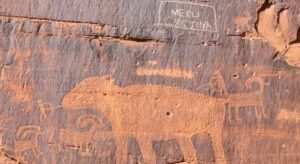
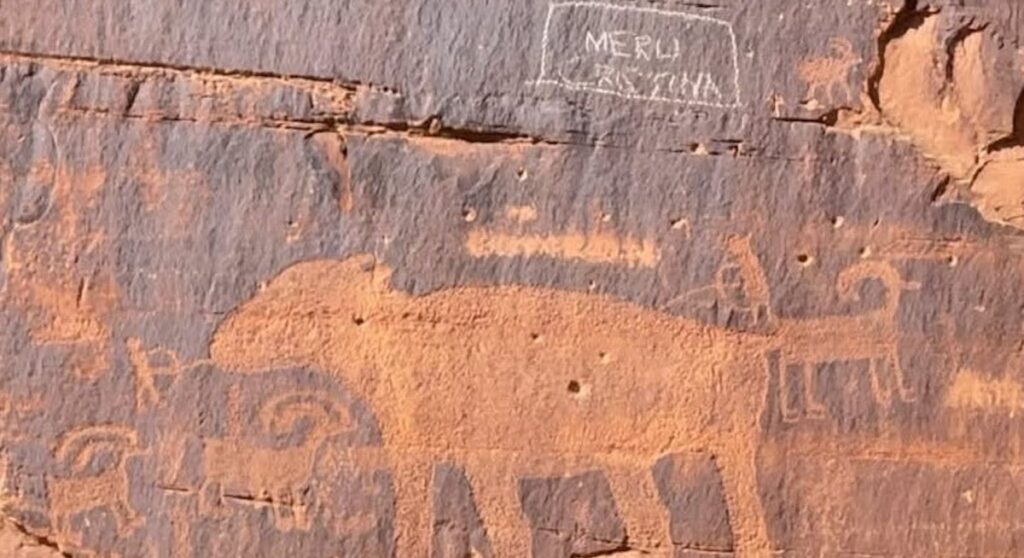
Photos show the name “Meru” scratched beside ancient carvings depicting a bear and a bighorn sheep at the Bear Panel. At the second site, near Hell’s Revenge, someone carved “Craig W” across several petroglyph figures.
Merritt said much of the artwork at the two sites dates back roughly 1,500 years and reflects Ancestral Puebloan and Fremont traditions, along with those of more recent Indigenous communities. The panels are part of a larger cultural landscape around Moab, where Indigenous peoples once lived, farmed, and traveled, he said.
Can the Damage Be Repaired?
Restoring the damaged petroglyphs presents different challenges at each site, Merritt said.
At the site near Hell’s Revenge, vandals scratched graffiti directly across ancient carvings. Merritt noted that typical fixes, such as scrubbing the stone or trying to conceal the marks with pigments, risk damaging the original artwork underneath.
The Bear Panel presents a different problem. A crack in the sandstone just below the graffiti means that scraping the rock could create openings for rainwater, weakening the structure through freeze-thaw cycles.
“Five minutes of damage could take weeks of repair to do carefully to preserve the subsurface imagery and the rock face,” Merritt said, emphasizing that any remediation must involve consultation with descendant tribal communities.
Protecting Rock Art in Popular Recreation Areas
Merritt said rock-art vandalism has become more widespread in Utah in recent years, a problem he believes is partly connected to growing visitation on public lands.
“We’ve always had folks going back to the 19th century scraping their initials on the panels, but what we’re seeing within five or six years is a pretty significant increase in the scale and distribution, hitting archaeological panels that have never had graffiti before,” Merritt said.
The latest incidents follow another case in March 2026, when the Grand County Sheriff’s Office investigated graffiti carved into petroglyphs near Tusher Tunnel, along an off-highway vehicle route northwest of Moab.
To combat the problem, Merritt said Utah is using its Protect Our Past education campaign and a statewide network of volunteer site stewards who monitor archaeological sites. Signage and fencing can also help discourage vandalism, he said.
In November 2025, a Utah woman who vandalized petroglyphs on BLM land near Wire Pass was sentenced to 12 months of probation and ordered to pay $14,853 in fines and restitution, according to a U.S. Department of Justice news release. She was also prohibited from entering BLM land during her probation.
“These aren’t victimless crimes,” Merritt said. “We need to find ways to catch, prosecute, and convict these folks, so it sends a message to future visitors that this is not acceptable in Utah or anywhere you visit heritage sites.”
Anyone with information is asked to contact Moab BLM Law Enforcement at 435-259-2131.
The post “These Aren’t Victimless Crimes.” Vandals Deface Ancient Petroglyphs Near Moab. appeared first on Outside Online.
About The Author