A River Runs Through It. An AI Data Center Tried to Move In.
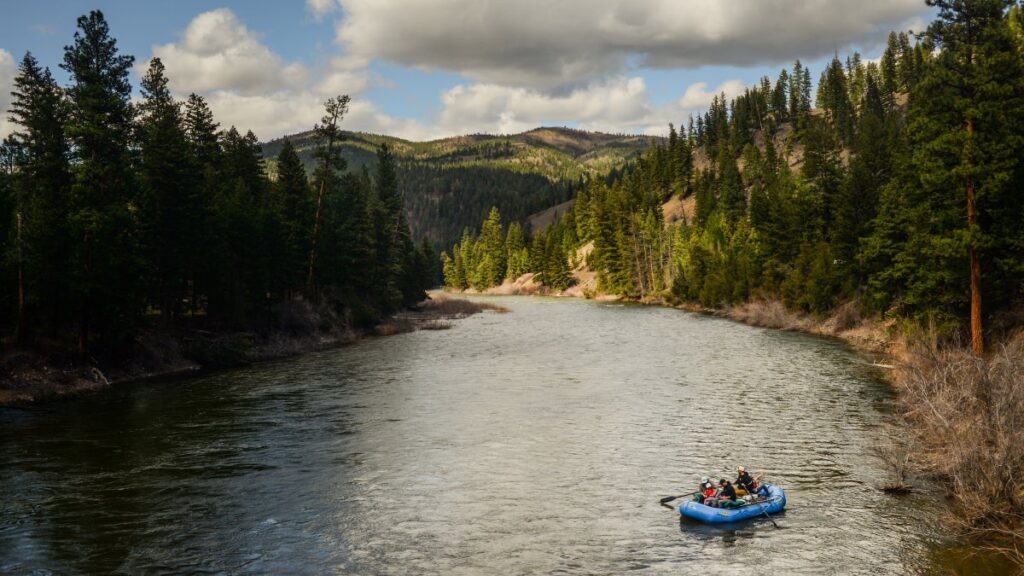

Brenna Love grew up fishing on the Blackfoot, a snow-fed Montana mountain river that spans 130 miles from its headwaters on the Continental Divide to the confluence of the Clark Fork River, seven miles east of Missoula. Its cold, fast-flowing water makes for premier blue ribbon trout fishing, scenic canyons, and whitewater recreation.
The Blackfoot was immortalized in Norman Maclean’s 1976 book A River Runs Through It and Other Stories, which was turned into a Hollywood film starring Brad Pitt in 1992.
Love, 29, is a resident of Bonner, a former mill town with just 2,700 residents located along the banks of the Blackfoot.
“My earliest memories are on my family’s raft,” Love told Outside. “Every time you’re on the water, you’re surrounded by other people loving the same backyard that we love so deeply. You look around and see people on boats of all shapes, sizes, and colors, recreating and enjoying. It’s the reason we live here in Montana.”
In March of 2026, an Idaho-based technology company called Krambu announced plans to build an artificial intelligence data center in Bonner, just steps from the banks of the Blackfoot. The project would convert an old mill building into a warehouse for computer servers, and the complex would draw water from the nearby Blackfoot River to provide continuous cooling for the computer racks.
Love and her community fought back—and won.
“It was hard,” she told Outside. “It was really hard. It took organizing and talking with each other about what this means. It took our evenings, our lunch breaks, reviewing the new application materials and doing our own research.”
It’s the latest in a growing wave of community pushback against big tech’s data center expansion—and a reminder that local voices, when organized, can have a lasting impact.
Data Centers Aren’t Going Away Anytime Soon
Data centers are rapidly popping up across the United States, fueled by the computing needs of artificial intelligence and cloud-based software. These centers house massive servers, data storage systems, and networking equipment, and they require sizable amounts of electricity and water to run and maintain the hardware.
According to Public Lands Intelligence, as of this writing, 1,302 data centers are proposed or under construction, in addition to 904 already operating across 49 states and Washington, D.C.
But as construction crews have erected these centers, they have become political lightning rods in towns and cities. The centers are often loud and large, and they eat up valuable electricity. As data centers have faced bipartisan backlash in cities across the country, tech firms have looked to rural communities, farming towns, and even unused public land to build.
At least 35 of current data center applications are on public lands, the Center for Western Priorities reports, and some are directly adjacent to national park units.
Secretary of the Department of the Interior Doug Burgum has tens of millions invested in AI data centers, according to a report published by ProPublica. In September, The Washington Sun reported that the Trump administration was considering at least 12 data center-related infrastructure projects on federal public lands.
Private equity firm Blackstone is building the Tallgrass Energy Project, a massive AI data center located south of Cheyenne, Wyoming. Blackstone also backed a historic $105 million donation to Yellowstone National Park.
The list goes on. Roughly 115 miles from Yellowstone’s north entrance, Quantica’s Big Sky Campus is proposing a 5,100-acre, or nearly eight-square-mile, data center. In Kentucky, Cave Point Commerce Center is a proposed 381-acre hyperscale data center near Mammoth Cave National Park. The City of Page, Arizona, is considering a $10 billion data center two miles from Horseshoe Bend near Glen Canyon National Recreation Area. In July, the federal government fast-tracked a data center ten miles from Lake Mead.

Old Mills, New Demands
In Bonner, the proposed data center would be in the Bonner Mill, a historic 169-acre former lumber mill along the riverbank. Originally built in 1886, the sawmill closed in 2008 and was transformed in 2011 into a multi-tenant industrial park.
Ben Catton, a legislative assistant at the Montana Environmental Information Center (MEIC), told Outside that sites like the Bonner Mill are ideal for companies that build data centers.
“Tech companies target old mill sites,” Catton said. “That’s part of their business model: to look for this existing infrastructure. Because those were really energy-consumptive sites, they have a lot of that energy infrastructure in place already.”
According to the Krambu proposal, the Bonner Mill data center would draw 16 million gallons of water from the river in July and August to cool its servers. Under Catton’s calculations, that means the 240,000-square-foot center would require roughly one megawatt of power—enough to power 800 homes for a year.
Montana’s energy and water needs during its driest months didn’t sit well with him.
“They’re going to be very consumptive in the two months when the landscape is the thirstiest for that water, when our rivers are at their lowest, and when our fish are most in need of cold water,” Catton said.

How A Small Mountain Town Beat Out Big Tech
The Bonner Mill sits 100 yards from Love’s front porch, and as a concerned community member, she began reaching out to her neighbors one by one to discuss the plan.
“Start by having a conversation with your neighbor, and then your other neighbor, and then your other neighbor,” Love said. “Those conversations really build up to a community-wide conversation.”
On March 20, local nonprofit Friends of Two Rivers—so-named for the confluence of the Clark Fork and Blackfoot Rivers—hosted the first public meeting at Saint Ann Catholic Church, a rural, single-story neighborhood church originally built in 1905. Against a wood-paneled backdrop, representatives from Krambu and Missoula County, along with Bonner Mill property manager Mike Heisey, spoke on a panel to a standing-room-only crowd.
Organizers were surprised by how many people showed up, Love recalled. Most people were there to voice their concerns about the project.
“There were just so many different people engaging in so many different ways through different avenues, and that’s what eventually changed the tide,” Love said. “It was organized in all of these different pockets, and I think any one of those groups couldn’t have done it alone.”
It was the first of many meetings held at libraries, schools, in living rooms, and at coffee shops. Love said she participated in at least eight, primarily working with her HOA members in closed meetings, as well as informal working groups of neighbors and the managers of the Bonner Milltown Historical Center.
“Rather than a scattershot signs and flyers approach, we were trying to find avenues where we thought we could make an impact,” Love said. “We organized as our HOA and then submitted our concerns and questions directly to the property manager.”
Love is one of hundreds who rallied through social media and in person to oppose the data center. Local regulations at the time weren’t rigid enough to deny Krambu approval, so Love and her team took their concerns directly to the property manager.
“The more direct action and impact you can make, the better,” Love said. “If you can figure out who has the authority, whether it is your county or your city, via the regulations in place there, the owner of the site, or who has investment in the community, find them.”
Between March and June of 2026, Krambu submitted five iterations of its application to build the data center, each time drawing backlash from the community. Love and other local advocates launched a petition that garnered more than 50,000 signatories to reject the AI data center, and flooded every town meeting with shoulder-to-shoulder opposition.
Citing overwhelming public feedback and neighborhood opposition, Heisey officially announced on July 6, 2026, that the property would not move forward with the data center and withdrew his support for the application.
A Krambu spokesperson told Outside in a statement that the company is under new leadership and that the Bonner data center was spearheaded by the company’s former management. The company has no plans to revisit the Bonner project, the spokesperson said.
In direct response to the community concerns exposed during the Krambu review, Missoula County Commissioners approved a temporary one-year moratorium on July 9 on new zoning permits for large-scale data centers to establish more comprehensive regulatory frameworks.
Love credits the victory to her community’s ability to organize across multiple fronts: viral online opposition, petitions, public comments and meeting attendance, coordinated feedback from small groups and the HOA, and direct outreach to decision-makers, from county commissioners and city council members to the landowner.
It’s a big win for a small mountain town, and one that could pave the way for other rural areas facing data center proposals.

What’s A Small Town To Do?
Montana is perhaps uniquely positioned for these types of fights. The Montana Constitution enshrines the right to a “clean and healthful environment” as a fundamental right, requiring the state and individuals to maintain and improve the environment for present and future generations. Outdoor recreation is also a major economic input for Montana, contributing $3.8 billion to the Montana economy.
Adam Schellhammer, Mid-Atlantic regional director for the nonprofit advocacy group American Rivers, warns that data centers pose new threats to states without such incentives or protections.
“On the national level, trends show that the speed and scale of development is just ramping up so quickly that we’re just having trouble keeping up,” Schellhammer said.
According to Schellhammer, data center regulation is fragmented across federal, state, and local municipal agencies. Water usage details are frequently concealed under non-disclosure agreements or classified as proprietary corporate information. Because many areas do not legally mandate public disclosure, city planners cannot always establish accurate water budgets to understand a center’s full impact. Schellhammer says communities should start by updating industrial zoning and land-use ordinances to make a difference, rather than reacting after sites are chosen.
When in doubt, Love says to speak out.
“The lesson learned is that every single voice matters,” Love said. “If there’s something you care about, say so. Find a place to speak your truth, speak your concerns, be an advocate for the things that you are passionate about, and someone will hear you.”
The post A River Runs Through It. An AI Data Center Tried to Move In. appeared first on Outside Online.
About The Author