Arc’teryx Wants the Sperro SV to Be the Last Jacket You Ever Buy—Seriously

Tucked alongside the interior chest pocket of a two-toned magenta Arc’teryx jacket is a laser-etched QR code—but instead of pulling up the menu at your local pub, it prompts you to register your new purchase, immediately kicking off a record of the jacket’s materials, origin, and, eventually, repair history.
A QR code seems simple enough—after all, you encounter dozens of them weekly—but a QR code on a mountain-grade hardshell requires a different level of engineering than the laminated square on your bartop. The internal placement makes it near-impossible to destroy or remove; the laser etching, adapted from the electronics industry, underwent multiple trials to ensure it left a permanent mark without degrading the fabric.
So why spend so much time, money, and engineering on a single square inch of jacket?
Building the System While Building the Jacket
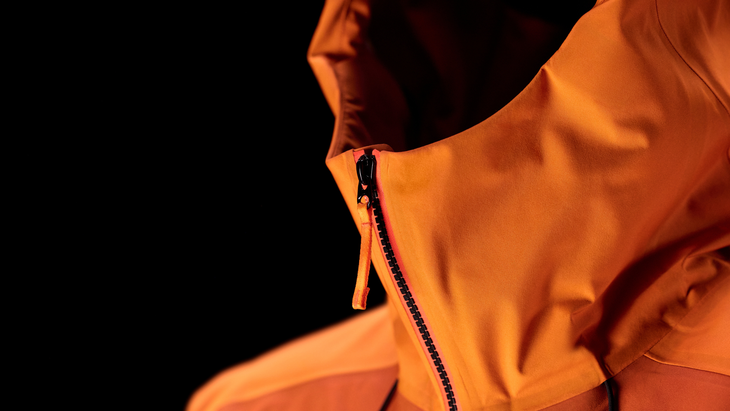
For Arc’teryx, that QR code is the entry point into System 0 , a new framework that reimagines how products can be designed, manufactured, used, repaired, and ultimately regenerated. In fact, the QR code is just one of many updates and innovations Arc’teryx built into its first System 0 jacket, the Sperro SV. Among the others: an easily repairable zipper, a nylon face fabric and backer engineered for chemical recyclability, and reinforcement at common failure points.
System 0 started as a “what if” conversation between Arc’teryx CEO Stuart Haselden and VP of Advanced Concepts, Alex Plante, brainstorming what circularity would look like for the company. At that point, Arc’teryx’s ReBIRD program already existed, with a solid infrastructure for product repairs, resale, trade-in, and upcycling, but the team knew they were still missing an actual process—a viable, repeatable way to create products that can be used for longer and ultimately regenerated into something new.
“We landed on what product we wanted to develop within that [circularity] concept, and then, while we were developing the product, realized that we didn’t have all the pieces of the system,” says Andrew Yip, Senior Director of Materials Innovation at Arc’teryx.
That meant building capability as they went, bringing in people like Kyle Wood, Vice President of Strategy, to focus on circularity. They also recruited for other supporting roles, like sourcing manager for raw materials.
“Less Bad” Isn’t Good Enough
Throughout the circularity initiative, Yip and his colleagues used one principle as their North Star: Sustainability alone isn’t a reason for a product to exist. Anything they created had to live up to Arc’teryx’s sky-high standards for technical excellence and durability.
“Most sustainable materials and products are just less bad than their incumbent,” argues Yip. “If you’re just going to make something less bad from a sustainability perspective but make it worse in terms of performance, then there really isn’t a justification for it to exist.”
To that end, Arc’teryx prioritized abrasion resistance on both face fabric and backer, while refusing to compromise on tear and tensile strength, waterproofing, and breathability—all the things that determine whether a jacket becomes a one-season purchase or a mainstay in your gear closet.
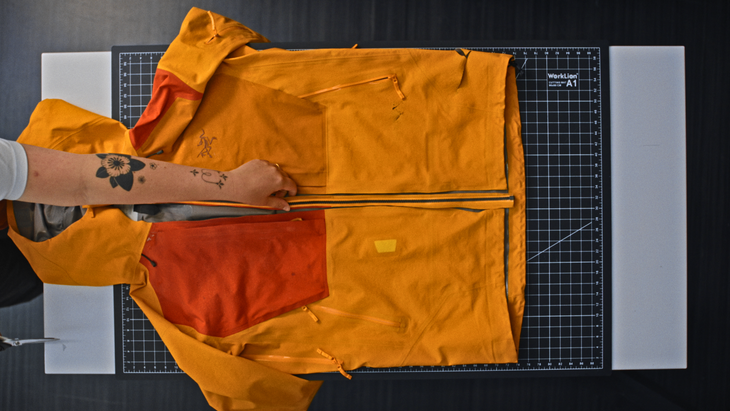
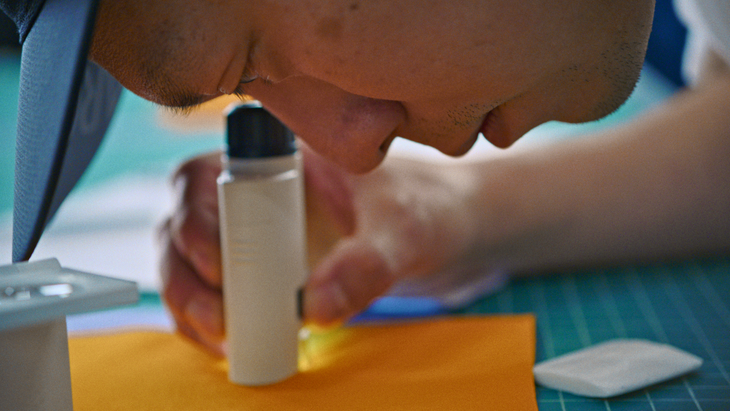
They also intentionally aligned on nylon 6 as the key material instead of polyester; even though polyester has more recycling opportunities, the team knew that nylon 6 fabric would perform best. To find the exact nylon content ratio—the perfect number that would make the fabric functionally and financially recyclable—Arc’teryx worked closely with Aquafil, the manufacturer of ECONYL® regenerated nylon. According to Aquafil, the textile is known for high wear resistance and impact strength (aka extreme durability).
A Swiss Army Knife, Not a Scalpel
Finding the perfect jacket material was one thing. But that wasn’t the hardest problem the Arc’teryx team had to solve, says Yip.
You already know Arc’teryx for its insanely technical, single-purpose shells like the Alpha SV—a scalpel, according to Yip.
“It’s really a precision tool, and it was designed for ice climbing,” he explains. “It doesn’t have hand pockets for a reason—you don’t need hand pockets when you’re ice climbing.”
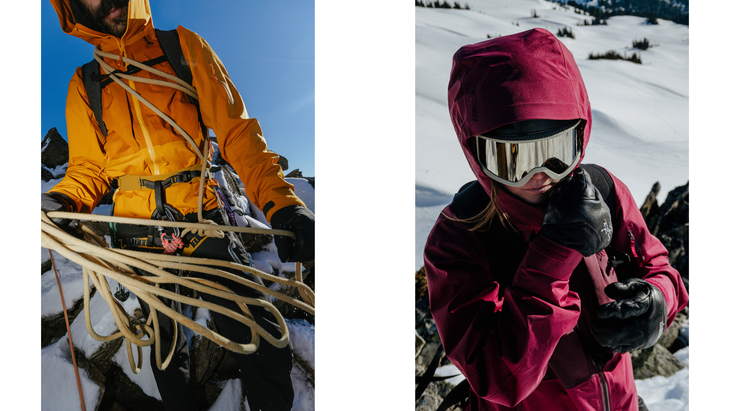
On the contrary, the Sperro SV had to be a jacket-of-all-trades, working in a variety of environments and use cases. “With the Sperro SV, we wanted to make something that was multi-environment, multifunctional, and multi-activity,” details Yip.
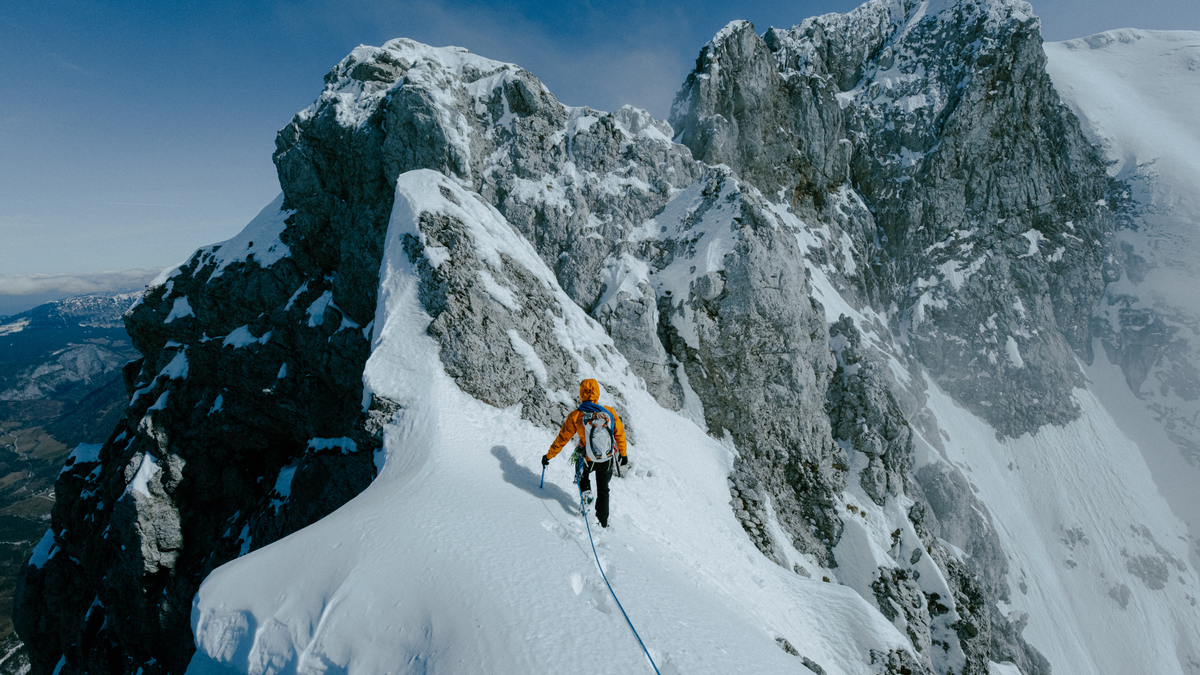
They needed a Swiss Army Knife, not a scalpel—but that Swiss Army Knife couldn’t compromise on durability. To ensure the Sperro SV was worth its mettle, Arc’teryx tested the jacket on ski tours, hiking trips, snowshoeing expeditions, and even ice climbing. They also partnered with the North Shore Search and Rescue, a volunteer-led organization and one of Canada’s oldest search-and-rescue teams, to make sure the jacket performed in high-stakes scenarios.
The Last Jacket You’ll Ever Buy?
All that engineering ultimately serves one purpose: creating a jacket worthy of what Yip refers to as custodianship, rather than ownership.
“Hopefully, the person who’s purchasing this jacket is somebody who cares about their stuff and is going to take care of the garment, bring it in for repair, and extend its lifetime as much as possible,” says Yip. “And only after many, many years and many, many repairs, when something is no longer repairable, only then is when we take it back.”
Hence, the QR code. Arc’teryx hopes that by making it as seamless as possible for customers to track the Sperro SV’s lifespan, materials, and repair history, customers will view themselves as custodians with a responsibility to their gear—instead of temporary owners of a disposable item.
If all goes according to plan, the Sperro SV might be the last jacket Arc’teryx ever sells you. At a gulp-worthy $1,200 retail price, most customers are probably praying that they never have to buy another jacket again, but it’s not exactly a sound business strategy in an industry that counts on customers to replace old gear. Yip is strangely okay with that.
“When we’re developing new products and prototypes, we know we have something when our athletes and field testers don’t want to give it back,” he explains. “Similarly, I think we’re onto something if we have a commercial product that people can buy and they don’t want to replace it. So personally, I would have no problem with that.”
When asked to comment on the price, Arc’teryx reps note that the Sperro SV is priced in line with their most advanced hard shells, and the price reflects the design effort and materials that went into this sustainable jacket. “Circularity at this level of performance requires significant investment across materials, manufacturing, certification, and end-of-life infrastructure,” Arc’teryx acknowledges.
They believe that the price reflects the value of three years of unlimited repairs, a product they’re backing to last for years, and eventually, an end-of-life offramp. “When you factor in the total life of the jacket, the value calculation looks different than a traditional purchase,” reasons the brand. Whether consumers will find the price a fair trade-off for the total package remains to be seen.
Sperro SV is Just the Beginning
The Sperro SV is just the first “statement of intent,” as Yip puts it, for what System 0 can do within the Arc’teryx playbook. With the streamlined processes and internal philosophies Arc’teryx has now aligned on, they’re free to explore further iterations of circular gear.
“We started with a hardshell because it’s what we know, what we make, and what we’re known for—so you can imagine that the other things we’re known for and make well are coming down the pipeline,” hints Yip.
And for the Arc’teryx loyalists who worry this new iteration of a hardshell won’t live up to their high standards—you’ve got nothing to worry about.
“If anyone were to put on the jacket and close their eyes, it really shouldn’t be different at all compared to anything that we’ve made before. And I think that’s the point,” says Yip. “It’s everything else around it that we’re trying to change.”
The post Arc’teryx Wants the Sperro SV to Be the Last Jacket You Ever Buy—Seriously appeared first on Outside Online.
About The Author