Is Yellowstone National Park (Back) in Its Wild West Era?
“Hey! Get ‘em!”
I was sitting on my tailgate, listening to the sounds of songbirds and car honks, when a scuffle broke out in a nearby picnic area. Shouts echoed from the woods as a crowd swarmed two dudes who were shoving and swinging at each other.
Welcome to a hot summer day in Yellowstone National Park. The tussling group seemed to be a motorcycle club, based on their headwear and matching T-shirts. Given their sweaty disposition, I’m not sure “staying hydrated” was listed in the bylaws.
“This place is nuts,” said my wife, returning from the restroom as the two dudes were separated. “What happened here?”
“Fist fight at the Old Faithful corral.” I shrugged.
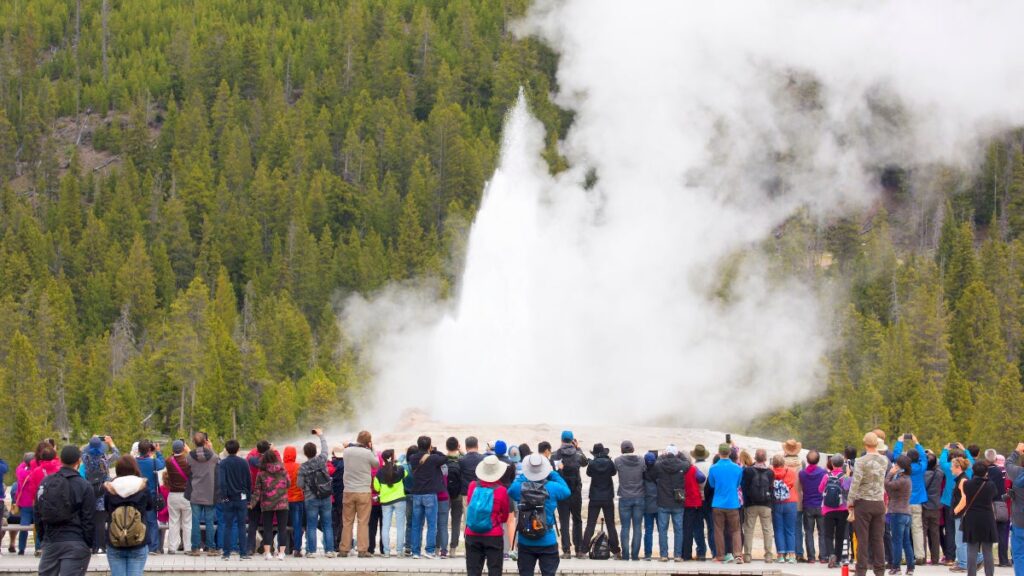
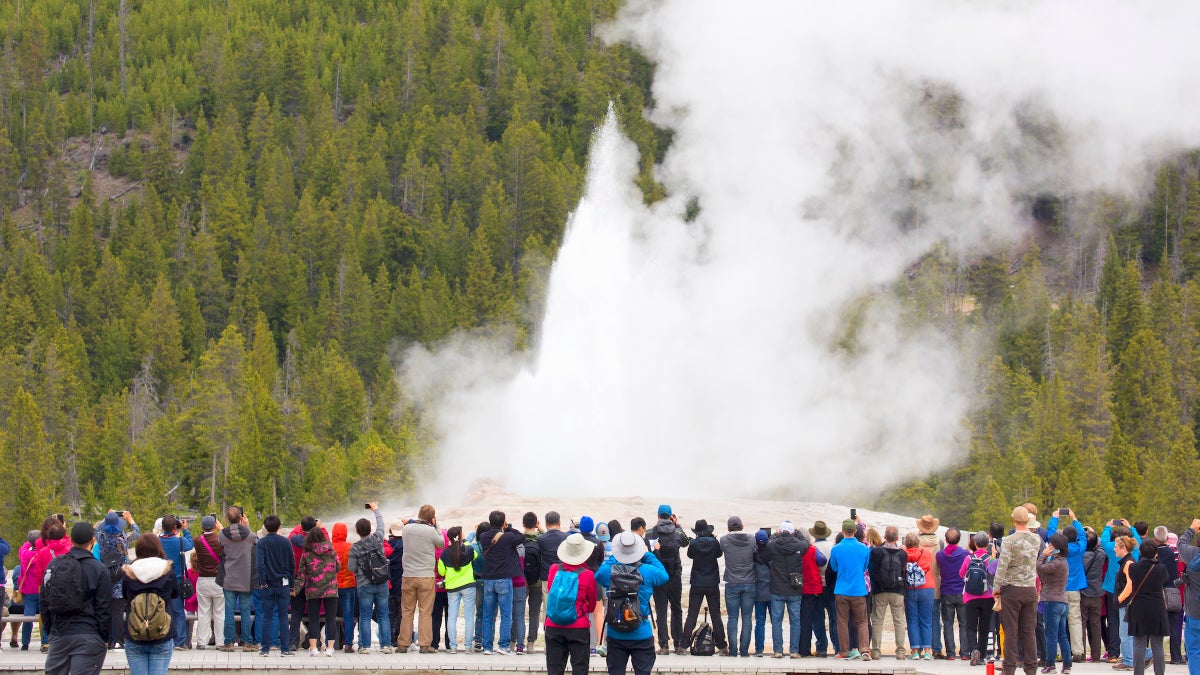
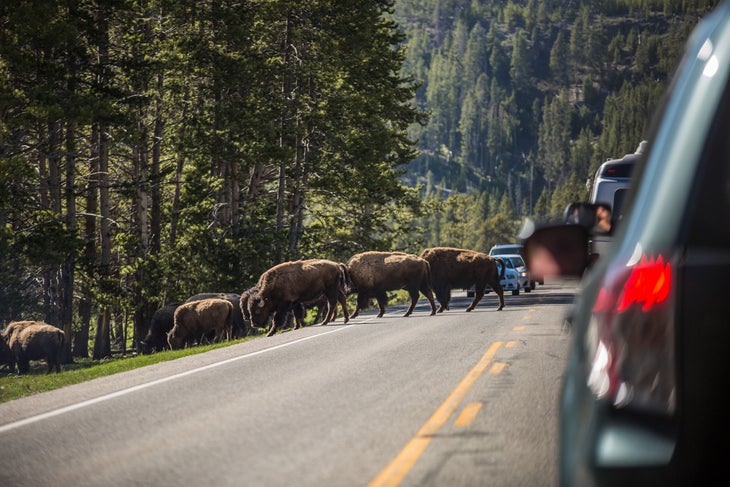
Then we embarked on a long trek through the semi-apocalyptic parking lot. Frantic drivers whipped around corners, cutting each other off. Exasperated families double-parked and hurried away. Frustrated sightseers returned to their blocked vehicles and laid on the horn. Finally, my wife and I breathed a sigh of relief as we reached the safer confines of the world’s most active hydrothermal zone, the scalding Upper Geyser Basin.
The “Good Old Days”
Yellowstone seems to be having a moment as the poster child for rising threats facing the National Park Service (NPS), including bad visitor behavior. While the parks attract record-setting crowds, the Trump administration simultaneously gutted the workforce, cutting NPS staff by nearly 25 percent since 2025. Interpretive signs about important topics like Indigenous displacement and slavery were torn down and replaced by nationalistic propaganda. More trash than ever was recently pulled from Yellowstone geysers, including strange stuff like fidget spinners, fake nails, and a baseball cap displaying the words cowboy hat.
For outdoor enthusiasts watching these disturbing events, it can feel like there’s never been a worse time for national parks such as Yellowstone. My wife, who’d never been there before, was shocked by the wackier things we saw during one high-season day. I arrived better prepared, having come to Yellowstone a grand total of TWO times. My first visit happened 20 years before, when some young whitewater paddlers and I came through on a cross-country road trip. The park felt somewhat calmer back then, but by no means sane. There were about 3 million visitors that year, instead of about 4.5 million now.
Back then, occasional thrill seekers with camcorders chased wildlife, while today’s park paparazzi are influencers with smartphones. Then, like now, I saw a few tourists hopping off boardwalks and stepping across dangerous thermal crusts. I don’t think I’ve ever witnessed anyone stick their fingers in toxic waters, but I’ve definitely seen videos on Tourons of Yellowstone. Each time I’ve gone, we talked about the poor souls who fell and the impulsive daredevils who flung themselves into acidic hot springs, where they were fatally burned or entirely dissolved.
After my first visit, I mostly gave Yellowstone a wide berth. Later, I returned to the mountains and canyons of Wyoming, exploring real places and stories from the Wild West era for a book, Discovering the Outlaw Trail. That’s how I learned that Yellowstone National Park never saw any “good old days,” though some periods have been better or worse for various reasons.
The Wild West Comes to Yellowstone
In 1872, when President Ulysses S. Grant signed the first national park into law, word had already spread in the East. Yellowstone was a landscape like no other, filled with abundant wildlife, erupting geysers, and plunging waterfalls. For ages, it was home to nomadic and resident Native peoples like the Mountain Shoshone. Now this volcanic plateau in the Rocky Mountains was threatened by westward expansion of the United States.
For a decade, no more than roughly a thousand visitors made the long and jolting stagecoach journey. Yet the bad behavior started immediately. Seeking souvenirs, vandals hammered away at mineral deposits. Poachers slaughtered countless bison, elk, and bears for their hides, leaving fields of carcasses. Squatters built illegal cabins within the boundaries, hoping the park law would be repealed. Tourists tossed trash, timber, and soap into geysers like Old Faithful. When the erupting fountains sent foaming debris sky high, onlookers cheered. The handful of park staffers watched on, horrified.
After the railroad arrived in 1883, things only got worse. With growing crowds came petty pickpockets, horse thieves, and gunslinging outlaws. Bandits hid behind bends in the road and robbed the passing tourist wagons one by one. The largest stagecoach robberies in U.S. history were said to have happened in Yellowstone. Not once, but three times.
The reason for the mayhem? During the lean federal budgets following the Civil War, Congress had been willing to establish the park, but they weren’t willing to fund it. With limited rules and near-zero enforcement, Yellowstone developed a reputation as a fun place to get away with things.
A Place Worth Protecting
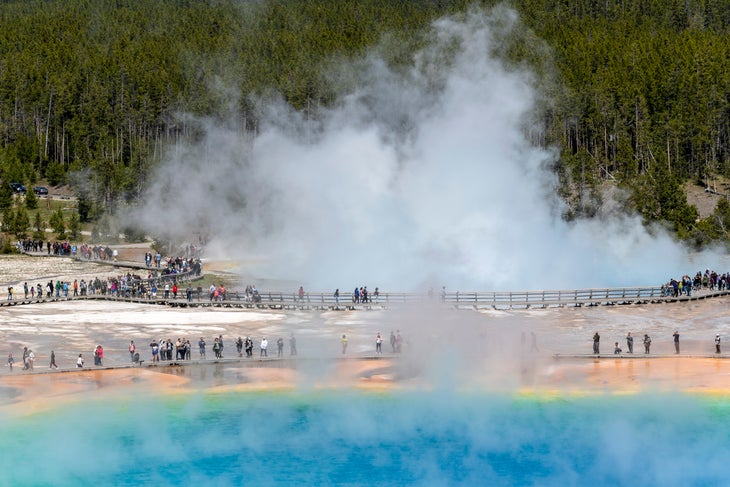
During our summer day in Yellowstone, my wife and I managed to break away from the crowds. To start, we took a six-mile hike through quieter parts of Upper Geyser Basin, which reminded us why this is a special place worth protecting.
We watched the angled eruption of Daisy Geyser with maybe a dozen fellow visitors. Then we walked past Punch Bowl Spring to a unique feature that few visit, Black Sand Pool. Under our feet, the ground tremored with loud thumps, the result of steam implosions happening beneath the pool’s surface.
During our hike, we met a friendly Oregon family that ranks Yellowstone among their favorite parks. To avoid the craziness, they devised a unique itinerary, staying a few nights each at several park lodges and hiking outward during the quieter mornings. In most ways, this family resembles the majority of parkgoers. Hikers who love the parks, follow the rules, and appreciate the rangers. While poor behavior may be increasing again, such offenders remain a highly visible minority of visitors.
That said, without a few key decisions made during the fading days of the Wild West, Yellowstone might have gone bad altogether.
The First Park Ranger
Tucked away in the woods bordering Norris Geyser Basin, there’s a log building overlooking a small river. Today, this old Army post ironically holds the Museum of the National Park Ranger. Inside, a bronze bust depicts Harry Yount, a legendary figure from Yellowstone history. If the frontiersman’s face looks particularly tired, well, there’s a reason for that.
In 1880, as this nascent national park was being overrun by poachers and miscreants, the meager budget was enough to hire exactly one game warden. He was expected to single-handedly patrol over 3,300 square miles of parkland. Instead, Yount quit in protest after 14 months, reporting that one guy couldn’t do a job that required a well-funded ranger service.
And guess what, the government listened! It just took 35 years. In the meantime, they tried pretty much anything else. They invited some vigilante cowboys, offering them half the collected fines. Naturally, these volunteers avoided the gunslingers and targeted wealthier tourists. So, the U.S. Army was sent in. For decades, half-hearted soldiers chased outlaws beyond park boundaries. The soldiers went back to their posts and waited until the villains cartoonishly returned.
In 1916, the National Park Service was established. Finally, professional rangers assumed responsibility for management, interpretation, and enforcement within an improving park system. Disorder gradually decreased across the West and in Yellowstone, but not entirely. The national parks went on to become a beloved feature of the U.S.
The story of Yellowstone’s destructive early days, and its first park ranger, offers a cautionary lesson that’s easily forgotten: when crowds increase and park budgets and staffing decrease, lawbreakers rise again. We’re seemingly back where we started, with Yellowstone in its Wild West era again.
The post Is Yellowstone National Park (Back) in Its Wild West Era? appeared first on Outside Online.
About The Author