The Country’s First Nature Library Lets You Check Out Camping Gear Like Books
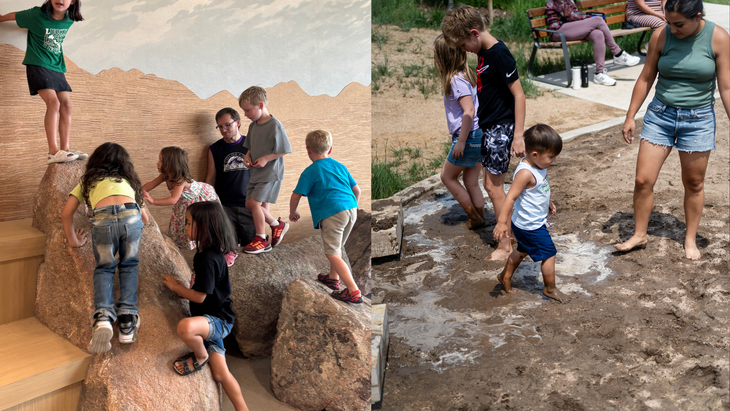
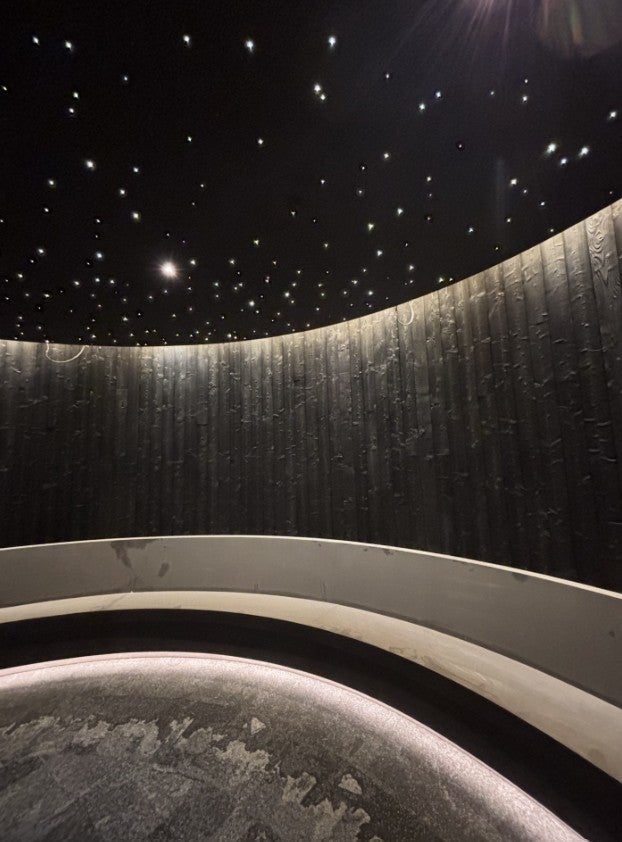
The earthy scent of waiting-to-be-opened books permeates the air when I walk into the Anythink Nature Library just outside Denver, Colorado. It’s to be expected, as the 33,000-square-foot, sunlit space just opened its doors August 8. But the hundreds of people surrounding me aren’t paging through those tomes. There are kids scrambling over a dozen boulders that have been placed in an organic path inside. Other people are staring up at star-like lights on the ceiling of the dark room, which is meant to simulate the experience of being outside at night, and smells faintly of campfire thanks to the Shou Sugi Ban treatment used for the wood.
Outside of the library, a mud pit is teeming with laughing littles who are vigorously moving the hand pumps to transform the sandy area into a messy playground. (Parents will be happy to discover there’s also a clean-up room with sinks and towels.) Nearby, visitors are watering the recently planted magnolias in the learning garden; they’ll be used in Hispanic Heritage Month programming in September. A quarter-mile gravel trail winds across some of the property’s 15-acre campus and leads to an outdoor storytelling circle.
The Country’s First Nature Library Opens Near Denver
Anythink is the public library system for Adams County; the Nature Library itself sits about 20 miles northeast of Denver, in Thornton, Colorado. The Nature Library is the county’s eighth branch and and the nation’s first public nature library.
“This will really be the first public library in the country that is solely dedicated to learning about nature,” said RyAnne Scott, Anythink’s director of external relations and brand strategy. “So much of the play kids do can be sanitized. We want to encourage kids to get in the mud and get dirty.”
Designed around the principles of the Environmental Kinship Model—an approach to teaching kids based on engaging in, with, for, and about nature—the venue is intended to remove barriers to outdoor access, encourage hands-on play, and generate positive experiences with the natural environment.
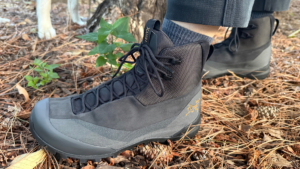
While visitors can, of course, check out books of all kinds, the library’s TryIts program is among its most exciting offerings. With a free library card, guests can borrow more than 650 outdoors-related items (the goal is to grow the collection to around 1,500 pieces), including gardening tools, hammocks, camping equipment, snowshoes, birdwatching and bug-finding kits, and more. “We’re hoping to be a little REI with the types of things in our collection,” Scott said.
The concept originated through conversations with the community, which consistently noted that they wanted more ways to access the outdoors.
Accessing the Outdoors While Combatting Screen Fatigue
“So often when we think of outdoors and nature, especially here in Colorado, we think of going up into the mountains and that’s where the outdoors and nature is. But really, so much of the outdoors and nature, it’s all around us,” Scott said. “We really want to be able to open up access to nature on the whole, regardless of who you are.”
Recent research by the National Recreation and Park Association found that children are spending less than ten minutes per day enjoying unstructured outdoor play compared to more than seven hours interacting with electronic media.
In addition to the myriad indoor and outdoor play spaces, the Nature Library’s programming is working to counter the screen-time problem. Beyond the traditional storytimes and arts classes, events are also being developed with local outdoor organizations, like a session focused on learning about organisms that glow in the dark with Great Outdoors Colorado. Regular “Wildings” sessions for two-to-six-year-olds will combine story time and sensory activities while adults can enjoy yoga classes or mindful crafting classes.
An indoor-outdoor art and science lab provides space for firsthand learning. When I stopped by, visitors were making cyanotype tote bags. There’s also a self-guided walking tour of ten different gardens based on local environments. (Anythink is also a member of the Outdoor Industry Association.)
The library itself is organized more like a bookstore, with an emphasis on nature-focused volumes, though popular titles and recent releases are also available.
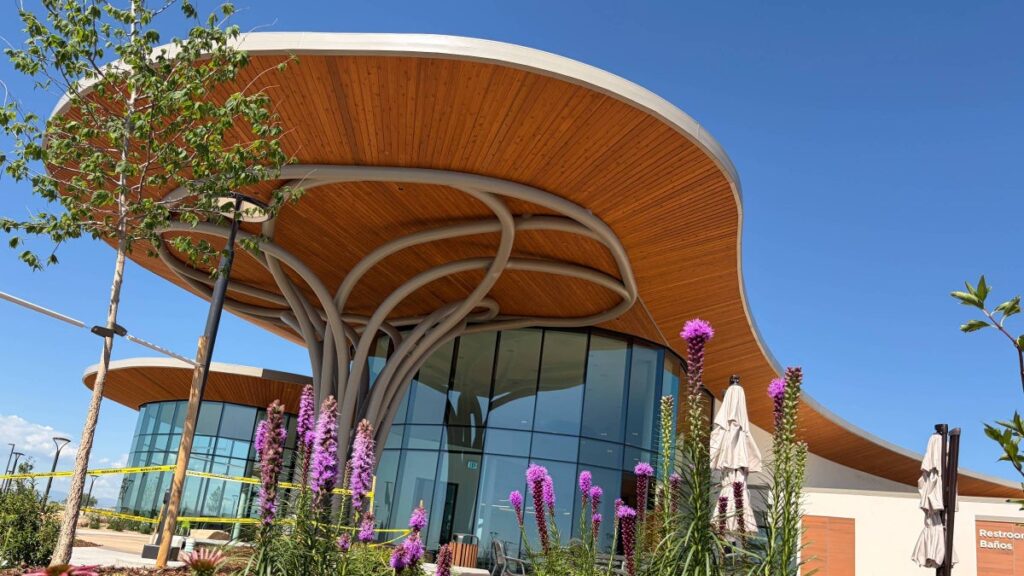
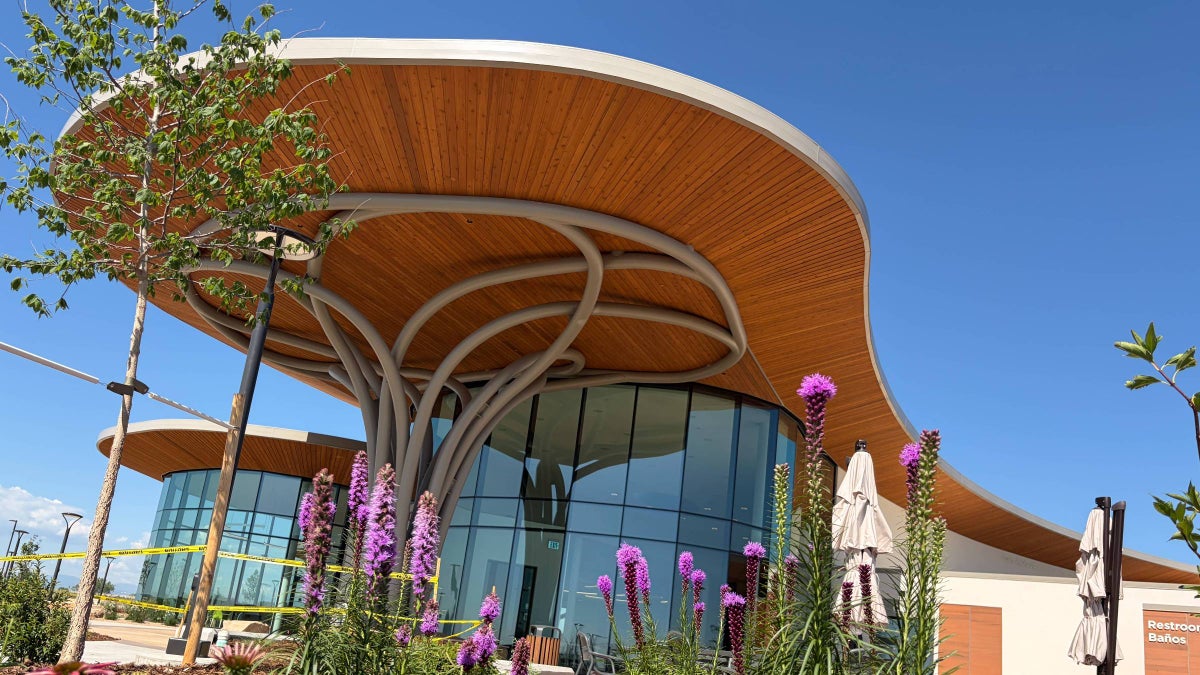
A six-member Indigenous Advisory Council was formed in 2023 to help design the nature-inspired building. The front entrance, for example, is supported by a structure that mimics cottonwood trees, and if you were to look at the library from above, you’d notice it’s shaped like three blades of grass blowing in the wind in celebration of the surrounding prairies. The duality of nature comes through in having a dark room and a sun room. In the Indigenous Voices section, the spine labels on books are organized by Indigenous tribal names.
Rethinking What a Library Can Be
Nature is infused throughout the library in small ways and big. A curving, live plant wall sets the tone in the lobby, while terrazzo floors have small Colorado animals built into the design—a scavenger hunt of sorts for curious minds.
“We’re trying to get outside of the library industry in general,” said Mark Fink, executive director of Anythink. “It’s about what is the community asking for? … That’s how libraries can rethink how they provide any kind of service. It doesn’t have to be books on a shelf.”
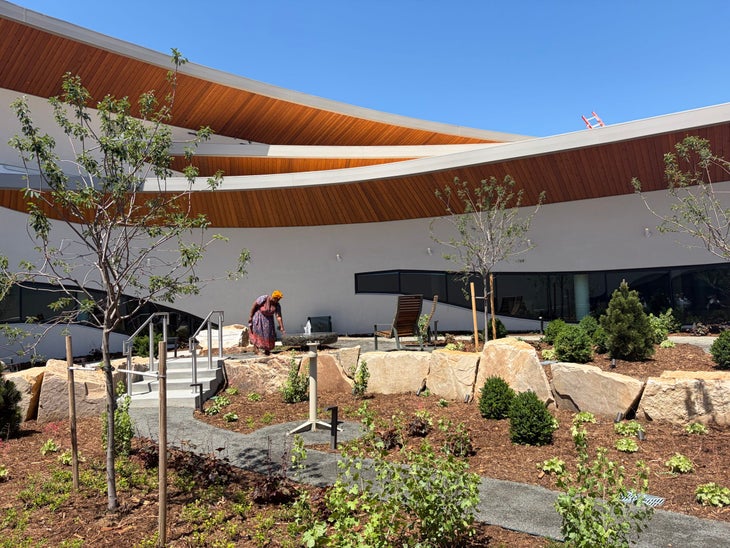
Five meeting and study rooms offer privacy and despite being farthest from the windows, still connect people with the outdoors through wallpapers derived from natural materials, like prairie flowers and herbs (which you can actually smell). Views through the floor-to-ceiling, bird-safe windows extend to Pikes Peak and downtown Denver. At the center of the building is an open-air kinship garden; peepholes allow visitors to peek out at the rocks and plants, including serviceberry trees.
By 2027, Scott said, the exterior loop trail should connect to the regional trails of the adjacent 140-acre Aylor Open Lands, which are owned by the city of Thornton. (Outdoor bathrooms will make the library a welcoming pit stop for hikers and bikers).
According to the National Assessment of Educational Progress, known as the Nation’s Report Card, reading for pleasure is on the decline among children and youth, and reading scores in schools have been struggling for years, with a sharp decline happening during the pandemic.
The Nature Library hopes to start building curiosity about the natural world so that kids, in particular, will be interested in picking up a book and learning more. And, eventually, becoming stewards for the land too.
“So many kids don’t have access to move their bodies freely, to just go and be and be carefree in natural spaces,” said Maria Mayo-Peasley, the Nature Library branch manager and a former interpretive ranger at Rocky Mountain National Park. “Some of what we’re offering here is starting with experiencing nature in a free way and maybe coming across a curiosity through that exploration, that then they can come inside [and find a book about it].”
Daliah Singer is a Denver-based freelance journalist whose global travels now include her almost-two-year-old daughter—who inherited her mom’s love of reading. Current favorites:Llama Llama Red Pajama and My Suitcase: A Fun Book of Travel.
The post The Country’s First Nature Library Lets You Check Out Camping Gear Like Books appeared first on Outside Online.
About The Author