The Untold Oral History of the Melly, the Fleece Hoodie That Became an Outdoor Cult Classic
At a hardware store in Portland, Oregon, I spot it from across the garden center: the signature micro-grid fleece, sleeves a different color than the torso, drawcord hood. A few moments later, the man wearing the unmistakable hoodie pushes his shopping cart into the next aisle, apparently also scoping out landscaping rocks. As we pass each other, I catch his eye.
“Nice Melly,” I quip.
He smiles knowingly. “You from Colorado?”
Anyone who owns a distinctive fleece from the brand Melanzana has undoubtedly had one of these encounters. The company, based in the former silver mining town of Leadville, Colorado, population 2,633, has inspired a peculiar kind of recognition among its devotees. Little did I know when I bought my own hoodie—blue torso, orange sleeves—in 2017 while living in Boulder, that I was joining an unofficial club of people drawn to simple mountain clothing made by hand.
Since 1994, co-founder Fritz Howard has led Melanzana’s every move. As a lanky New England ski bum in his twenties, Howard and his childhood friend, Kevin “Kevco” Crochetiere, got their paws on some Polartec fleece remnants from an outlet in Lawrence, Massachusetts, and began sewing basic mountain garments for themselves and friends. Howard’s mom taught him to sew when he was a kid, and for the first two winters of the fledgling business, he lived in the woods outside town in a tipi he had sewn himself, keeping his expenses low. They initially called their small enterprise Eggplant because the silly, uncool vegetable evoked the antithesis of big outdoor brands. But a trademark conflict soon forced a change, and they settled on Melanzana, Italian for eggplant.
Howard chose Leadville because, even back then, he wanted to live in a place without the ostentation of a ski resort. Friends of his say he never expected, or really even wanted, the recognition Melanzana has today. As someone who identifies as anti-corporate, Howard intended to make affordable and quality gear for friends and neighbors as a service to the community—not for personal gain or fame. As demand grew, though, the hobby accidentally evolved into a business, and three decades later, Howard’s hoodie has become a symbol of sorts, connecting its wearers while putting Leadville on the outdoor gear map.
Outside reached out to Howard for this story, but, being a private person, he said he preferred to step back and let others who have played an important role in Melanzana’s success tell the story instead.
Told through the voices of former employees, Leadville residents, devoted customers from around the world, and a moderator of the Melanzana subreddit, this is the untold narrative of how Melanzana became legendary in the outdoor industry, Colorado, and beyond.
Early Days in Leadville
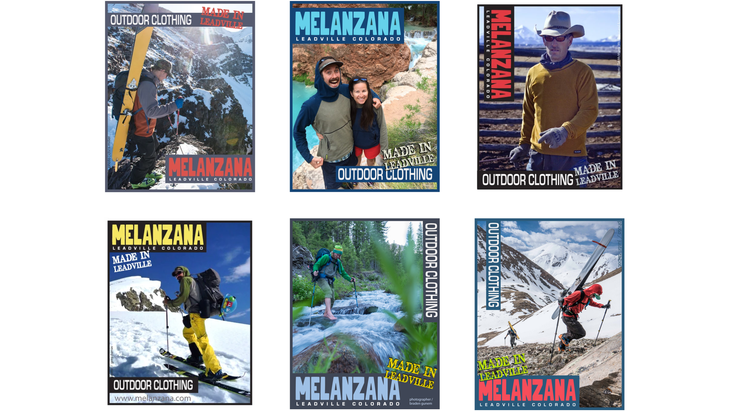
Melanzana’s first storefront was tiny and tucked between other small businesses in the 700 block of Harrison Avenue, Leadville’s main thoroughfare, across from a cluster of brick buildings including the old church and city clerk’s office.
Mark “Smokey” Burgess (first retail employee, now the owner of the Leadville consignment store Community Threads): I was in between jobs, and Fritz approached me. He’s like, “Why don’t you come work for me?” I said, “I don’t think so; I don’t want to do retail.” He said, “I’ll let you live in my tipi.” I was like, “Let’s go look at it.” It was spring, so it was super snowy, and we post-holed to get to the tipi. I was like, “Sweet, I’ll do it.”
Zach Neater (former employee, recently returned to Leadville after years away): Smokey and I would come in on Wednesdays. We always had our dogs, Charlie and Louie. Fritz had his gang of dogs, too. He was a skijoring racer and would be in the back surfing sled dog websites while we were cutting up fleece. It kind of felt like a little community clubhouse with everybody growing up together.
Smokey: We would bust our ass to get product on the shelf. The weekend would come, people would buy it all, and then we’d be like, “Oh shit. We’ve got to make more.” It’s been the exact same business model since way back when. It’s really not that much different.
Ann Stanek (hired to oversee advertising in 2004; now owns the artist collective Harper Rose Studios in Leadville): Smokey was working when I bought my first fleece. That’s when he sewed and did retail. I didn’t like the length of it and asked if there was any way he could just whack off three inches. He was like, “Sure, if you go get me a bagel and a coffee.” And I did. That’s how we do it in Leadville.
Smokey: Melanzana’s saying was “Original, Functional, Soulful.” And it was. Everything we did was just Fritz and us doing it. If we needed a new cutting table, we went to the hardware store and bought two-by-fours and plywood, and we built it. The racks I built back in the late ’90s are still in use.
Kendra Kurihara (bookkeeper from 2012 to 2016): I started coming to Leadville in 1993 to work for Outward Bound. Then I bought a house in 2001. I became friends with Fritz soon after that. We skied together a few times. I would go into the store, where Smokey’s store [Community Threads] is now, because I knew Smokey and Fritz, and I liked them and wanted to talk. I never bought anything because I was so poor and so cheap, and I think because I had pro deals with other companies to buy clothes.
Smokey: I’m not gonna lie, back in the day [the product] wasn’t that awesome. I mean, it was the mid- to late-nineties. It was the very beginning, so it was a pretty rudimentary fit. I have one hanging up on the wall of my shop today. People try to buy it, and I’m like, “No, look at it; it’s like putting on a pizza box.” But back in the day, it was pretty innovative. All the locals, of course, bought them.
Melanzana’s saying was “Original, Functional, Soulful.” And it was.
Johnny Welsh (local bartender who bought his first fleece circa 1997): If you walked in the front door, there was a wooden receptacle about four feet high. The company had extra scraps in there. I took some home and made a flute case that I still have. I bought a hat, and it’s the exact colors of the scraps that I picked up.
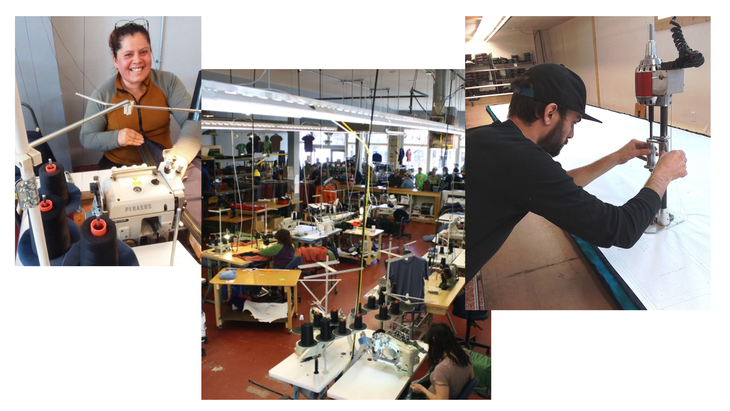
Smokey: We used to cut everything out by hand with a knife roller. Then Fritz was going to digitize all of his patterns. He rolled them up, took them on a plane to L.A.—I think it was L.A.—and that was the start of really getting into manufacturing. We built this big, long cutting table. He and I would roll out fleece, and he would print out his digitized patterns all nested in together. Then he cut them out with a stack cutter. That was big-time back then.
Stanek: The sewers would sew the same colors for months. There was a cutter named James Healy. He was the first one to lay out a new color on the big table. At the top of his lungs as he was rolling out the new colors, he’d be like, “New color! New color!” Everybody would cheer.
Kurihara: Everyone had a key. I think they could come in any time they wanted. I lived just down the street from the shop, so sometimes I’d turn onto my street and think, Oh the lights are on. Someone’s sewing, I guess.
Stanek: We got to choose the music. It was a five- or six-CD player. There was a big CD book, and we’d toss in the music, whatever we wanted to listen to for the day. A lot of Grateful Dead, Willie Nelson, Burning Spear, and reggae.
Neater: What I loved about it was we were part of that outdoor community before social media.
Kurihara: I think Fritz did a really good job of avoiding cliquiness by making sure we had a diversity of people, be it age or background or lifestyle. We had 20-year-old hippie chicks and older retired people who were looking for different work towards the end of their careers.
Stanek: There was a gal, Lane. She was a sewer, and she would make costumes for shows. That’s why she gravitated to Melanzana. She brought a super fun vibe. She brought a hula hoop in, and every so often, we’d take hula hoop breaks.
Kurihara: I’ve actually only bought one Melanzana in my entire life. When we worked there, we had a 100 percent discount. I was like, “Maybe we should put some guardrails on this.” Fritz finally did. But you still got to spend, like, $800 a year.
The Birth of the Hoodie
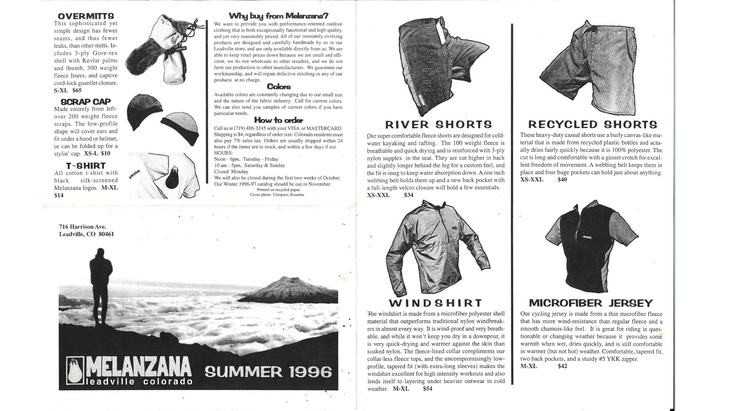
Early on, Melanzana made all kinds of outdoor apparel. The 1996 summer catalog lists river shorts, windshirts, microfiber jerseys, overmitts, T-shirts, and scrap caps. The Polartec Micro Grid hoodies that would become the brand’s signature product weren’t introduced until the early 2000s.
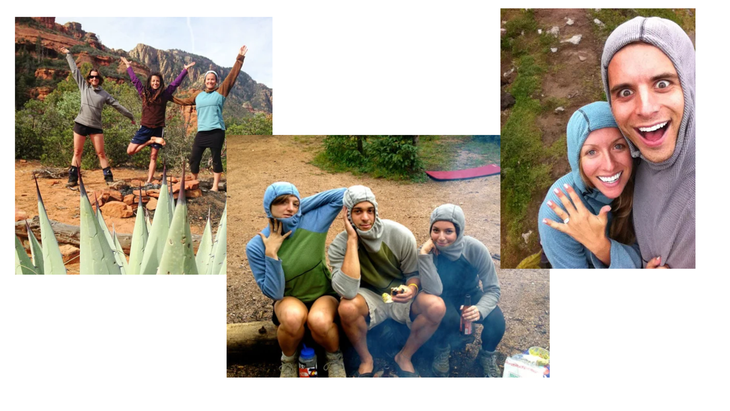
Smokey: Here’s the story with the hoodies. There were four hippie girls sewing. They kept saying, “Fritz, you should make hoodies.” He’s like, no. We were just trying to keep up with demand. A couple of the sewing girls started making these pullover hoodies anyway, not even resembling what they are now. We made some for ourselves, too. We knew Fritz wasn’t happy about it. Then he saw it and decided that he would make some, basically the hoodie that it is today. They were so functional and so good. That’s when it all kind of shifted. (Around the same time, a woman in the community was also pestering Howard to make hoodies.)
Kurihara: We just gradually brought more colors in. We would do eight colors in ten or twelve different combinations. We’d find a color that we liked—a random fabric, a T-shirt, a photo, a paint chip. We’d put it together and send it to the fabric mill, then they would send a sample back. I just didn’t trust that way of collecting colors, so I was like, “Let’s get a Pantone color swatch.”
At the top of his lungs as he was rolling out the new colors, he’d be like, “New color! New color!” Everybody would cheer.
Smokey: [Fritz] was just constantly working with Polartec to get materials, experimenting, and refining his design skills. That’s when I was transitioning out. (Smokey left the company in the late 1990s to pursue other things, and went on to open the consignment shop Community Threads in one of Melanzana’s former spaces a block away.)
Stanek: Fritz was so funny in where he was picky, and one of those things was how a garment was photographed for the website. You’d lay the shirt on the ground and flip one elbow up and one elbow down, kind of in the pocket, but you’d scrunch it up so it had a little bit of movement but not too much, but still the shape but not too much. Oh my god, I swear my tummy muscles are strong because I had to lean over the fleece, and it had to be just the right angle of the dangle.
Kurihara: I was anxious all the time thinking we’re growing, we don’t have room, we need to expand, or we need to do something. And Fritz would be like, “We’re not there yet.”
Stanek: Fritz is a great model for everybody to really just stand by what you have and don’t try and do too much; stick to your values.
Melly Fans Near and Far
In 2008, Fritz bought the building at 716 Harrison Avenue, where it’s still located today. At first it was three separate addresses, but Melanzana gradually took over the entire 7,500 square feet. In 2011, he installed a rooftop solar system to power the building. Already popular locally, the brand grew faster as word of mouth and social media spread.
Stanek: The last project I did with Fritz was the “Nice Melly” sticker. We were like, wouldn’t it be fun if we had these stickers people could grab after they get a Melly?
Smokey: It’s just part of wearing your Melanzana. I was at Dead & Company’s 60th anniversary in Golden Gate Park [in 2025], and there was a guy just over there with the exact same color as me. We looked at each other and nodded like, right on, man.
Stanek: I’ve even said to him, “This has to be so cool to look around and see all these people in your things.” He’s very proud and psyched, I think, in those kinds of situations.
Smokey: It used to be a really popular gift for people’s crew and pacers for the [popular endurance race, the Leadville] 100.
Adam Ducharme (tourism and economic development director of Lake County, which includes Leadville): What I notice is that people don’t just come to Melanzana to buy a fleece. They’re coming because they want to experience a place that feels real.
What I loved about it was we were part of that outdoor community before social media.
Mariel Fulton (grew up in Colorado, bought her first fleece circa 2008): I first got mine in high school at a cross-country camp held at Colorado Mountain College in Leadville. On the last day, we always fast-hiked up Mount Elbert, and I forgot a jacket. Melanzana was not a popular thing then, and I’d never heard of it. But it was the only real place to grab a layer, so we walked or ran down from campus, grabbed an energy drink at Kum & Go, and I got myself an all-brown hoodie in the colorway “Cup of Joe.” Honestly, the store was pretty empty, and we could see folks sewing in the back. It became my most beloved piece of gear, and I wore it on every hike. I still have it!
Evan Stout (artist from Colorado): I got my first Melly in late 2019 right after coming home to Colorado from living abroad in East Africa. While I was living abroad, I met folks who owned Mellys, and it felt like a miracle that someone on the other side of the world knew about this tiny brand. It was such a point of connection to home for me.
Lauren Fagan (Melly collector): I got my first Melanzana in 2013 before they became a Colorado staple, back when you could walk into the store in Leadville any time of the day and try stuff on. I now have four hoodies, two dresses, and one half-zip. So many companies are making knock-offs now, but they just don’t compare. My OG Melly is still in excellent condition 13 years later. All of the stitching is intact even after hundreds of washes and adventures.
Mellanzaniac (moderator of the Melanzana subreddit who spoke on the condition of anonymity): They don’t make the absolute best gear, they don’t make the absolute lightest gear, they don’t make the absolute most unique gear, but I like the fact that it is a quality piece of merchandise. I’m more impressed by the fact that they take care of their employees; they pay their employees a living wage, and they give them benefits.
An Insatiable Demand
When demand exploded during the pandemic, Melanzana faced a problem many brands envy: more customers than it could serve. The company responded with purchase limits, online lotteries, and caps on store traffic. Some shoppers interpreted the restrictions as a scarcity tactic, but the truth was far less calculated—the tiny sewing operation simply couldn’t make enough hoodies to satisfy everyone who wanted one.
In March 2024, Melanzana opened a second cut-and-sew facility in Alamosa, another small Colorado mountain town with a population of 9,871. The growing staff is helping the company return to online sales for the first time in six years. “As we continue to ramp up, we hope to carve away at the wait times in Leadville, and eventually bring more Mellys to all our people, on the web,” the company wrote. Today, nonlocals still need an appointment to visit the store.
Stanek: It was awesome because you’re part of this big movement and you could see over the years the growth and the respect people had—but then there starts to be this tipping point where now friends of friends are saying you’ve got to get one of these. Pretty soon there are people who don’t even know why they want the Melanzana, but they want the Melanzana.
Mellanzaniac: Even before the lottery, it was ridiculous to try to get a hold of one. You see a lot of people complain about the appointment system they use today and say they’re just manufacturing scarcity. And I’m like, “Clearly you were never in Leadville when there were 100 people in line at eight in the morning waiting for the doors to open so they could run in, grab everything off the shelves, and immediately post it on eBay.”
What I notice is that people don’t just come to Melanzana to buy a fleece. They’re coming because they want to experience a place that feels real.
Ducharme: I think there can be this perception that there’s sort of this gatekeeping, or trying to create a false sense of supply and demand scarcity, but I can assure you with every fiber of my being, Melanzana and Leadville-Twin Lakes are not that. We are just really invested in maintaining a sense of humanity that might even be from a bygone era.
Mellanzaniac: It’s a piece of gear that is recognizable enough that if you see someone with it, you know what they’re wearing. It used to be that you knew they had gone to Leadville because that was the only way they could get it.
Smokey: Melanzana used to do a local sale. They would take all their second-quality product, and twice a year, they would let all the locals come in and shop. During the COVID frenzy, they couldn’t really do that. I worked it out with Fritz, and he just brought boxes and boxes of seconds over. We had three H racks, and we had a top-secret Melanzana sale for the locals. I think I might still have the sign somewhere. It said, “Shhh! Melly sale.” That was more or less to take care of the locals.
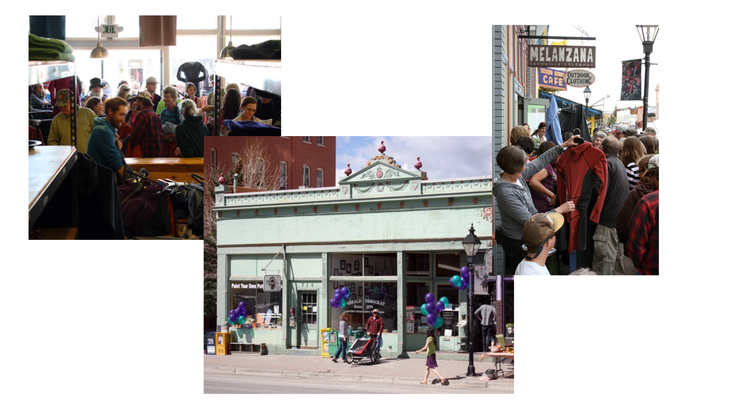
Stanek: We all get a little defensive, those of us who know and understand. People get so frustrated about the appointments, but it makes sense, actually. It’s all made by hand, and if there’s going to be something for people to shop, they’ve got to manage the inventory.
Smokey: Here at Community Threads, we’re super protective of them. When people come in and say, “What’s up with that store? You’ve got to have an appointment. What a great marketing scheme.” We’re like, “Here’s the deal, man.” We will actually take the time to get the story straight.
Kurihara: [Fritz] would always say that he never wanted all of this. But there’s nothing you can do when your product is hot. What he realized is that you don’t have any control over demand. We might be behind, or we might be ahead, but there’s no point in only listening to the market or the demand because they’ll turn at an instant and drop you like a hot potato. Or they’ll love you to death, and then they’ll hate you. They can be mercurial. So don’t listen to that—you’ve got to listen to yourself.
The post The Untold Oral History of the Melly, the Fleece Hoodie That Became an Outdoor Cult Classic appeared first on Outside Online.
About The Author