Astronaut Christina Koch Made History on Artemis II. But She Still Loves to Sleep in a Tent.

“WE ARE VERY close to being able to see Carroll Crater!” Christina Koch shouts across the campground, glancing up from her moonscope.
The NASA astronaut is bent over a small tube that looks like a telescope, attached to a tripod. A nearly full moon illuminates her curly hair, with her tent and a field of scraggly creosote bush behind her. The Big Bend National Park campsite is large enough to sleep eight people, but it’s just the two of us here tonight. Even at 10 P.M., the temperature hovers in the mid-70s. It’s already past my bedtime, but Koch and I came to the park to witness what happens in the sky after dark.
“If you look to the lower left, there’s a dark spot, almost like a mole. Carroll Crater is a little up to the left of that,” Koch says as I bend down to look through the lens, the dark splotches of the moon suddenly massive and detailed to my right eye.

Koch and the other three astronauts on the 2026 Artemis II mission named Carroll Crater after colleague and mission commander Reid Wiseman’s late wife. Mission specialist Koch, Wiseman, pilot Victor Glover, and mission specialist Jeremy Hansen made history in April 2026 when they completed a ten-day-long mission around the moon, traveling a record-setting 252,757 miles from Earth, livestreaming the event, and going viral along the way. It made Koch the first woman to travel around the moon, adding another record to her list, which also includes the longest spaceflight by a woman (328 days throughout 2019 and 2020), and embarking on the first all-women spacewalk on October 18, 2019.
FIVE MONTHS AFTER the Artemis II crew touched down in the Pacific Ocean, Koch and I met in Big Bend to go on our own small mission: nighttime photography. Last night, September 26, was a full moon, and it still looks massive, bright, and round above the Chihuahuan Desert tonight. The only way you can tell it’s no longer full, Koch tells me, is that you can spot a little bit of the Terminator in the upper right corner. The Terminator, the line that divides the side of the moon that’s glowing from the one going into shadow, looks like a sliver of darkness that shifts the moon’s craters into 3D.
“Imagine seeing that when it’s literally this big in your view,” Koch says, holding her hands wide.
We’ve spent the evening on a couple-mile hike and scramble up to Balanced Rock to photograph the stars and moon. Balanced Rock is a massive boulder suspended between stacks of rocks on either side so that it appears to hover above the ground. Sitting next to the boulders, Koch set up her tripod and snapped shots of the massive, orange moon rising and the stars sparkling above the syenite rock formations. She even managed to capture the shooting star we both spotted streaking above.

Photography is her hobby, she tells me. She’s been taking pictures since she did so for her college paper at North Carolina State University, from which she holds multiple degrees in physics and electrical engineering.
Her love of photography came in handy for her space missions. NASA, which features an entire photography training team, worked with Koch and the rest of the Artemis II crew ahead of their historic trip to optimize documenting photos of the moon and Earth from space. They had to learn how to use a wide lens as the Artemis II crew occupied a very small vehicle, how to use the proper f-stop and shutter speeds, and how to take more technical photography, too, to report back on anything that appeared broken and other details for the on-the-ground engineers.
Photography wasn’t the only arts-based training the Artemis II crew took on prior to their mission. The four astronauts decided to seek out and collaborate with a poet to assist them in better describing what they saw in space. Koch still trains with the poet today. “He helps me a lot with metaphors and language, but also just seeing the beauty in things,” she says.
The crew’s holistic approach is, in many ways, different from how older generations of astronauts prepared for space travel. The Apollo Generation, which included astronauts like Neil Armstrong and Buzz Aldrin, who became the first people to walk on the moon in 1969, focused on thousands of hours of moonwalk and lunar surface simulations and reduced gravity training. While practical, technical skills were vital to the Artemis II astronauts, too, they also concentrated heavily on team dynamics: the crew embarked on a National Outdoor Leadership School (NOLS) trip together, a common practice today for NASA teams. “We made so many commitments to being a crew that loved and trusted each other,” says Koch. “NOLS was one of the things that we did when we learned a lot of those actual skills to keep us in a good place and keep us friends.”
Another focal point for the Artemis II crew was learning about the meaning behind their destination. “We worked with cultural experts on the moon and tried to cultivate a deeper understanding of the many facets of where we were going, not just the scientific ones,” says Koch.
But for the differences in training approaches and communication styles throughout history, the narrative around space exploration has, in many ways, remained the same. “Beautiful concepts like love and peace, and going for all of humanity, those have always been a part of it,” says Koch. “There is almost no one who went [to space] and didn’t have beautiful things to say.”
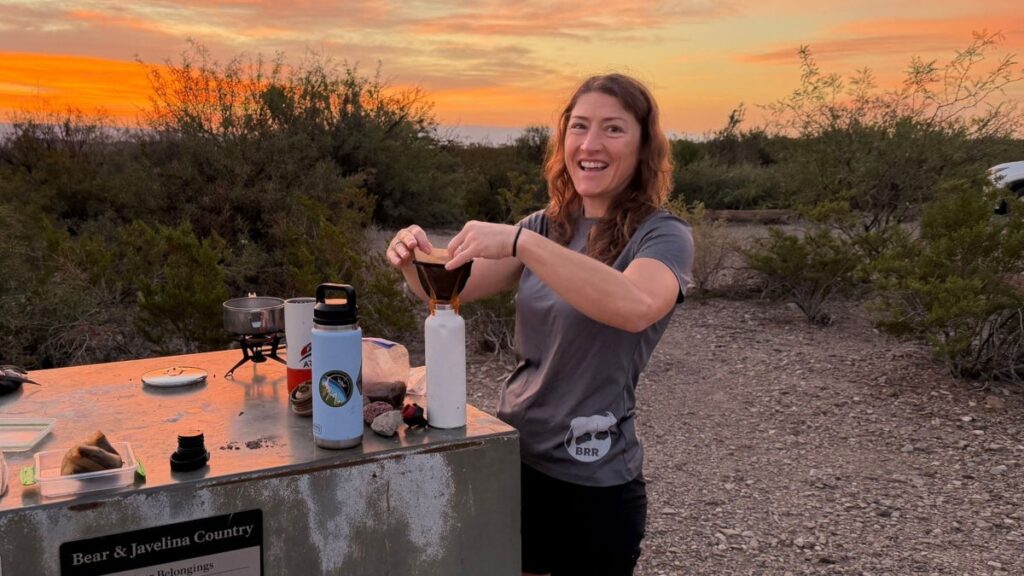
AFTER A COUPLE of hours taking pictures near Balanced Rock, Koch and I are back at camp, eating dinner under the moonlight. She’s cooked up some simple couscous on a backpacking stove and finishes it with a handful of pine nuts.
“This is how low-key I am,” says Koch, gesturing to her pot. “It’s practically plain couscous, and I’m so excited for it because I was such a dirtbag backpacker for so long. This is very standard and kind of nostalgic.”
The post Astronaut Christina Koch Made History on Artemis II. But She Still Loves to Sleep in a Tent. appeared first on Outside Online.
About The Author